Welcome to XiangShan biweekly column! Through this column, we will regularly share the latest development progress of XiangShan. This is the 106th issue of the biweekly report.
The XiangShan tutorial at ISCA 2026 was held ~~not so~~ smoothly! Although some students could not present on site due to visa issues, we quickly arranged backup speakers and ultimately ensured that the tutorial was completed with high quality. Special thanks to everyone who follows XiangShan's development!
Regarding the recent development progress of XiangShan, the frontend added support for the 2-fetch feature; the memory subsystem optimized DCache, Sbuffer, and the prefetchers; XSAI supported new matrix memory access modes and updated the instruction extension.
Welcome to XiangShan biweekly column! Through this column, we will regularly share the latest development progress of XiangShan. This is the 105th issue of the biweekly report.
The RISC-V Summit Europe has successfully concluded! Professor Bao Yungang, Deputy Director of the Institute of Computing Technology, Chinese Academy of Sciences, and Chief Scientist of the Beijing Open Source Chip Research Institute, shared his experience at the summit and provided insights into the future prospects of RISC-V development. We welcome everyone to engage in discussions with us!
Regarding the recent development progress of XiangShan, the frontend continues to optimize timing; the backend and memory access have fixed some functional bugs while optimizing DCache and Sbuffer performance; XSAI has supported the BF16 extension, and HBL2 has implemented PutFullData for TL-TL and TL-CHI.
Welcome to XiangShan biweekly column! Through this column, we will regularly share the latest development progress of XiangShan. This is the 104th issue of the biweekly report.
We are very excited to share with you an important component in the "XiangShan" + "Ruyi" ecosystem: RuyiSDK! This is a one-stop development resource management platform for RISC-V architecture, which integrates toolchains, simulators, runtime environments, and debugging tools based on the ruyi package manager and IDE plugin system, providing full-process development support. The platform has built a comprehensive matrix of RISC-V development boards and operating system support, providing developers with a more convenient operating experience and serving as an important infrastructure for promoting RISC-V development and ecosystem construction.
You can get more information through the following links:
RISC-V European Summit is ongoing! The XiangShan team has multiple talks and posters at the summit, and the detailed schedule can be found here.
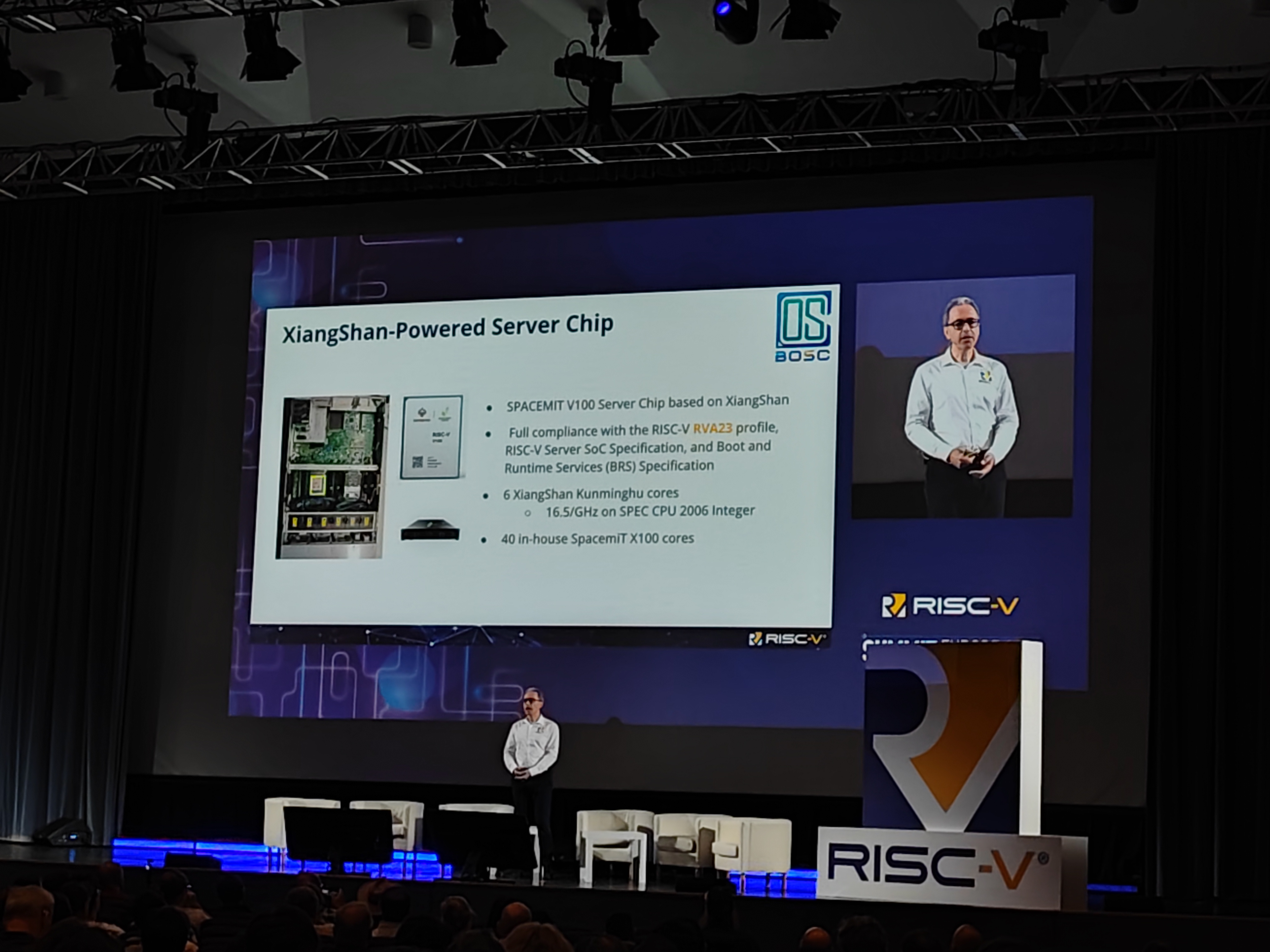
In the opening report of the RISC-V International, CEO Andrea Gallo introduced the application of XiangShan in high-performance server scenarios.
Andrea Gallo introducing the application of XiangShan in high-performance server scenarios
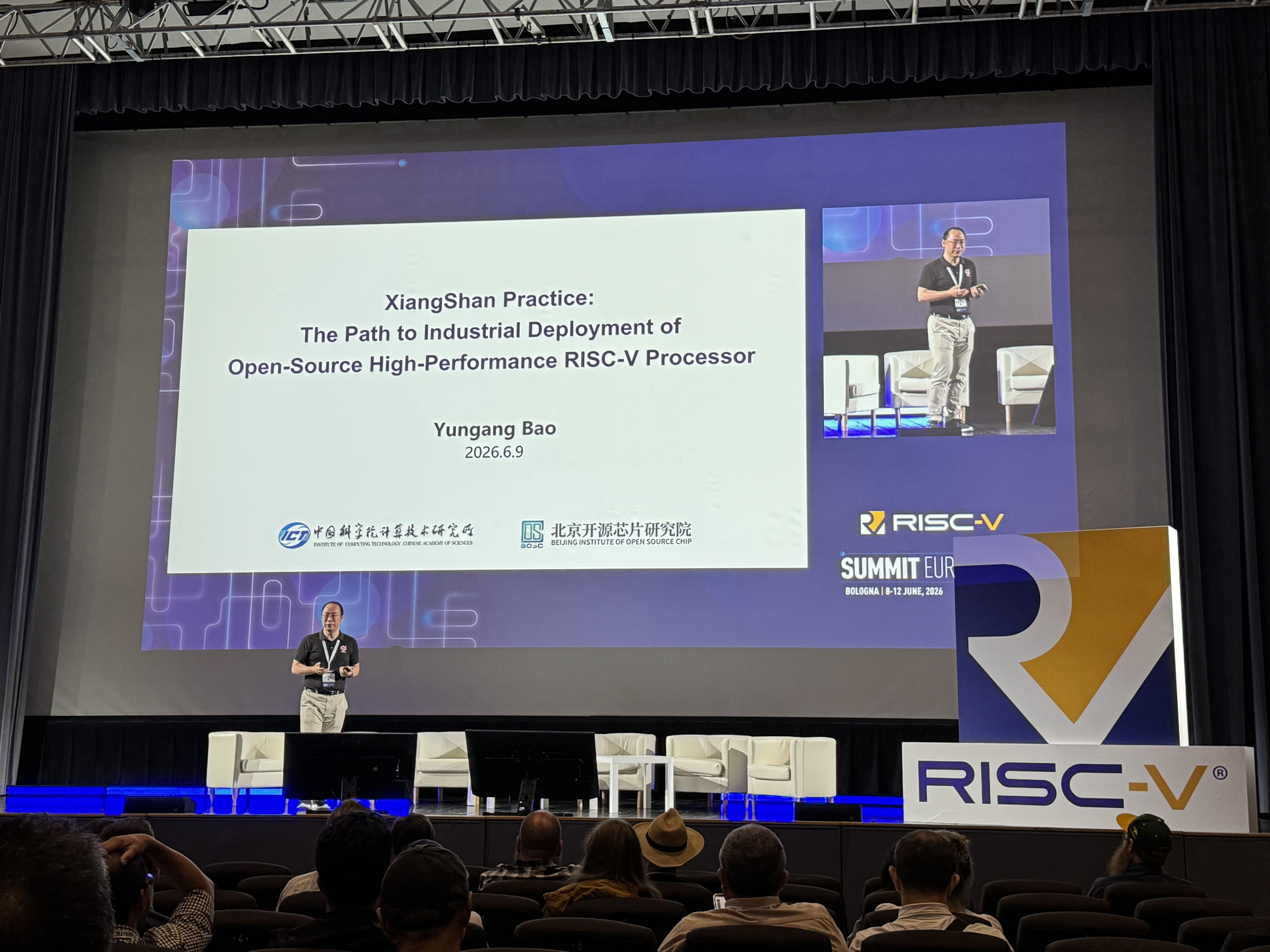
Deputy Director of the Institute of Computing Technology, Chinese Academy of Sciences, and Chief Scientist of Beijing Open Source Chip Research Institute, Researcher Bao Yungang gave a report titled "XiangShan Practice: The Path to Industrial Deployment of Open-Source High-Performance RISC-V Processor", introducing the industrial deployment path of XiangShan.
Researcher Bao Yungang introducing the industrial deployment path of XiangShan
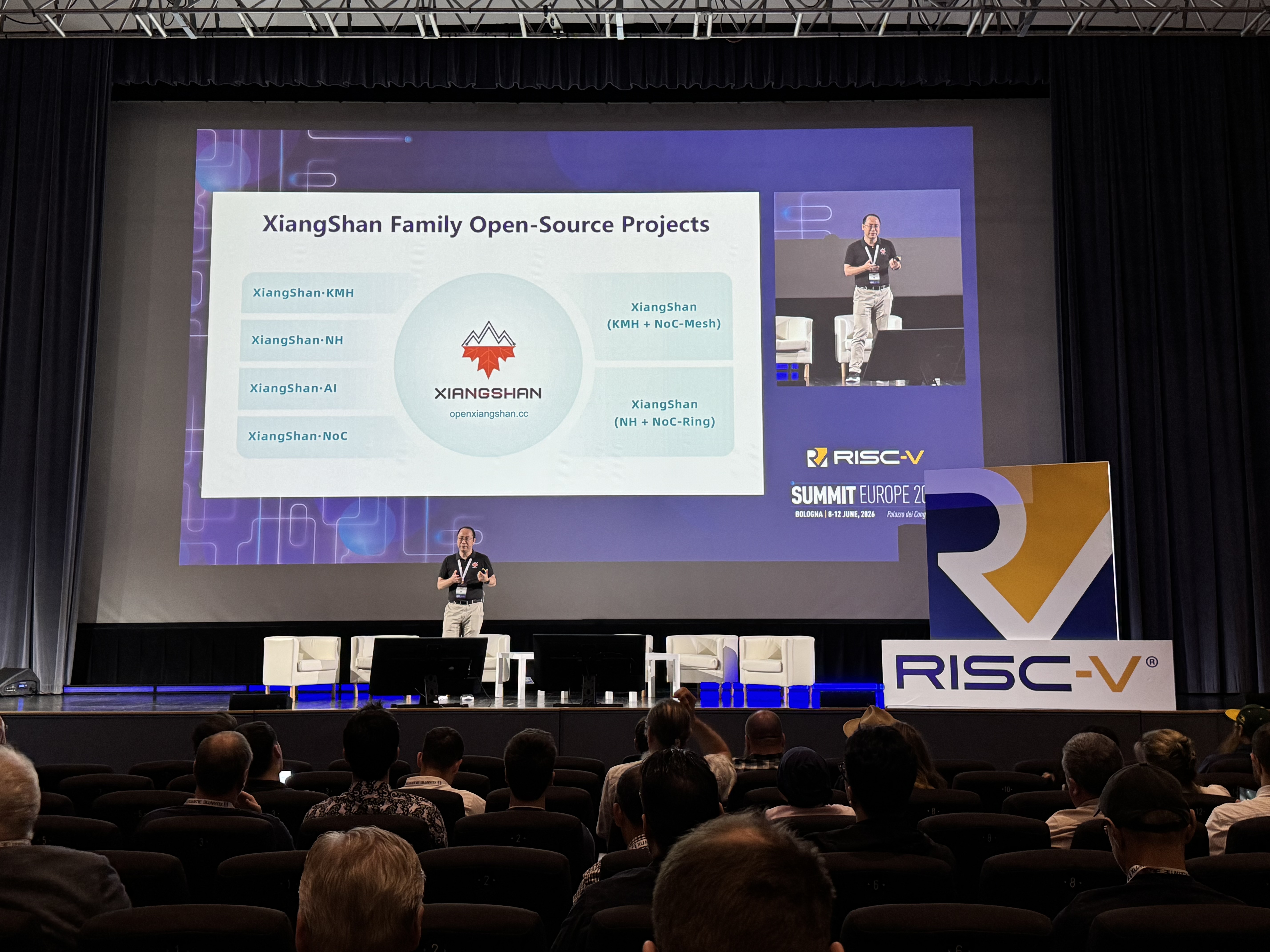
XiangShan family
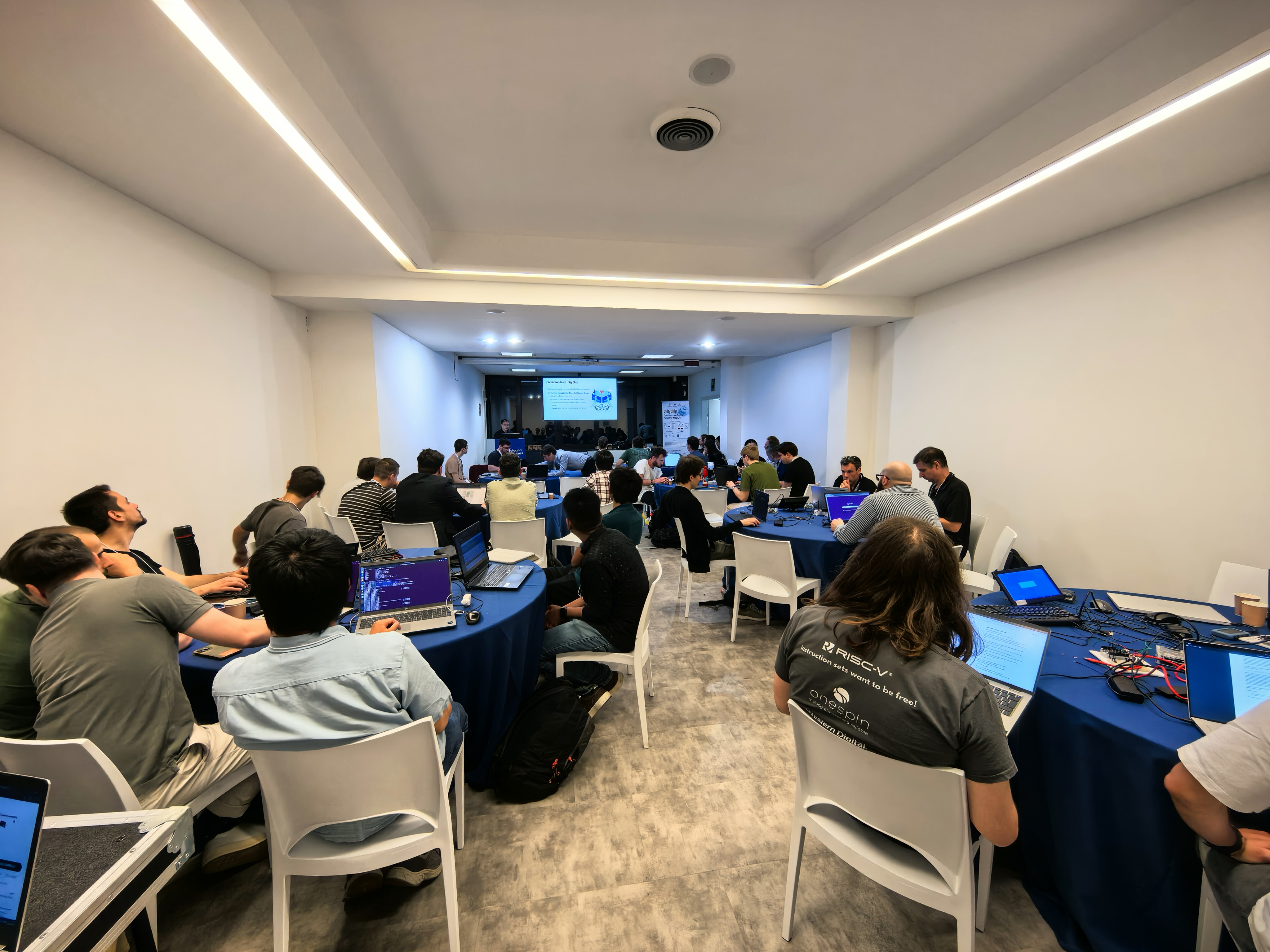
We also held the workshop of Unity Chip for the first time, sharing with everyone the exploration and practice of software-native open-source chip intelligent crowdsourcing verification.
Unity Chip workshop
Regarding the recent development progress of XiangShan, the frontend continues to optimize timing while reducing redirect latency; the backend implements some new features and instruction set extensions; the memory subsystem fixes some bugs while optimizing L2 timing; XSAI optimizes code structure while advancing HBL2 support for CHI.
在 RISC-V 国际协会的开场报告中,CEO Andrea Gallo 介绍了香山在高性能服务器场景的应用。
Andrea Gallo 介绍香山在高性能服务器场景的应用
中国科学院计算技术研究所副所长、北京开源芯片研究院首席科学家包云岗研究员作了题为 XiangShan Practice: The Path to Industrial Deployment of Open-Source High-Performance RISC-V Processor 的报告,介绍了香山的产业部署之路。
包云岗研究员介绍香山的产业部署之路
香山家族
我们还首次举办了万众一芯的 workshop,与大家分享软件原生的开源芯片智能众包验证探索与实践。
万众一芯 workshop
关于香山近期开发进展,前端继续优化时序,同时降低了重定向延迟;后端实现了一些新特性与指令集扩展;访存修复了一些 bug,同时优化了 L2 的时序;XSAI 优化了代码结构,同时推进了 HBL2 对 CHI 的支持。
Welcome to XiangShan biweekly column! Through this column, we will regularly share the latest development progress of XiangShan. This is the 103rd issue of the biweekly report.
We recently received many issues on GitHub! We welcome every developer who is interested in XiangShan to communicate and provide feedback with us. Whether it's bug reports, feature suggestions, or questions about using XiangShan, we will respond in a timely manner. In this biweekly report, we share a very interesting issue with you, through which we fixed four bugs.
As for the recent development of XiangShan, the frontend fixed some bugs while continuing to optimize timing; the backend implemented new extensions and fixed some bugs; the memory subsystem expanded L2 to 2MB while optimizing PPA and code style; XSAI implemented overlapping execution of the C matrix memory access module and fixed some bugs.
Welcome to XiangShan biweekly column! Through this column, we will regularly share the latest development progress of XiangShan. This is the 102nd issue of the biweekly report.
The development of X200, SpacemiT's third-generation high-performance RISC-V processor core derived from XiangShan Kunming Lake V2, has been completed. Based on a conventional cloud-computing processor core, X200 has been specifically optimized for cloud-side Agent applications and flagship end-device Agent applications. Its SPECint 2006 performance reaches 16.0 points/GHz, and its single-core frequency can reach 3.3GHz. Compared with X100, its performance per core has improved by more than 100%, reaching 50 SPECint 2006 points/Core.
Even more encouraging than the fact that X200 builds on Kunming Lake V2 is that the full XiangShan open-source infrastructure was used throughout X200's development. This is the part below the surface that supports X200 on its path toward production readiness. These open-source toolchains greatly accelerated X200's development on top of XiangShan and provided strong assurance for its quality.
As for recent XiangShan development, the frontend is implementing 2-fetch while optimizing timing; the backend and memory teams fixed several functional bugs and continued advancing the new L2 design; XSAI added FP8 support for the matrix unit while also improving code quality and evaluation tools.