Welcome to XiangShan biweekly column! Through this column, we will regularly share the latest development progress of XiangShan. This is the 107th issue of the biweekly report.
Regarding the recent development progress of XiangShan, the frontend has fixed timing issues in multiple modules and resolved some bugs reported by the community; the backend has fixed several bugs related to CSR, debug mode, and performance events, and synchronized V2 fixes to V3; in terms of memory access and caching, support for pre-allocated StoreQueue, LoadQueueReplay fast wakeup, and dual-port L1-L2 TileLink bus has been added, along with multiple bug fixes; XSAI has fixed control signals for load/store whole C instructions and added support for configurable multi-channel memory access in CUTE.
Welcome to XiangShan biweekly column! Through this column, we will regularly share the latest development progress of XiangShan. This is the 106th issue of the biweekly report.
The XiangShan tutorial at ISCA 2026 was held ~~not so~~ smoothly! Although some students could not present on site due to visa issues, we quickly arranged backup speakers and ultimately ensured that the tutorial was completed with high quality. Special thanks to everyone who follows XiangShan's development!
Regarding the recent development progress of XiangShan, the frontend added support for the 2-fetch feature; the memory subsystem optimized DCache, Sbuffer, and the prefetchers; XSAI supported new matrix memory access modes and updated the instruction extension.
Welcome to XiangShan biweekly column! Through this column, we will regularly share the latest development progress of XiangShan. This is the 105th issue of the biweekly report.
The RISC-V Summit Europe has successfully concluded! Professor Bao Yungang, Deputy Director of the Institute of Computing Technology, Chinese Academy of Sciences, and Chief Scientist of the Beijing Open Source Chip Research Institute, shared his experience at the summit and provided insights into the future prospects of RISC-V development. We welcome everyone to engage in discussions with us!
Regarding the recent development progress of XiangShan, the frontend continues to optimize timing; the backend and memory access have fixed some functional bugs while optimizing DCache and Sbuffer performance; XSAI has supported the BF16 extension, and HBL2 has implemented PutFullData for TL-TL and TL-CHI.
Welcome to XiangShan biweekly column! Through this column, we will regularly share the latest development progress of XiangShan. This is the 104th issue of the biweekly report.
We are very excited to share with you an important component in the "XiangShan" + "Ruyi" ecosystem: RuyiSDK! This is a one-stop development resource management platform for RISC-V architecture, which integrates toolchains, simulators, runtime environments, and debugging tools based on the ruyi package manager and IDE plugin system, providing full-process development support. The platform has built a comprehensive matrix of RISC-V development boards and operating system support, providing developers with a more convenient operating experience and serving as an important infrastructure for promoting RISC-V development and ecosystem construction.
You can get more information through the following links:
RISC-V European Summit is ongoing! The XiangShan team has multiple talks and posters at the summit, and the detailed schedule can be found here.
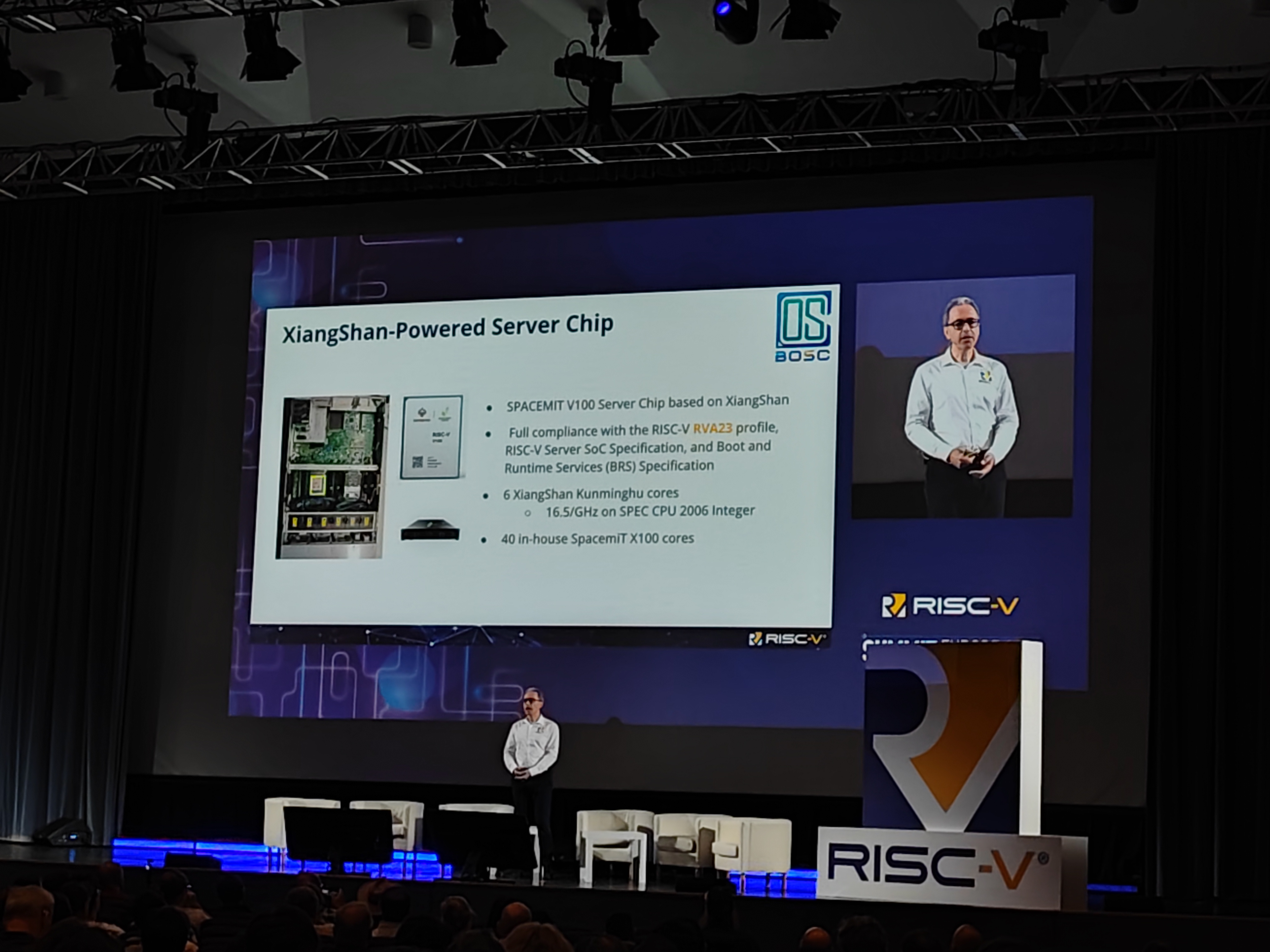
In the opening report of the RISC-V International, CEO Andrea Gallo introduced the application of XiangShan in high-performance server scenarios.
Andrea Gallo introducing the application of XiangShan in high-performance server scenarios
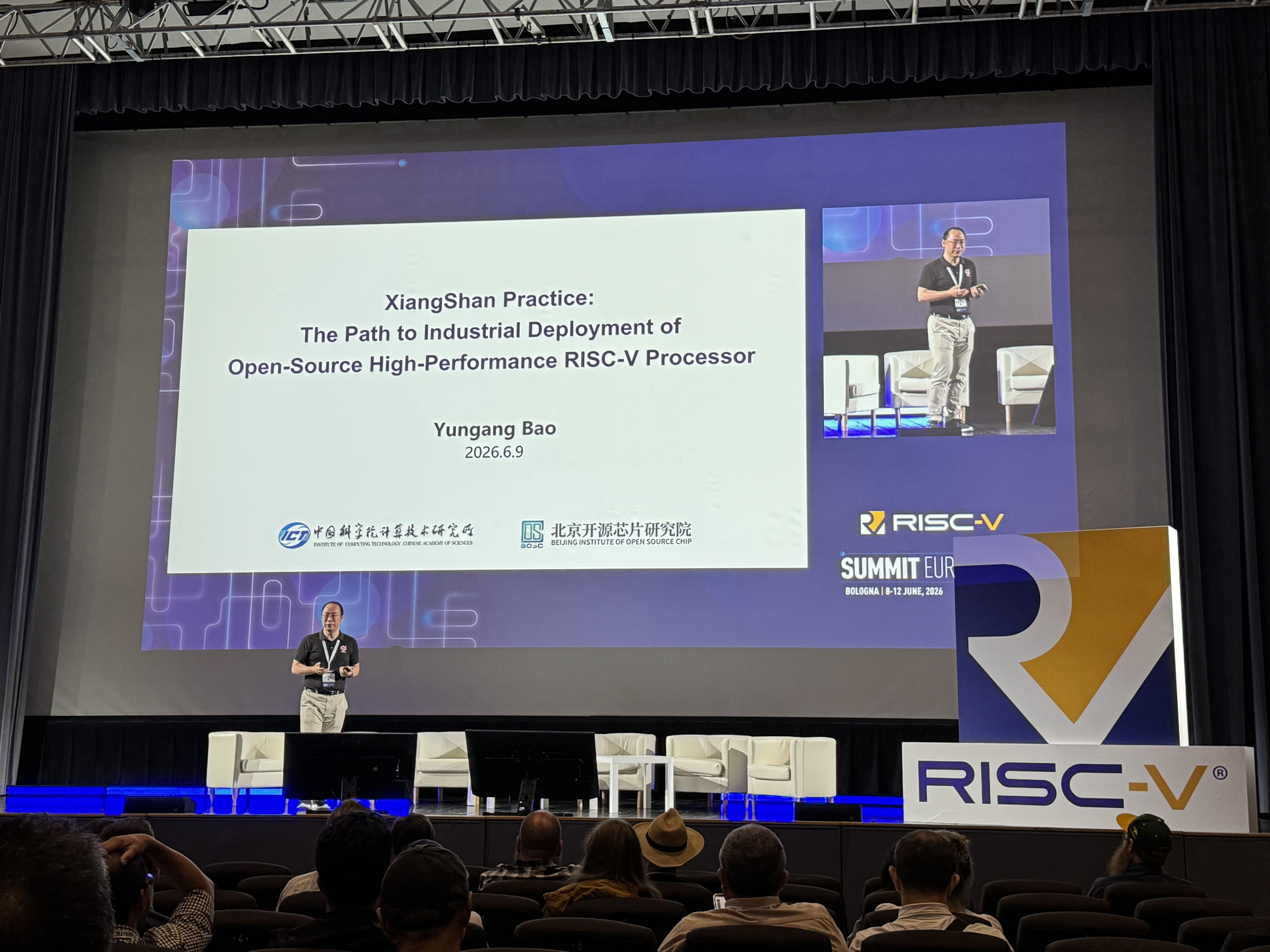
Deputy Director of the Institute of Computing Technology, Chinese Academy of Sciences, and Chief Scientist of Beijing Open Source Chip Research Institute, Researcher Bao Yungang gave a report titled "XiangShan Practice: The Path to Industrial Deployment of Open-Source High-Performance RISC-V Processor", introducing the industrial deployment path of XiangShan.
Researcher Bao Yungang introducing the industrial deployment path of XiangShan
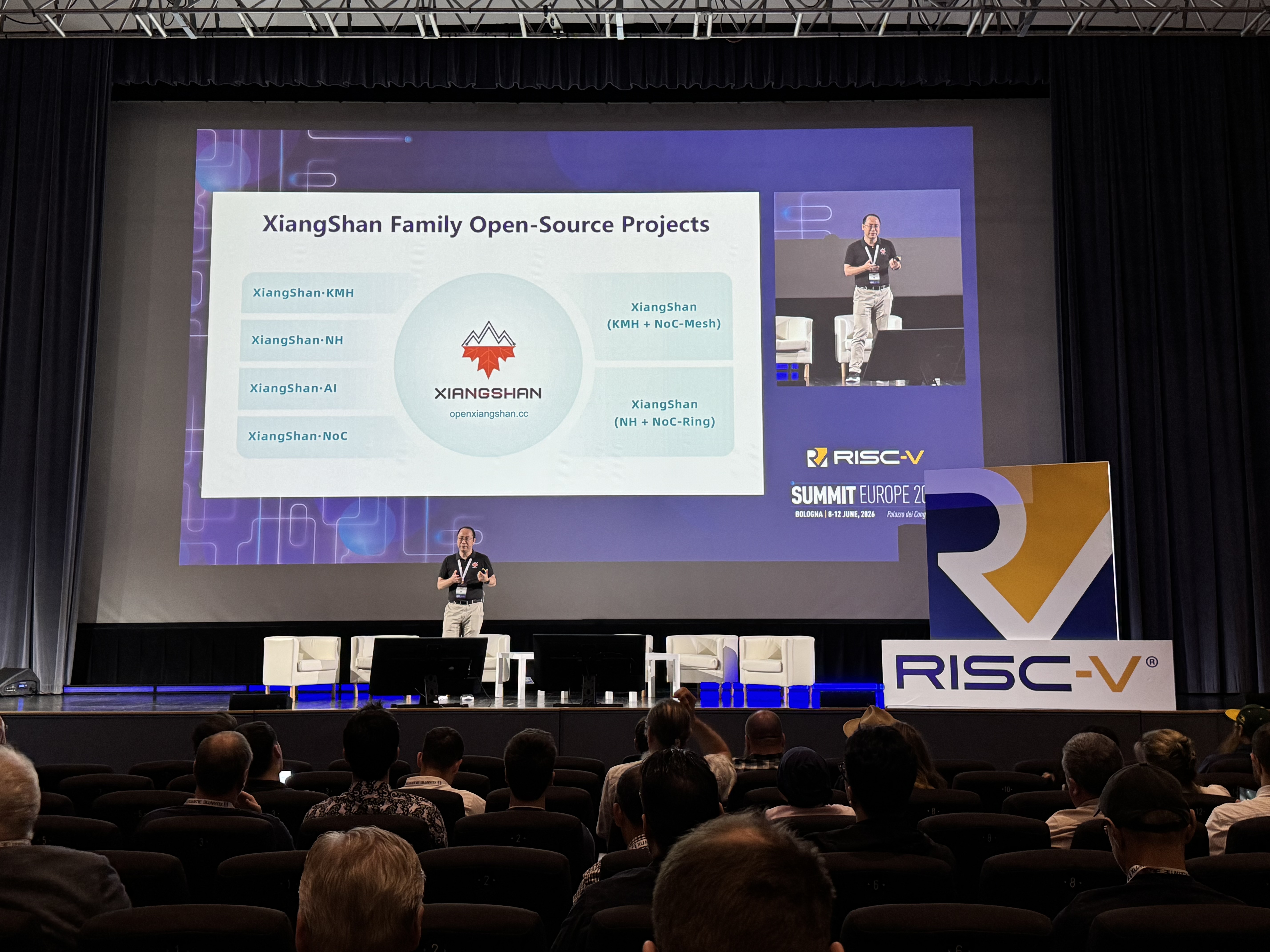
XiangShan family
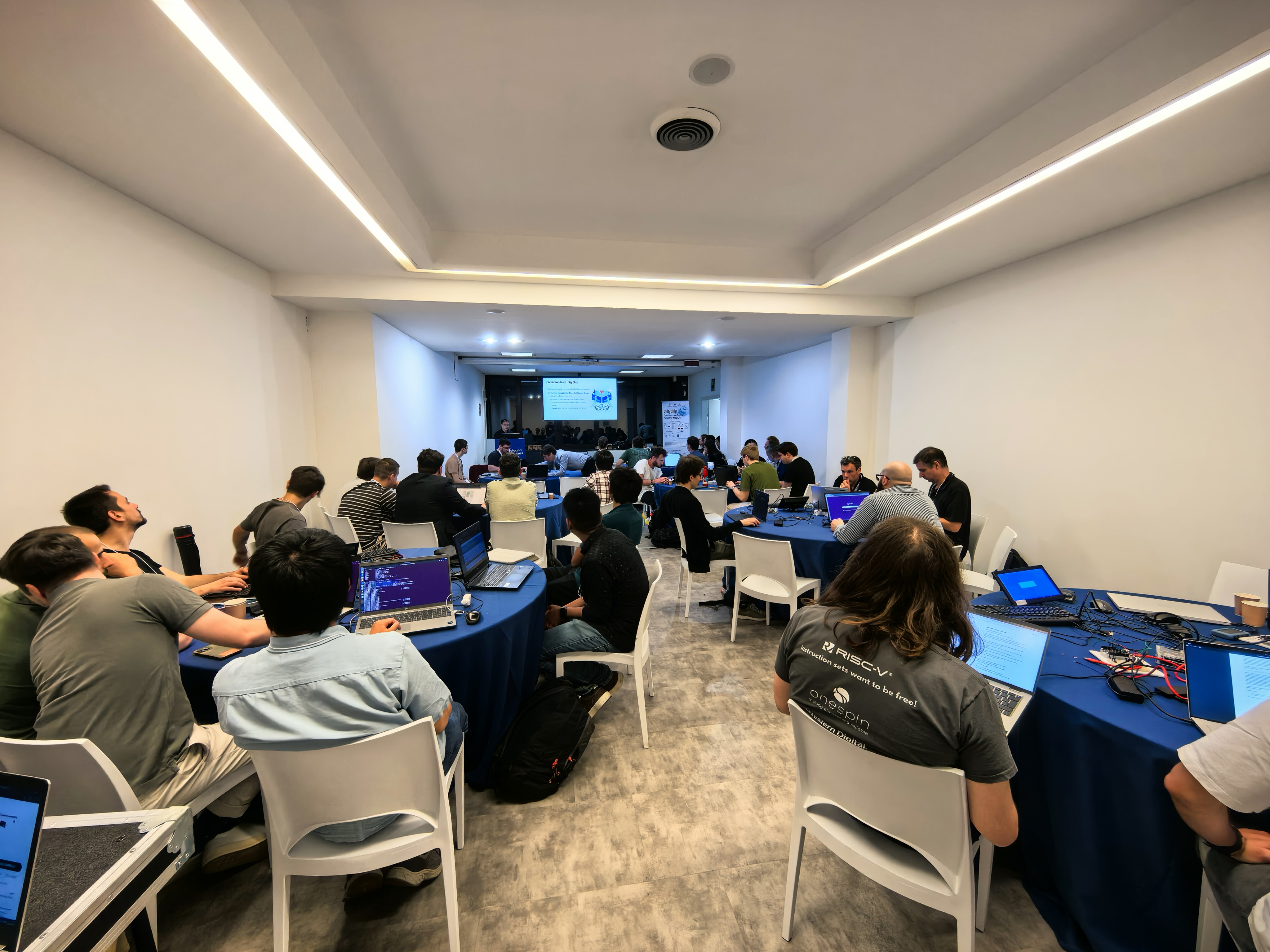
We also held the workshop of Unity Chip for the first time, sharing with everyone the exploration and practice of software-native open-source chip intelligent crowdsourcing verification.
Unity Chip workshop
Regarding the recent development progress of XiangShan, the frontend continues to optimize timing while reducing redirect latency; the backend implements some new features and instruction set extensions; the memory subsystem fixes some bugs while optimizing L2 timing; XSAI optimizes code structure while advancing HBL2 support for CHI.
Welcome to XiangShan biweekly column! Through this column, we will regularly share the latest development progress of XiangShan. This is the 103rd issue of the biweekly report.
We recently received many issues on GitHub! We welcome every developer who is interested in XiangShan to communicate and provide feedback with us. Whether it's bug reports, feature suggestions, or questions about using XiangShan, we will respond in a timely manner. In this biweekly report, we share a very interesting issue with you, through which we fixed four bugs.
As for the recent development of XiangShan, the frontend fixed some bugs while continuing to optimize timing; the backend implemented new extensions and fixed some bugs; the memory subsystem expanded L2 to 2MB while optimizing PPA and code style; XSAI implemented overlapping execution of the C matrix memory access module and fixed some bugs.
Welcome to XiangShan biweekly column! Through this column, we will regularly share the latest development progress of XiangShan. This is the 102nd issue of the biweekly report.
The development of X200, SpacemiT's third-generation high-performance RISC-V processor core derived from XiangShan Kunming Lake V2, has been completed. Based on a conventional cloud-computing processor core, X200 has been specifically optimized for cloud-side Agent applications and flagship end-device Agent applications. Its SPECint 2006 performance reaches 16.0 points/GHz, and its single-core frequency can reach 3.3GHz. Compared with X100, its performance per core has improved by more than 100%, reaching 50 SPECint 2006 points/Core.
Even more encouraging than the fact that X200 builds on Kunming Lake V2 is that the full XiangShan open-source infrastructure was used throughout X200's development. This is the part below the surface that supports X200 on its path toward production readiness. These open-source toolchains greatly accelerated X200's development on top of XiangShan and provided strong assurance for its quality.
As for recent XiangShan development, the frontend is implementing 2-fetch while optimizing timing; the backend and memory teams fixed several functional bugs and continued advancing the new L2 design; XSAI added FP8 support for the matrix unit while also improving code quality and evaluation tools.
Welcome to XiangShan biweekly column! Through this column, we will regularly share the latest development progress of XiangShan. This is the 101st issue of the biweekly report.
The design document of Kunming Lake V3 has been gradually released, and we welcome everyone to read and discuss it with us! Currently, the new design document includes two modules: ICache and BPU. The design documents for other modules will be released as development progresses. The design document is still available at https://docs.xiangshan.cc/projects/design/zh-cn/. If you are interested in the design document of Kunming Lake V2, you can switch branches at the bottom right corner of the webpage to view it.
As for recent XiangShan core development, the frontend optimized branch predictor timing, while backend and memory teams fixed bugs and continued module refactoring and testing.
Welcome to XiangShan biweekly column! Through this column, we will regularly share the latest development progress of XiangShan. This is the 100th issue of the biweekly report.
Before we knew it, XiangShan Biweekly has reached its 100th issue. At this special milestone, the XiangShan project also welcomes an important new member: XiangShan AI (XSAI), a unified general-purpose-and-inference AI processor implemented on top of XiangShan’s open-source, high-performance RISC-V processor. Starting from this issue, the biweekly will include XSAI development updates.
XSAI is the XiangShan team’s exploration of unified general-purpose-and-inference AI chips on top of its existing RISC-V CPU ecosystem, and a practical application of XiangShan’s agile development methodology. The Beijing Institute of Open Source Chip, together with the Microprocessor Technology Research Center and the Center for Advanced Computer Systems at the Institute of Computing Technology, Chinese Academy of Sciences, jointly participate in XSAI development. Like XiangShan, XSAI is also a fully open-source project, and its repository is available at https://github.com/OpenXiangShan/XSAI. In 2026, we will gradually release instruction extension manuals, architecture documentation, and user manuals, and open-source our development toolchain.
In addition, we would like to give you a sneak peek that the XiangShan tutorial at ISCA 2026 in Raleigh, USA at the end of June will also include content on the XSAI unified general-purpose-and-inference processor for the first time. We look forward to seeing you there!
As for recent XiangShan core development, the frontend optimized branch predictor timing, while backend and memory teams fixed bugs and continued module refactoring and testing.
Welcome to XiangShan biweekly column! Through this column, we will regularly share the latest development progress of XiangShan. This is the 99th issue of the biweekly report.
On March 26th, "XiangShan" + "Ruyi" were officially released at the ZGC Forum Annual Conference! Readers of the biweekly report are probably already familiar with XiangShan, so we won't go into details here. Ruyi (openRuyi) is a RISC-V native operating system jointly developed by the Institute of Software, Chinese Academy of Sciences and the Ruyi community. During the development process, it closely collaborates with the XiangShan team to achieve deep adaptation and optimization for XiangShan's open-source high-performance RISC-V processors. This kind of software-hardware co-design is a key step in building the RISC-V ecosystem and is one of the core competitive advantages of the "XiangShan + Ruyi" open-source community. We hope to work together with the entire community to promote software-hardware co-innovation and build an open, inclusive, and prosperous RISC-V ecosystem.
Ruyi ecosystem diagram, provided by ISCAS
In terms of XiangShan, this release includes the "KunMingHu" processor core, the world's first open-source on-chip interconnect network for data centers "WenYuHe", and the first terminal open-source on-chip interconnect IP "ZhuJiang". The V100 server chip based on the "KunMingHu" processor core, which was exhibited at the conference, was designed and taped out by our partner SpacemiT. The measured single-core performance reaches a score of 16.5/GHz in SPEC2006, making it the world's first open-source processor core that fully supports the RVA23 profile and has the highest single-core performance.
The V100 processor exhibited on site, photo by XianDong Zhu
In addition, the next-generation "KunMingHu" joint development plan was officially launched at the conference. We will work together with the Institute of Computing Technology, Institute of Software, Institute of Information Engineering, CAS, as well as industry and research units such as SpacemiT, ESWIN Computing, Tencent, Lirui Microelectronics, China Mobile, China Telecom, Alibaba DAMO Academy, Moore Threads, SOPHGO, and Lanxin Computing to promote the industrialization of XiangShan's core technologies and further enhance the competitiveness of the XiangShan series in the high-performance computing field. We strive to build an innovative base for high-performance RISC-V chips to support enterprises in developing more competitive products.
Group photo of the launch of the joint development plan
We also prepared an exclusive benefit for readers of the biweekly report, showing the V100 installed in a server~
V100 Server
Regarding the recent development progress of XiangShan, the frontend has fixed some performance bugs in BPU, the backend has optimized the timing of some modules, and the memory subsystem continues to refactor and test modules.
Welcome to XiangShan biweekly column! Through this column, we will regularly share the latest development progress of XiangShan. This is the 98th issue of the biweekly report.
Kunminghu V2 has been returned from the fab! We are currently conducting intensive testing, and more information will be disclosed in the future. Stay tuned!
Regarding the recent development progress of XiangShan, the frontend has fixed some performance bugs in BPU, the backend has optimized the timing of some modules, and the memory subsystem continues to undergo refactoring and testing.