MetaArray and DataArray
MetaArray Interleave
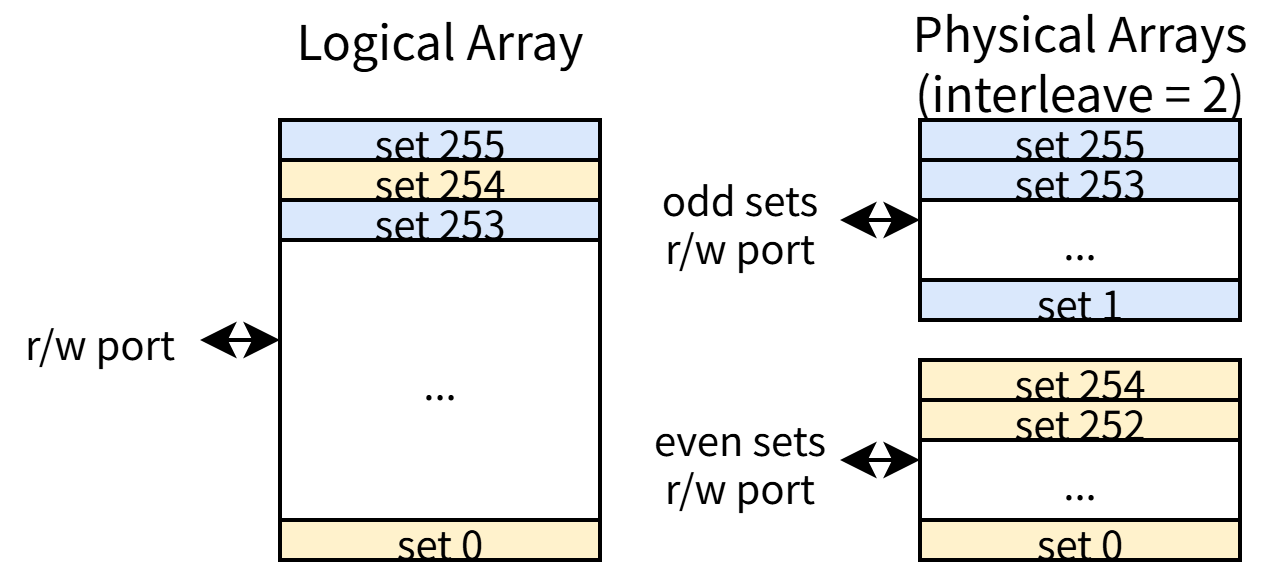
MetaArray uses set-index interleave: sets with different setIdx % NumInterleaveBanks are stored in different physical SRAMs to reduce access conflicts. We require NumInterleaveBanks to be at least 2, so one fetch block can always be handled within one cycle (if not cross-line, access one setIdx; if cross-line, access setIdx and setIdx + 1, which fall into two different physical SRAMs).
The case with NumInterleaveBanks = 2 is shown in 此图:
DataArray Banking
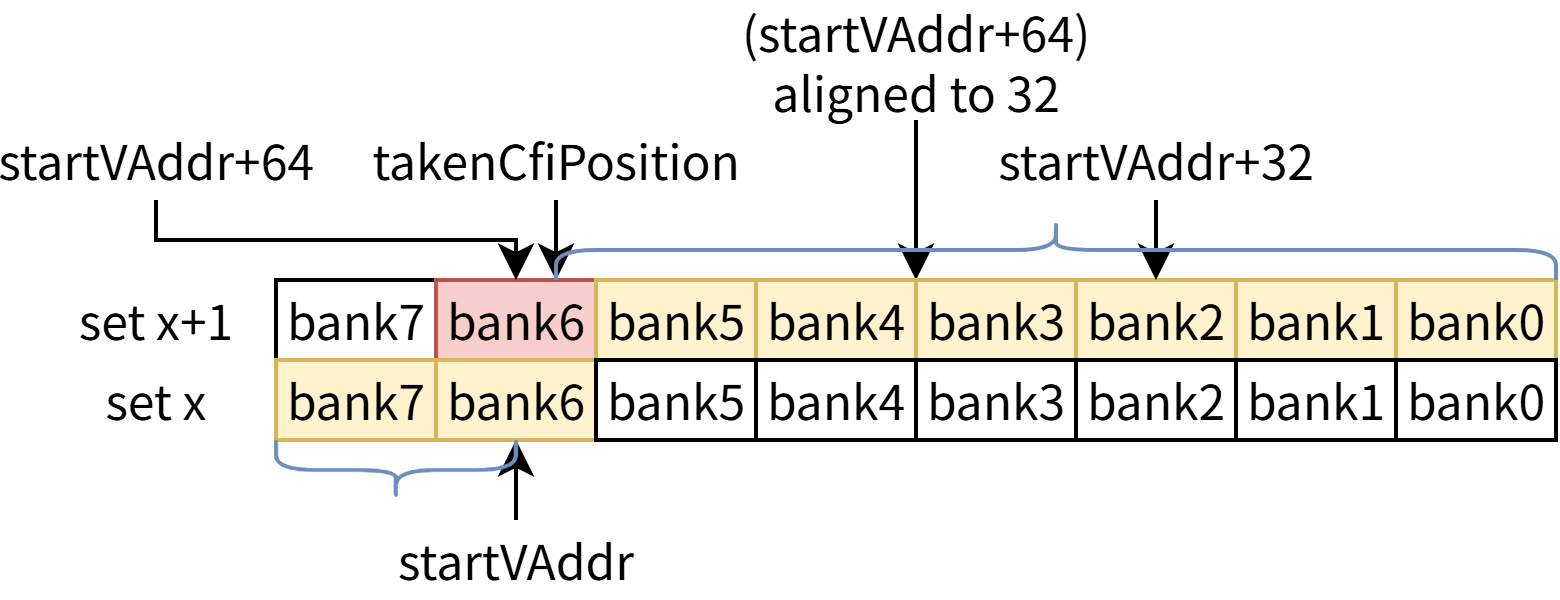
DataArray splits one cacheline into multiple banks. Each bank stores part of one cacheline, and each access activates only the required banks, reducing power. The example below uses the default configuration where one 64B cacheline is split into eight 8B banks.
In V2R2, one fetch block had a fixed size of 34B, so each access always activated 5 banks. In V3, fetch-block size is determined by takenCfiPosition provided by BPU (that is, fetch-block range is from start address to the address of the first taken branch instruction predicted by BPU). BPU guarantees this value is conflict-free for ICache accesses. Therefore, ICache does not need to check takenCfiPosition; it can directly activate corresponding banks.
此图 shows the DataArray banking design.
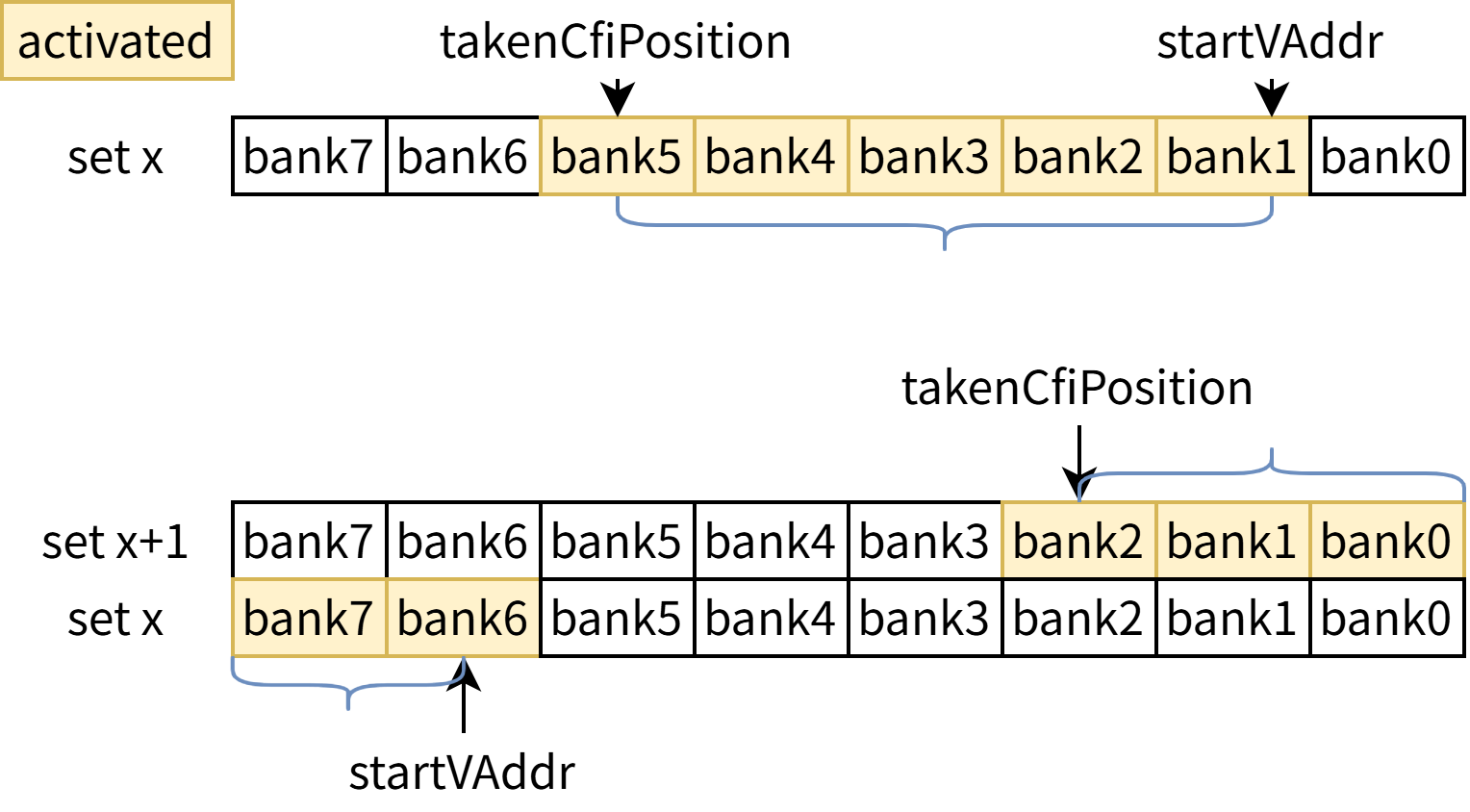
In 此图, the fetch block size is smaller than 64B and appears legal. Because its start position has an offset inside the bank, the head and tail of this fetch block fall into the same bank of different sets, which may look like an SRAM conflict.
But BPU design guarantees this case will not happen. In short, BPU-predictable takenCfiPosition must be before startVAddr + 64B aligned to a 32B boundary. In this example, it can be at most at the end of bank3 in set x+1, and cannot reach bank4 or later banks. For more details, see BPU design documentation.