IFU Submodule PreDecoder
Functional Description
Functional Overview
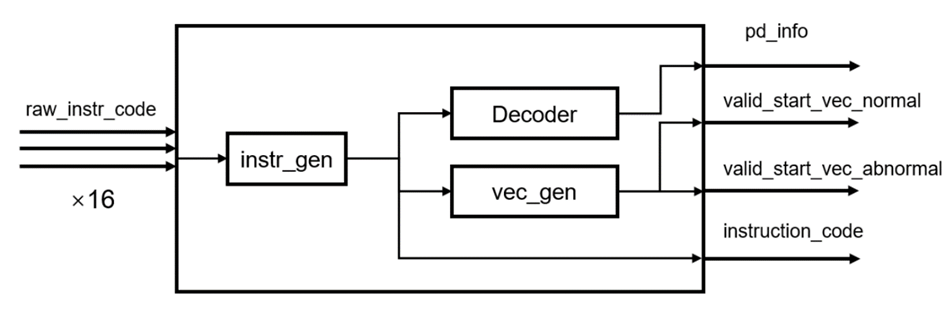
The PreDecoder receives the initial instruction code and performs instruction code generation. Each instruction code queries the pre-decoding table to produce pre-decoding information, including whether the position is the start of a valid instruction, the CFI instruction type, whether it is an RVC instruction, whether it is a Call instruction, and whether it is a Ret instruction. The pre-decoder generates two types of valid instruction start vectors: one defaults the 1st 2-byte as the start of a valid instruction, and the other defaults the 2nd 2-byte as the start. The final selection is made at the IFU side.
Feature Descriptions
Feature 1: Instruction Code Generation (instr_gen)
The pre-decoder receives the initial instruction code of 17×2 bytes from the IFU after instruction segmentation and selects a total of 16 4-byte instruction codes using a 4-byte window and a 2-byte step length, starting from the 1st 2-byte up to the 16th 2-byte.
Feature 2: Valid Instruction Start Vector Generation (vec_gen)
While generating the initial instruction code, the pre-decoder also produces a 16-bit valid instruction start vector, where each bit indicates whether the corresponding position is the start of a valid instruction. The generation logic is as follows:
- Normal Mode: By default, the first 2 bytes are considered the start of the first instruction. If the (n-1)th 2-byte segment is the start of a valid instruction and is an RVC instruction, or if the (n-1)th 2-byte segment is not the start of a valid instruction (definitely the last 2 bytes of a 4-byte instruction), then the nth 2-byte segment is the start of a valid instruction.
- Abnormal Mode: By default, the first 2 bytes are considered the latter half of a 4-byte instruction, with the first valid instruction starting from the second 2-byte segment. Subsequent generation logic follows the same rules as the normal mode.
Both modes generate results in parallel, with the final selection determined by whether there is a cross-cache-line RVI instruction within the IFU.
Feature 3: Pre-Decoding Information Generation (decoder)
The pre-decoder generates pre-decoding information based on the instruction code, including: whether it is an RVC instruction, whether it is a CFI instruction, the type of CFI instruction (branch/jal/jalr/call/ret), and the target address calculation offset for CFI instructions. The CFI instruction types are shown in Table 1.2.
Overall Block Diagram
Interface timing
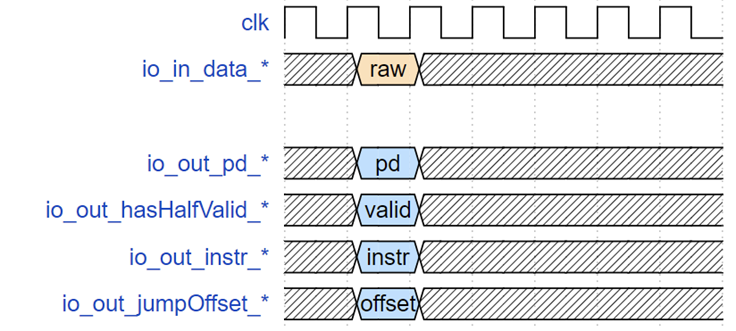
Since the PreDecode module consists entirely of combinational logic, both inputs and outputs are processed within the same clock cycle.
IFU Submodule PredChecker
Functional Description
Functional Overview
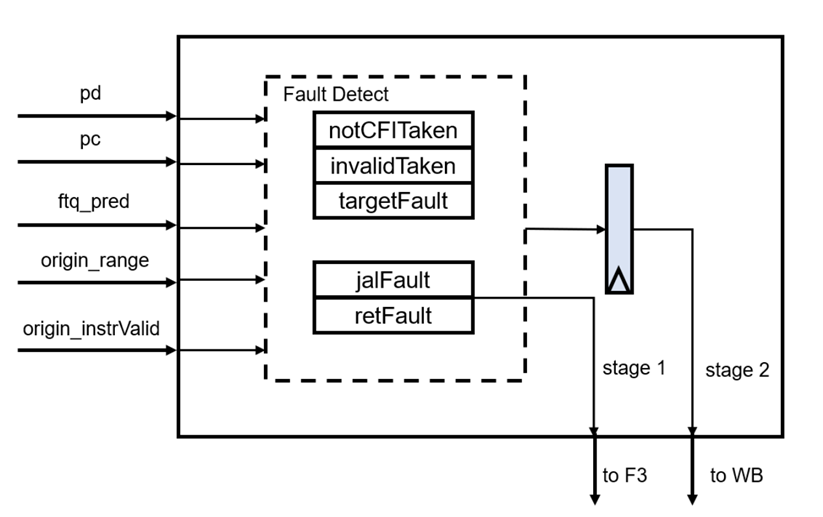
The branch prediction checker PredChecker receives prediction block information from the IFU (including the position of the predicted jump instruction within the block, the predicted jump target, pre-decoded instruction information, instruction PC, and pre-decoded jump target offsets). It internally checks for five types of branch prediction errors. The module is divided into two pipeline stages, each outputting information. The first stage outputs to the F3 stage to correct the instruction range and prediction results of the prediction block. The second stage outputs to the WB stage to generate frontend redirection upon detecting branch prediction errors and to write back correct prediction information to the FTQ.
Feature Descriptions
Feature 1: Jal Instruction Misprediction Check
The condition for a jal instruction prediction error is when there is a jal instruction in the prediction block (indicated by pre-decode information), but either the prediction block does not predict a jump, or the predicted jump instruction in the block occurs after this jal instruction (i.e., this jal instruction was not predicted to jump).
Feature 2: Ret Instruction Prediction Error Check
The condition for a ret instruction misprediction is that the prediction block contains a ret instruction (provided by pre-decoding information), but either the prediction block has no predicted jump, or the predicted jump instruction in this prediction block is after the ret instruction (i.e., this ret instruction is not predicted to jump).
Feature 6: Regenerate Instruction Valid Range Vector
When PredChecker detects a Jal/Ret instruction misprediction, it needs to regenerate the instruction valid range vector, truncating the valid range to the position of the Jal/Ret instruction and setting all subsequent bits to 0. Note that both jal and ret instruction mispredictions will shorten the instruction valid range, so the fixedRange must be regenerated, and the prediction result must be corrected (i.e., canceling the original prediction and regenerating the prediction result for this instruction block based on the jal instruction's position).
Feature 3: Non-CFI Prediction Error Check
The condition for a non-CFI misprediction is that the predicted jump instruction, according to pre-decoding information, is not a CFI instruction.
Feature 4: Invalid Instruction Prediction Error Check
The condition for an invalid instruction prediction error is when the predicted instruction's position, according to the instruction valid vector in the pre-decode information, does not indicate the start of a valid instruction.
Feature 5: Target Address Prediction Error Check
The condition for a target address prediction error is when the predicted instruction is a valid jal or branch instruction, but the predicted jump target address does not match the jump target calculated from the instruction code.
Feature 5: Hierarchical Output Check Results
The PredChecker results are output in two stages. As previously mentioned, Jal/Ret instructions require regenerating the instruction valid range vector and reassigning the predicted position, so their error results must be output directly to the Ibuffer in the same cycle (F3) to correct instructions entering the backend promptly. Due to timing considerations, other error information (such as the error positions of the five types of errors and the correct jump addresses) is returned to the IFU in the next cycle (WB) for frontend redirection.
Overall Block Diagram
Interface timing
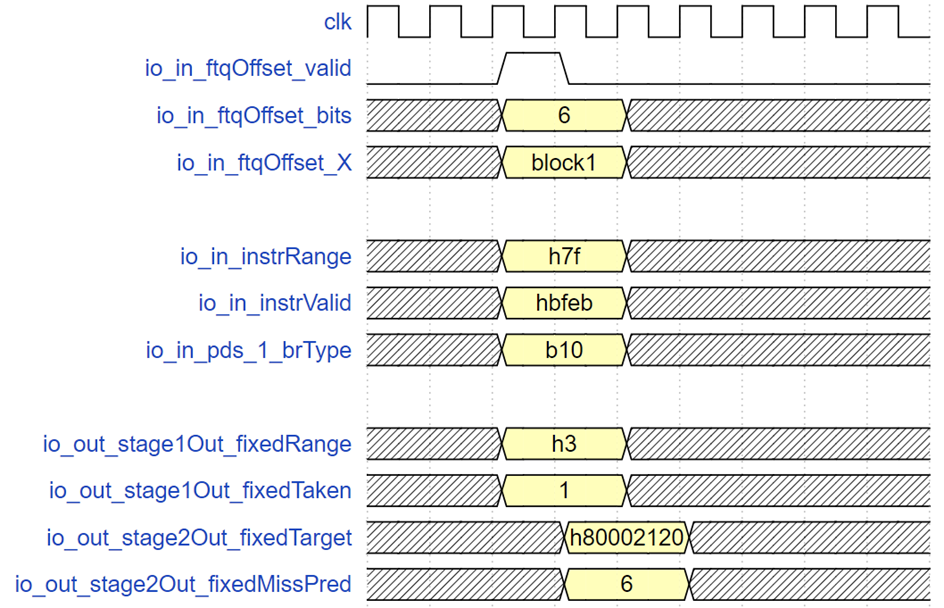
As shown in the figure, yellow represents the checking process of the same prediction block in PredChecker. The 6th byte position of this prediction block is predicted as a jump, and the original valid instruction range of the prediction block is h7f (i.e., 0000000001111111), with the instruction valid vector being hbfeb (i.e., 1011111111101011). However, the checker identifies that the 1st byte position (counting from 0) is a jal instruction (brType value is b10). Therefore, the checker first modifies the valid instruction range to h3 in stage1, sets the predicted byte position to 1 for F3 to perform Ibuffer instruction enqueue selection, and corrects the target address to h80002120 in the WB stage while marking the misprediction position as 6, notifying the WB stage to perform redirection.