Rename renaming
- Version: V2R2
- Status: OK
- Date: 2025/01/20
- commit:xxx
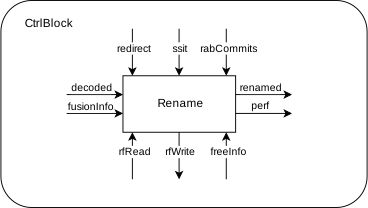
The Rename module receives instruction decode information from the Decode module and allocates robIdx and physical registers based on the decode information, querying the corresponding physical registers for operands. Simultaneously, the module maintains the state of the freeList according to the instruction decode information, instruction commit information, and register release information from RenameTable. It also sends write requests to RenameTable to update the register mapping state during speculative execution, based on the instruction decode and commit information. Additionally, the module handles redirect requests from the ROB, updating the freeList state according to the redirect information. After renaming, Rename sends the renamed instruction information to the Dispatch module.
Basic functionality
Mapping logical registers to physical registers, assigning a physical register to each logical register in the instruction.
Register renaming maintains rename-related tables or pointers. It manages the mapping table from logical registers to physical registers, recording the most recently allocated physical register number for each logical register.
For integer, floating-point, and vector registers, separate physical register state tables are maintained with 224, 192, and 128 entries, respectively. These tables record the allocation status of physical registers and track unallocated physical registers using free physical register allocation pointers.
Maintains a committed logical-to-physical register mapping table (RenameTable, RAT) recording the mapping relationship between logical and physical registers in committed state.
Maintains a commit-state pointer for free physical register allocation. Register renaming technology eliminates write-after-read (WAR) and write-after-write (WAW) dependencies between instructions, ensuring precise state recovery when instructions are canceled due to exceptions or mispredicted branch instructions.
Rename Input
- Input from the decode stage (the FusionDecoder modifies the instructions output by the DecodeStage for macro-op fusion, adjusting valid, uop, and other information based on adjacent instruction combinations. It also modifies the commit type CommitType of the fused instruction based on the ftqptr and ftqoffset combinations of adjacent instructions.)
- Accepts speculative rename data feedback from RAT
- Instruction fusion information, and modifying decoded instruction stream based on fusion conditions.
- SSIT, waittable information
- Ctrlblock snapshot control information and enqueue/dequeue pointers
- RAB commit information
Rename Output
- Interact with RAT: Write rename information.
- Interact with dispatch: Pipeline output of renamed uop information when dispatch recv is valid.
- With snapshot: enqdata, allowing snapshot generation.
Allocating integer physical registers
Upon receiving valid integer instruction decoding information from the Decode module, the Rename module determines whether a new integer physical register needs to be allocated based on the signals io_in_[0-5]_bits_rfWen and io_in_[0-5]_bits_ldest. If rfWen is high and ldest is not 0, a new integer physical register is allocated. If allocation is required, a request is sent to intFreeList, and the allocation result is obtained in the same cycle; otherwise, no request is sent. Additionally, the Rename module supports integer Move instruction elimination. If a decoded instruction is identified as an integer Move instruction, no new integer physical register is allocated.
Allocating floating-point or vector physical registers
Upon receiving valid vector floating-point instruction decode information from the Decode module, the Rename module determines whether to allocate new vector floating-point physical registers based on the io_in_[0-5]bits_fpWen and io_in[0-5]_bits_vecWen signals. If the fpWen or vecWen signal is high, a new floating-point or vector physical register needs to be allocated. If allocation is required, a request is sent to the fpFreeList or vecFreeList, and the allocation result is obtained in the same cycle; otherwise, no allocation request is sent.
Setting the Physical Register for Source Operands (psrc)
If the instruction decode information from the Decode module includes integer register or vector floating-point register-type source operands, under normal circumstances, the Decode module will query the RenameTable one cycle in advance to obtain the physical register corresponding to the logical register. The result is obtained in the Rename module one cycle later and transmitted to the Dispatch module via io_out_[0-5]bits_psrc[0-4]. As an exception, if the destination operand of the previous instruction is the same as the source operand of the current instruction, the psrc of the current instruction should be set to the pdest of the previous instruction.
Set the physical register (pdest) for the destination operand
If the instruction decode information from the Decode module indicates the
presence of a destination operand (see and
), the Rename module typically assigns a new physical
register to the Dispatch module via io_out_[0-5]_bits_pdest. As an exception,
if the instruction is an integer Move instruction, its pdest should be set to
its psrc.
Integer Instruction Commit
When integer instructions commit, Rename sends free signals to intFreeList based on io_int_need_free_[0-5] and io_int_old_pdest_[0-5] from RenameTableWrapper, releasing the corresponding integer physical registers for reuse. If io_int_need_free_[0-5] is high, the integer physical register in io_int_old_pdest_[0-5] must be freed. Rename also forwards commit signals from RAB to intFreeList for maintaining architectural state rename pointers.
Commit of Floating-Point or Vector Instructions
After receiving floating-point instruction commit information from the RAB,
Rename combines this with commit information from RenameTableWrapper to send
free signals to fpFreeList, releasing unused vector/floating-point physical
registers for new instructions. If the delayed
io_rabCommits_info_[0-5]_fp/vecWen signal, along with the delayed
io_rabCommits_isCommit and io_rabCommits_commitValid_[0-5] signals (which
indicate the current cycle is in the commit phase and the commit signal for that
channel is valid, as detailed in ), are all high, then the
corresponding io_fp/vec_old_pdest_[0-5] floating-point or vector register
needs to be released. Additionally, Rename forwards the commit signal from the
RAB to fpFreeList for maintaining the architectural state rename pointer.
Redirect
When a redirect signal is received via the io_redirect port, freeList suspends physical register allocation and resets the allocation pointer to the architectural state or a snapshot state. Additionally, the Rename module stops sending write request signals to the RenameTable.
Re-rename
One cycle after the redirect signal is received, the Rename module enters the
re-renaming process. The re-renaming signal is passed to Rename from the RAB via
the io_rabCommits port. During re-renaming, the Rename module will no longer
output valid instruction signals to Dispatch or send write request signals to
RenameTable.
The Rename module sends re-renaming signals to intFreeList, fpFreeList, and vecFreeList through their respective io_walkReq_[0-5] ports. These re-renaming signals originate from the RAB module's io_rabCommits_walkValid_[0-5], io_rabCommits_info_[0-5]_isMove, io_rabCommits_info_[0-5]_ldest, and io_rabCommits_info_[0-5]_rf/fp/vecWen signals. The signals on io_walkReq_[0-5] are only valid when io_rabCommits_isWalk is high.
For intFreeList, when io_rabCommits_walkValid_[0-5] is high, and the corresponding channel's io_rabCommits_info_[0-5]rfWen is high, io_rabCommits_info[0-5]ldest is not 0, and io_rabCommits_info[0-5]isMove is low, the corresponding io_walkReq[0-5] port will send a valid signal, indicating that re-rename is required.
For fpFreeList and vecFreeList, when io_rabCommits_walkValid_[0-5] is high
and the corresponding channel's io_rabCommits_info_[0-5]_fp/vecWen signal is
high, the io_walkReq_[0-5] port will receive a valid signal, indicating that
re-renaming is required.
robIdx Allocation
The Rename module is responsible for assigning robIdx to each micro-instruction. It internally maintains a robIdxHead. Under normal circumstances, the Rename module sequentially assigns consecutive robIdx to the decoded instructions from the Decode module and increments the robIdxHead. However, if the corresponding channel's io_in_[0-5]bits_lastUop is low, or the compressUnit's corresponding channel's io_out_needRobFlags[0-5] is low, the next channel's micro-instruction will not be assigned a robIdx.
In the cycle when a redirect occurs, the module resets robIdxHead to the redirected robIdx. In the next cycle, it decides whether to increment robIdxHead based on the value of io_redirect_bits_level.
Determining rename snapshot generation
The Rename module is also responsible for deciding whether to generate rename
snapshots. Rename snapshots aim to reduce the time required for re-renaming
after a redirect occurs. Rename snapshots are distributed across multiple
modules, including RenameTable, RenameTable_1, RenameTable_2,
intFreeList, fpFreeList, vecFreeList, Rob, Rab, and CtrlBlock, with
each storing different snapshot contents. Therefore, a module is needed to
coordinate snapshot generation across these modules, and this module is Rename.
Externally, Rename transmits the snapshot generation signal to other modules via
io_out_*_bits_snapshot. Internally, Rename also forwards the snapshot
generation signal to intFreeList, fpFreeList, and vecFreeList.
There are several constraints on the generation of rename snapshots. First, the
Rename module internally maintains a snapshot counter, snapshotCtr, and a
snapshot can only be generated when this counter is 0. Second, if another
snapshot already exists, the robIdx assigned to the first micro-op renamed in
the current cycle must differ by 6 from the robIdx of the most recently
generated snapshot, which is greater than the ROB commit width. Finally, the
first micro-op renamed in the current cycle must be the first micro-op of its
corresponding instruction, meaning io_in_0_bits_firstUop must be high. Only
when these three conditions are met, and there is a branch/jump instruction
among the six micro-ops being renamed, will a snapshot be generated. At this
point, the io_out_*_bits_snapshot signals for the channels containing
branch/jump instructions will be pulled high, and Rename will also notify its
internal submodules of the snapshot generation signal.
The snapshot counter snapshotCtr controls the interval between snapshot generations. Since snapshots taken too close together are meaningless and waste snapshot resources, this counter is implemented. snapshotCtr is initially set to 4 times the RAB commit width, i.e., 4×8=32. If no valid rename snapshot currently exists, snapshotCtr is set to 0; otherwise, it decrements by n for every n microinstructions renamed, until it reaches 0. Once snapshotCtr is 0, if a rename snapshot is generated at any point, snapshotCtr is reset to the maximum value minus the number of microinstructions renamed in that cycle, i.e., 32 - PopCount(io_out_valid && io_out_ready).
Overall Block Diagram
Interface timing
Timing Diagram of Decode Input Interface
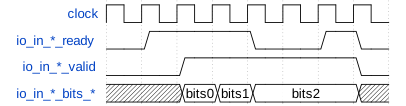
此图 shows three input examples from decode. When both ready and valid signals are high, the corresponding bits are received by the Rename module.
Timing diagram of Rename output interface
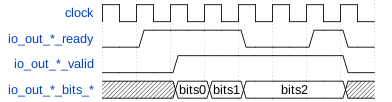
此图 illustrates three rename result examples. When both ready and valid signals are high, the corresponding bits are sent by Rename module to Dispatch.
Timing diagram of instruction commit logic
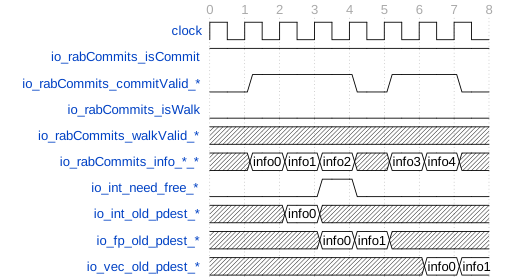
此图 illustrates the five instruction commit inputs from the ROB. When io_rabCommits_isCommit is high and io_rabCommits_isWalk is low, io_rabCommits_info__ represents the instruction commit information. When io_rabCommits_commitValid_ is high, the corresponding io_rabCommits_info_ transmits valid instruction commit information to the Rename module. Meanwhile, io__old_pdest will send the old physical register number to be released to the Rename module after a one-cycle delay, and after another cycle delay, it will transmit the signal indicating whether an integer physical register needs to be released via the io_int_need_free_ port to the Rename module.
Timing Diagram of Redirect and Rename Recovery
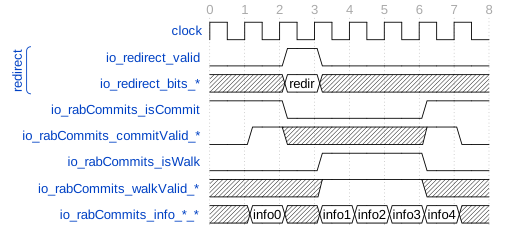
此图 illustrates the signals before and after a redirect occurs. In the first two cycles, io_redirect_valid is low, and Rename operates normally, as shown in 此图. Subsequently, the io_redirect_valid signal is pulled high for one cycle, indicating the arrival of a redirect. The redirect information is sent via io_redirect_bits_, and Rename will enter the re-rename state starting from the next cycle. In the following three cycles, io_rabCommits_isCommit is low, and io_rabCommits_info_ no longer sends commit information. Conversely, io_rabCommits_isWalk is high, indicating that io_rabCommits_info_ is sending re-rename information, and Rename needs to perform re-rename operations. When io_rabCommits_walkValid_ is high, the corresponding io_rabCommits_info__ sends valid re-rename information.
RenameTableWrapper
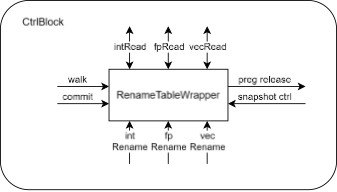
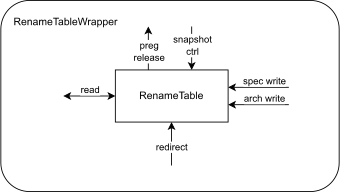
The RenameTableWrapper is a wrapper module that internally contains the integer rename table module RenameTable, the floating-point rename table module RenameTable_1, and the vector rename table module RenameTable_2. Beyond simply bundling these three rename tables, this wrapper module also handles logic related to commit and re-rename internally. The RenameTableWrapper serves as a bridge between the internal rename tables and external modules.
Read speculative rename table
RenameTableWrapper has 12 integer register read ports, 18 floating-point register read ports, and 30 vector floating-point register read ports. The integer read ports are grouped in pairs, the floating-point read ports in triplets, and the vector read ports in sets of five, with six groups of read ports each. The integer read ports retrieve speculative mappings from integer logical registers to integer physical registers, the floating-point read ports retrieve mappings from floating-point logical registers to vector floating-point physical registers, and the vector read ports retrieve mappings from vector logical registers to vector floating-point physical registers.
RenameTableWrapper's read operations are synchronous. This means a read request
sent via io_(int/fp/vec)ReadPorts__addr in cycle T will return the logical
register's corresponding physical register in cycle T+1 through
io(int/fp/vec)ReadPorts___data.
Reads from RenameTableWrapper are forwarded. If a read request is sent to an
address in clock cycle T while a write request is also sent to the same
address, the value read in cycle T+1 will be the value written to that address
in cycle T.
The read operation of RenameTableWrapper has a hold function. If at the T
clock cycle, a read port's io_(int/fp/vec)ReadPorts___hold is high, then at
the T+1 clock cycle, the read value will be the same as that at the T clock
cycle.
Writing to the Speculative Rename Table During Rename Phase
RenameTableWrapper has 6 integer register write ports, 6 floating-point register write ports, and 6 vector register write ports, used to update speculative rename tables during the rename phase. The integer register write ports update the speculative mapping from logical integer registers to physical integer registers, the floating-point write ports update the mapping from logical floating-point registers to vector floating-point physical registers, and the vector write ports update the mapping from logical vector registers to vector floating-point physical registers.
Writes to RenameTableWrapper are synchronous. This means that write requests
sent via io_(int/fp/vec)RenamePorts_addr and io(int/fp/vec)RenamePorts__data
in clock cycle T will not be readable until cycle T+1.
The writes to RenameTableWrapper are enabled. Only write requests with io_(int/fp/vec)RenamePorts_*_wen asserted are valid.
RenameTableWrapper's write operations are prioritized. Higher-numbered write channels have higher priority, meaning if two channels write to the same address, the result from the higher-numbered channel prevails.
Writing architectural rename table during commit phase
The RenameTableWrapper updates the architectural rename table by monitoring commit information from RAB. When the io_rabCommits_isCommit signal is high in a cycle, it indicates a commit is occurring. If any io_rabCommits_commitValid_ signal is high, the commit signal for that port is valid. Further examination is then required for io_rabCommits_info_rfWen, io_rabCommits_infofpWen, and io_rabCommits_infovecWen. If io_rabCommits_inforfWen is high, the integer register needs architectural rename table update; if io_rabCommits_infofpWen is high, the floating-point register requires update; if io_rabCommits_infovecWen is high, the vector register needs update. In these cases, RenameTableWrapper will modify the entry at address io_rabCommits_infoldest in the integer/floating-point/vector architectural rename table to io_rabCommits_info*_pdest.
Providing Physical Register Release Information During Commit Phase
The RenameTableWrapper provides physical register release information based on
writes to the architectural rename table during the commit phase. This
information includes the integer physical register numbers to be released
(io_int_old_pdest_*) and their corresponding valid signals
(io_int_need_free_*), as well as the vector/floating-point physical register
numbers to be released (io_(fp/vec)_old_pdest_*). These signals come directly
from the submodules of RenameTableWrapper and are used by the Rename module to
release physical registers based on instruction commit status.
Writing to the Speculative Rename Table During Re-Rename Phase
RenameTableWrapper listens to commit information from RAB to perform re-renaming. If the io_rabCommits_isWalk signal is high in a cycle, it indicates re-renaming is occurring. If a specific io_rabCommits_walkValid_* signal is high, it means the re-renaming signal for that port is valid. Further checks are required for io_rabCommits_info_*_rfWen, io_rabCommits_info_*_fpWen, and io_rabCommits_info_*_vecWen. If io_rabCommits_info_*_rfWen is high, it indicates integer registers need re-renaming; if io_rabCommits_info_*_fpWen is high, it indicates floating-point registers need re-renaming; if io_rabCommits_info_*_vecWen is high, it indicates vector registers need re-renaming. In these cases, RenameTableWrapper will modify the entry at io_rabCommits_info_*_ldest in the integer, floating-point, or vector speculative rename tables to io_rabCommits_info_*_pdest.
Maintenance of rename snapshots
The RenameTableWrapper forwards external rename snapshot signals io_snpt_* to each submodule for generating, releasing, flushing, and using rename snapshots.
Overall Block Diagram
Interface timing
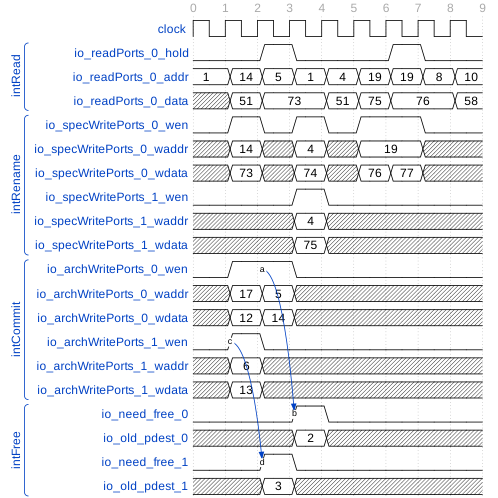
Timing Diagram for Integer Read/Write Interface (Floating-Point Vector Similar)
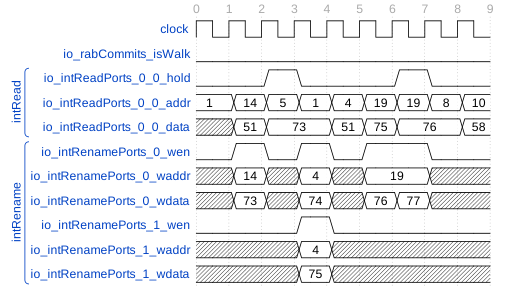
此图 illustrates the timing of integer read/write interfaces.
At time 2, io_intRenamePorts_0 writes 73 to address 14. Simultaneously, io_intReadPorts_0_0 issues a read request to address 14, thus reading the value 73 written at time 2 during time 3.
At time 4, io_intRenamePorts_0 writes 74 to address 4, and io_intRenamePorts_1 also writes 75 to address 4. Consequently, when io_intReadPorts_0_0 issues a read request to address 4 at time 5, it reads the value 75 written by io_intRenamePorts_1 at time 6.
At times 3 and 7, io_intReadPorts_0_0_hold is high, so the values read at times 4 and 8 match those read at times 3 and 7 (73 and 76, respectively), rather than the values at address 5 or the newly written value 77 at time 7.
Timing Diagram of Rename Recovery and Commit Interface
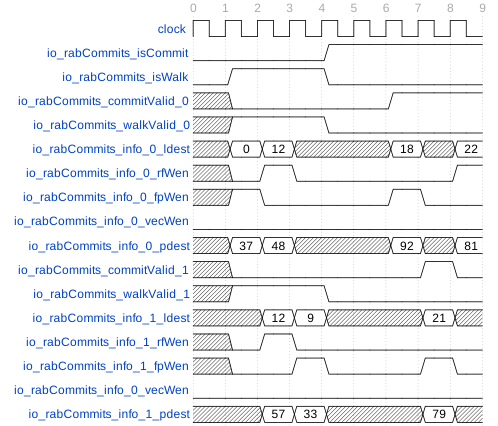
此图 illustrates the timing of two re-rename and commit interfaces.
From time 1 to time 4, io_rabCommits_isWalk is high, and io_rabCommits_ioCommit is low, indicating a re-renaming state. At time 2, io_rabCommits_walkValid_0 is high, io_rabCommits_info_0_rfWen is low, and io_rabCommits_info_0_fpWen is high. Thus, re-rename interface 0 writes 37 to address 0 of the floating-point speculative rename table. At time 3, both re-rename interfaces write to logical integer register 12. Here, interface 1 has higher priority than interface 0, so 57 is written to address 12 of the integer speculative rename table.
From time 5 to time 9, io_rabCommits_isWalk is low and io_rabCommits_ioCommit is high, indicating the commit state. At time 7, io_rabCommits_commitValid_0 is high, io_rabCommits_info_0_rfWen is low, and io_rabCommits_info_0_fpWen is high, so commit interface 0 writes 92 to address 18 in the floating-point architectural rename table.
RenameTable supporting move elimination
The RenameTable supporting move elimination is used for integer register
renaming. The module, named RenameTable, maintains the mapping between
logical and physical integer registers. It has 12 speculative rename table read
ports, 6 speculative rename table write ports, and 6 architectural rename table
write ports. Internally, it uses 32 registers with a width of 8 to manage the
mappings. The behavior of the read and write ports is identical to that
described in RenameTableWrapper. Note that for timing considerations,
speculative rename table write requests at T0 are processed at T1, and
speculative rename table write data at T0 is bypassed to speculative rename
table read results at T1.
Additionally, the module internally maintains 4 speculative rename table snapshots for quick recovery during redirection and re-renaming. These snapshots are stored in the submodule SnapShotGenerator_3, named snapshots_snapshotGen_io_snapshots_0/1/2/3[0-31] in RenameTable. The generation, release, usage, and flushing of snapshots are entirely controlled by external signals io_redirect and io_snpt_*.
The externally provided redirect signal io_redirect and snapshot control
signal io_snpt_* are delayed by one cycle to become t1_redirect and
t1_snap_*. When t1_redirect is high, the t1_snap_useSnpt signal is
checked. If t1_snap_useSnpt is low, the speculative rename table is set to the
architectural rename table. If t1_snap_useSnpt is high, the speculative rename
table is set to
_snapshots_snapshotGen_io_snapshots_[t1_snap_snptSelect]_[0-31].
Additionally, the module generates physical register release signals based on the write ports to the architectural rename table and the internal architectural rename table outputs. If the write enable signal io_archWritePorts_n_wen for a write port is low, the next cycle's io_old_pdest_n will be 0. If the write enable signal is high, the next cycle's io_old_pdest_n will be the current cycle's arch_table[io_archWritePorts_n_addr]. Note that io_old_pdest_n is bypassed. For n > 0, if a lower-indexed channel (j < n) writes to the same logical register in the architectural rename table, the next cycle's io_old_pdest_n should reflect the value written by the lower-indexed channel (io_archWritePorts_j_data) instead of arch_table[io_archWritePorts_n_addr]. Furthermore, for n > 1, if multiple lower-indexed channels write to the same logical register, the next cycle's io_old_pdest_n should reflect the value written by the highest-indexed channel among them (e.g., io_archWritePorts_k_data for j < k < n).
The physical register release signals also include io_need_free_. If the current cycle's io_old_pdest_n signal does not match any entry in arch_table_, the next cycle's io_need_free_n signal for that channel will be set high. Note that for n > 0, if a lower-indexed channel's io_old_pdest_j matches io_old_pdest_n, the next cycle's io_need_free_n signal will not be set high.
Overall Block Diagram
Interface timing
Timing diagram of read/write interfaces
RenameTable without move elimination support
The RenameTable without move elimination support is fundamentally similar to
but excludes io_need_free_* signals. The floating-point rename
table RenameTable_1 and vector rename table RenameTable_2 use this type.
The floating-point register rename table RenameTable_1 maintains the mapping
between logical floating-point registers and physical vector floating-point
registers. It has 18 read speculative rename table ports, 6 write speculative
rename table ports, and 6 write architectural rename table ports. Internally, it
uses 34 registers with a width of 8 to maintain the mapping relationships.
The floating-point register rename table RenameTable_2 maintains the mapping
between logical vector registers and physical vector/floating-point registers.
It has 30 speculative rename table read ports, 6 speculative rename table write
ports, and 6 architectural rename table write ports. Internally, it uses 48
registers with a width of 8 to manage the mappings.
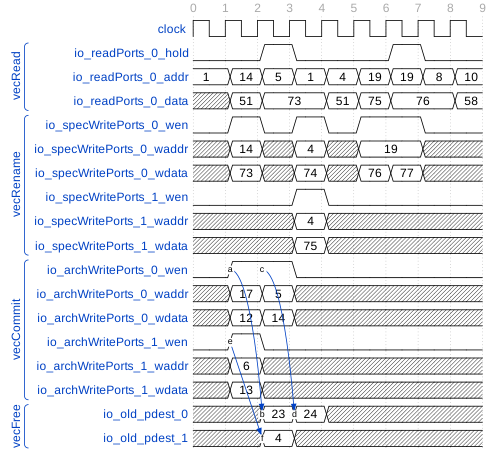
Interface timing
Timing diagram of read/write interfaces
StdFreeList
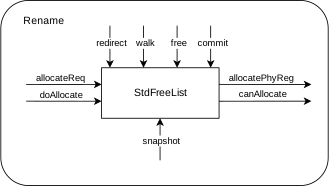
Within the Rename module, StdFreeList is instantiated as fpFreeList and vecFreeList. As mentioned in , , and , fpFreeList is responsible for receiving allocation requests for vector floating-point physical registers during rename, returning allocated free vector floating-point physical registers. During re-rename, it handles reallocation of vector floating-point physical registers based on re-rename requests from the RAB. During commit, it releases vector floating-point physical registers that are no longer in use and updates the architectural dequeue pointer.
Overall Block Diagram
Interface timing
Timing diagram of free register allocation
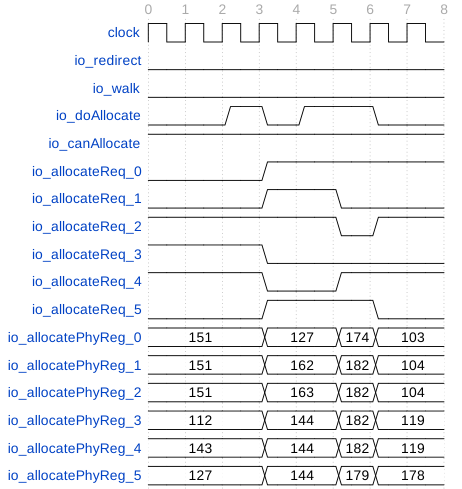
此图 illustrates the timing for free physical register
allocation. At times 3, 5, and 6, io_redirect and io_walk are low, while
io_doAllocate and io_canAllocate are high, enabling the allocation of free
physical registers. At time 3, io_allocateReq_[2-4] is high, and StdFreeList
returns the allocated free physical register numbers 151, 112, and 143 via
io_allocatePhyReg_[2-4]. At time 5, io_allocatePhyReg_[0-2|5] returns the
allocated free physical register numbers 127, 162, 163, and 144. At time 6, it
returns 174, 182, and 179. For every successful allocation of n free physical
registers, the internal headPtr increments by n.
Instruction Commit Timing Diagram
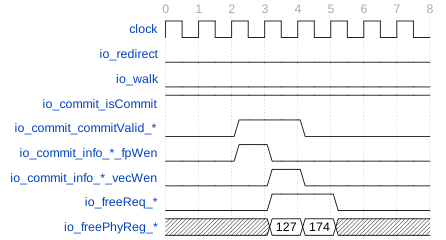
此图 illustrates the timing of instruction commit, where io_freeReq_ represents the io_freeReq signal for a specific path, and io_freePhyReg_ represents the io_freePhyReg signal corresponding to io_freeReq_* for a specific path. When both io_redirect and io_walk are low, if io_freeReq is high, StdFreeList will add the corresponding io_freePhyReg to the free queue.
Furthermore, one cycle before io_freeReq_*, the Rename module also passes the
RAB commit information to update the architectural dequeue pointer archHeadPtr.
When io_commit_isCommit and the corresponding channel's
io_commit_commitValid_* signal are high, it indicates that the update signal
for that channel is valid. In this case, if the corresponding channel's
io_commit_info_*_fpWen or io_commit_info_*_vecWen is high, it means
the channel will increment archHeadPtr by one. If k channels meet the above
conditions, archHeadPtr will be incremented by k.
Timing Diagram of Instruction Rename Recovery
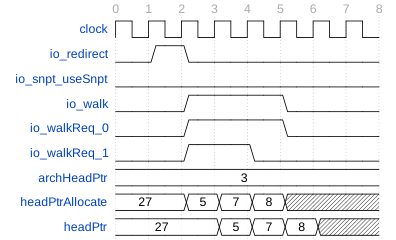
此图 illustrates the timing of instruction
re-renaming. When io_redirect is asserted high for one cycle at time 1,
io_walk will be held high for several cycles, indicating the module has
entered the re-renaming phase. At time 1, since io_snpt_useSnpt is low,
headPtr is restored to the value of archHeadPtr. This restoration is not
immediate; instead, at time 2, the count of high io_walkReq_* signals (2) is
added to obtain headPtrAllocate (5), which is written to headPtr at time 3.
Subsequently, while io_walk is high, headPtrAllocate is set to headPtr +
PopCount(io_walkReq_*) and written to headPtr in the next cycle.
The rename recovery process aims to eliminate rename states on mispredicted execution paths. This is achieved by first restoring headPtr to the architectural state archHeadPtr (or to the snapshot state when io_snpt_useSnpt is high), then renaming back to the state before entering the incorrect path.
Key circuit: Circular queue
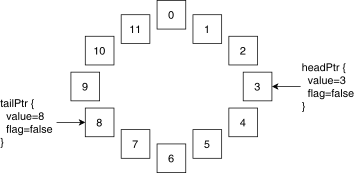
Free physical registers are maintained by a circular queue. This queue consists of the register group freeList (i.e., freeList_ in the code, with a size of size), a head pointer headPtr (i.e., headPtr_ in the code), and a tail pointer tailPtr (i.e., tailPtr_* in the code). Here, headPtr is the dequeue pointer, and tailPtr is the enqueue pointer.
For clarity, consider a standard queue where both headPtr and tailPtr are pointers to elements in the freeList. During normal operation, tailPtr is always greater than or equal to headPtr, and the queue elements are {headPtr, headPtr + 1, ..., tailPtr - 1}. When an element is enqueued, it is placed in freeList[tailPtr], and tailPtr is incremented by one. When an element is dequeued, freeList[headPtr] is retrieved, and headPtr is incremented by one. If tailPtr equals headPtr, the queue is empty; if tailPtr is greater than headPtr, the queue is non-empty.

However, since freeList cannot be infinitely long, we designed a circular queue - essentially connecting a finite regular queue end-to-end. Here, tailPtr and headPtr can no longer simply point to freeList elements: under original design, when tailPtr equals headPtr, the circular queue could be either empty or full.
To address this issue, we added a flag field to tailPtr and headPtr. This field is initially false and toggles each time the pointer wraps around from freeList[size - 1] to freeList[0]. Thus, when the value is the same, if the flags are identical, it indicates the circular queue is empty; if the flags differ, it indicates the queue is full.
Timing for updating canAllocate: In the current cycle, freeRegCnt is calculated based on headPtr, tailPtr, freeReq, and allocateReq. This value is then registered in the next cycle as freeRegCntReg (which represents the actual size). If freeRegCntReg exceeds the decode width, canAllocate is set high and propagated in the same cycle.
MEFreeList
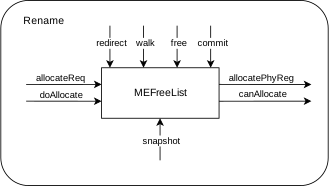
MEFreeList is instantiated as intFreeList in the Rename module. As mentioned in , , and , intFreeList handles allocation requests for integer physical registers during rename, returns allocated free integer physical registers, reallocates integer physical registers based on re-rename requests from RAB during re-rename, and releases unused integer physical registers during commit. Unlike StdFreeList, MEFreeList supports move instruction elimination. If an instruction is a move instruction, Rename does not assert io_allocateReq_*_valid, so MEFreeList does not allocate a free physical register for it.
Overall Block Diagram
Interface timing
Timing diagram of free register allocation
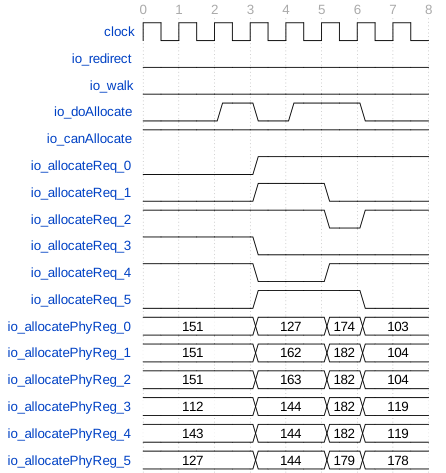
此图 illustrates the timing of free physical register allocation. At times 3, 5, and 6, io_redirect and io_walk are low, while io_doAllocate and io_canAllocate are high, enabling free physical register allocation. At time 3, io_allocateReq_[2-4] is high, and MEFreeList returns allocated free physical register numbers 151, 112, and 143 via io_allocatePhyReg_[2-4]. At time 5, io_allocatePhyReg_[0-2|5] returns allocated free physical register numbers 127, 162, 163, and 144. At time 6, it returns 174, 182, and 179.
Instruction Commit Timing Diagram
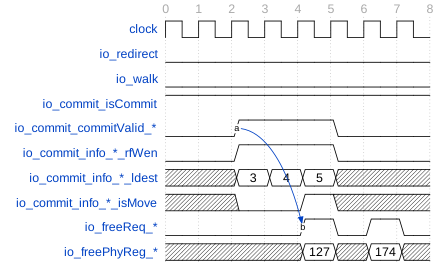
此图 illustrates the timing of instruction commits. Here,
io_freeReq_* represents the io_freeReq signal for a specific lane, and
io_freePhyReg_* represents the io_freePhyReg signal corresponding to
io_freeReq_* for that lane. When both io_redirect and io_walk are low, if
io_freeReq is high, StdFreeList will add the corresponding io_freePhyReg
to the free queue.
Additionally, two cycles before io_freeReq_, the Rename module passes commit
information from the RAB to update the architectural dequeue pointer
archHeadPtr. When io_commit_isCommit and the corresponding channel's
io_commit_commitValid_ are high, the update signal for that channel is valid.
If the channel's io_commit_info_rfWen is high, io_commit_infoldest is
non-zero, and io_commit_info*_isMove is low, it indicates that the channel will
increment archHeadPtr by one. If k channels meet these conditions, archHeadPtr
will be incremented by k.
When io_commit_commitValid_* is high in a cycle, the io_freeReq_* signal may not always be high two cycles later. This phenomenon is caused by move elimination. The io_freeReq_* signal here comes from the RenameTable's output signal io_need_free. As mentioned in the RenameTable module, RenameTable's io_need_free signal may not be asserted when the arch_table contains the same physical register. This occurs because move elimination causes different logical registers to share the same physical register, resulting in identical physical registers across different entries in RenameTable.
Timing Diagram of Instruction Rename Recovery
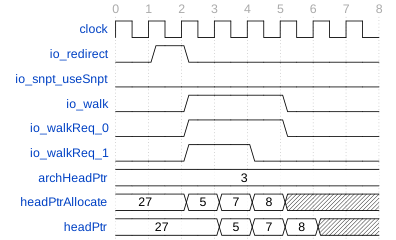
此图 illustrates the timing of instruction re-rename. When io_redirect is asserted high for one cycle at time 1, io_walk is subsequently asserted high for several cycles, indicating the module has entered the re-rename phase. At time 1, since io_snpt_useSnpt is low, headPtr is restored to the value of archHeadPtr. This restoration does not occur immediately but is calculated at time 2 by adding the count of high io_walkReq_ signals (2) to obtain headPtrAllocate (5), which is then written to headPtr at time 3. Thereafter, when io_walk is high, headPtrAllocate is set to headPtr + PopCount(io_walkReq_) and written to headPtr in the next cycle.
The re-rename process aims to eliminate rename states on incorrectly speculated execution paths. This is achieved by first restoring the headPtr to the architectural archHeadPtr state (or to the snapshot state when io_snpt_useSnpt is high), then re-renaming to the state before entering the incorrect path.
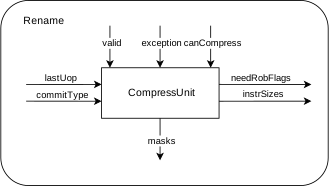
CompressUnit
The CompressUnit determines which instructions can share the same ROB entry, i.e., be compressed into a single ROB entry. This module receives outputs from the decode unit and generates ROB compression information based on the decode results.
A channel is marked as compressible by the ROB (canCompress_[0-5]) if and only
if the decoded information for that channel meets the following conditions: the
channel's decoded information is valid (io_in_[0-5]_valid), the channel does
not involve instruction fusion (!io_in_[0-5]_bits_commitType[2]), the channel
does not involve instruction splitting or is the last micro-op of a split
instruction (io_in_[0-5]_bits_lastUop), the channel has no exceptions
(io_in_[0-5]_bits_exceptionVec_* are all low), and the channel is marked as
compressible by the ROB (io_in_[0-5]_bits_canRobCompress).
The CompressUnit outputs a flag for each channel indicating whether a ROB
entry needs to be allocated (io_out_needRobFlags_[0-5]). The
io_out_needRobFlags_[0-5] signal for a channel is set high if and only if
canCompress_[0-5] for that channel is 0, or if the channel is the one with the
highest index in its contiguous group of canCompress_[0-5] set to 1.
The CompressUnit outputs the number of instructions in the ROB entry for each
channel via io_out_instrSizes_[0-5]. When canCompress_[0-5] for a channel is
0, io_out_instrSizes_[0-5] for that channel is 1. When canCompress_[0-5] for
a channel is 1, io_out_instrSizes_[0-5] for that channel is the count of
elements in the contiguous group of canCompress_[0-5] where it belongs.
CompressUnit outputs a channel mask io_out_masks_[0-5] for each channel, indicating which channels share the same ROB entry. This signal is 6 bits wide, matching the number of channels. When canCompress_n is 0 for a channel, io_out_masks_n[n] is 1, and all other bits are 0. When canCompress_n is 1, the bits set to 1 in io_out_masks_n correspond to the indices of channels in the "continuous group of canCompress_[0-5] set to 1" that includes the current channel.
For example, if {canCompress_5, canCompress_4, canCompress_3, canCompress_2, canCompress_1, canCompress_0} == {1, 0, 0, 1, 1, 0}, then {io_out_needRobFlags_5, io_out_needRobFlags_4, io_out_needRobFlags_3, io_out_needRobFlags_2, io_out_needRobFlags_1, io_out_needRobFlags_0} == {1, 1, 1, 1, 0, 1}, {io_out_instrSizes_5, io_out_instrSizes_4, io_out_instrSizes_3, io_out_instrSizes_2, io_out_instrSizes_1, io_out_instrSizes_0} == {1, 1, 1, 2, 2, 1}, {io_out_masks_5, io_out_masks_4, io_out_masks_3, io_out_masks_2, io_out_masks_1, io_out_masks_0} == {{1, 0, 0, 0, 0, 0}, {0, 1, 0, 0, 0, 0}, {0, 0, 1, 0, 0, 0}, {0, 0, 0, 1, 1, 0}, {0, 0, 0, 1, 1, 0}, {0, 0, 0, 0, 0, 1}}.
Overall Block Diagram
Interface timing
This module is purely combinational logic with signals processed within the same cycle.
SnapshotGenerator
As mentioned in , rename snapshots are distributed across modules requiring error path elimination after redirection to accelerate re-renaming. For rename-related modules, this submodule exists in RenameTable, RenameTable_1, RenameTable_2, StdFreeList, and MEFreeList.
The snapshot data stored in different submodules varies. For RenameTable(_*), each stores four spec_tables; for StdFreeList and MEFreeList, each stores four headPtrs.
The module internally maintains a pair of circular pointers, snptEnqPtr and
snptDeqPtr. When io_redirect is low, if the snapshot storage is not full and
io_enq is high, the module records the data from io_enqData_* into
snapshots_[snptEnqPtr_value], sets snptValids[snptEnqPtr_value] to 1, and
increments snptEnqPtr.
Conversely, when io_redirect is low, if io_deq is high, it indicates that the snapshot module needs to dequeue a snapshot. At this point, snptValids_[snptDeqPtr_value] will be set low, and snptDrqPtr will be incremented by one.
During redirection, the snapshot module flushes internal snapshots based on io_flushVec_ signals. First, if io_flushVec_ is high, the corresponding channel's snptValids_ will be deasserted; second, snptEnqPtr rolls back to the first position where snptValids_ becomes low after deassertion.
The data stored in snapshots is transmitted externally via the io_snapshots_[0-3]_* interface for recovery during redirection. Whether and which snapshot to use during redirection is determined by CtrlBlock, which generates the unified control signals. This module only provides the snapshot data.