IssueQueue
- Version: V2R2
- Status: OK
- Date: 2025/01/20
- commit:xxx
Design specifications
- Supports four different types of issue queue modules to accommodate scalar integer, vector floating-point, scalar memory, and vector memory operations
- Supports two enqueue ports and two dequeue ports
- Supports speculative wake-up signal generation
- Support speculative wake-up signal register replication
- Supports early detection of instruction write-back conflicts
- Supports issuing the oldest instruction among ready instructions
Function
The issue queue module serves as the starting point of the processor's out-of-order scheduling, connecting the previous Dispatch pipeline stage and the subsequent DataPath pipeline stage. In a superscalar out-of-order processor, to achieve correct out-of-order execution of instructions, it is necessary to correctly handle the dependencies between instructions. The key to determining whether an instruction can execute correctly is the readiness of its source operands. A source operand becomes ready only after the preceding instruction it depends on has completed execution. The IQ receives up to two instructions dispatched from the Dispatch stage, whose source operands may not yet be ready. These instructions are temporarily stored inside the IQ, which continuously monitors wake-up signals that will mark the corresponding source operands as ready. Each cycle, the IQ internally selects up to two instructions with all operands ready, following the oldest-first policy, and sends them to the subsequent DataPath pipeline stage. Through this method, the issue queue ensures that all inter-instruction dependencies are guaranteed during out-of-order execution while maximizing the performance of out-of-order scheduling.
Instruction enqueue
The enqueue logic for the four different types of issue queues is largely the same, with only minor differences due to variations in certain signals. The issue queue internally instantiates the Entries module responsible for instruction storage. Generally, the issue queue supports two enqueue ports, meaning it can receive up to two valid instructions from the previous pipeline stage each cycle. Correspondingly, the Entries module also supports two enqueue ports. The instruction enqueue process involves the instructions entering through the IQ's input ports, selecting key signals, and sending them to the Entries' input ports. During this process, signals inherent to the instructions, such as robIdx and fuType, are directly connected without additional processing. Signals indicating instruction status, such as srcState, are initialized through combinational logic before entering the Entries. For detailed signal information, refer to the Entries interface documentation. This issue queue supports simultaneous instruction enqueue and wake-up. Due to timing considerations, the wake-up logic is not implemented directly before the instructions enter the Entries but instead involves sending the input wake-up signals to the Entries, synchronously delaying them by one cycle before wake-up.
Maintenance of instruction age relationships
To implement the oldest-first policy for instruction issue selection, the issue queue needs to record and process the age of instructions within the entries every cycle. The issue queue internally instantiates several AgeDetector modules to achieve this functionality. Corresponding to the three different types of entries, the issue queue needs to instantiate up to three AgeDetectors. Each age matrix can simultaneously receive multiple age queries from dequeue ports and return the oldest entry among the queries. Each cycle, the AgeDetector receives the enqueue status of the three types of entries from the Entries feedback, responsible for maintaining the age relationships of all instructions. Intuitively, when an instruction is enqueued, its age is necessarily the youngest among all instructions. The issue queue maintains instruction age relationships through signal transmission from Entries to AgeDetector and applies the oldest-first policy during the instruction issue selection phase by reading the AgeDetector.
Instruction issue selection
The issue queue divides entries into at most three types and supports the transfer of instruction storage locations between entries. The three types of entries have strict age relationships, so instruction issue selection is performed in parallel for each type of entry, followed by a final 3-to-1 selection of the oldest instruction for issue. Due to timing considerations, to meet the requirement of two dequeue ports, the design prioritizes the needs of the first dequeue port. The functional implementation is as follows: based on the three Detectors corresponding to EnqEntry, SimpleEntry, and ComplexEntry, the three oldest issuable instructions are selected, and then, according to the strict age relationships among the three types of entries, one instruction is ultimately selected following the priority order Complex > Simple > Enq and sent to the first dequeue port. For the second dequeue port, the selection depends on the configuration of the functional units (fu) at the ports: if the fus of the two ports are different, the instructions they can dequeue will not overlap, and the second port selects the oldest instruction using the same method as the first port. If the fus of the two ports are the same, overlap is possible, so after masking the selection result of the first port, a "random" valid instruction is selected. In the current IQ configuration, the fus of the two ports are different (or there is only one port), so there is no "random" selection scenario, and the specific "random" process is not elaborated further.
Speculative wake-up signal generation
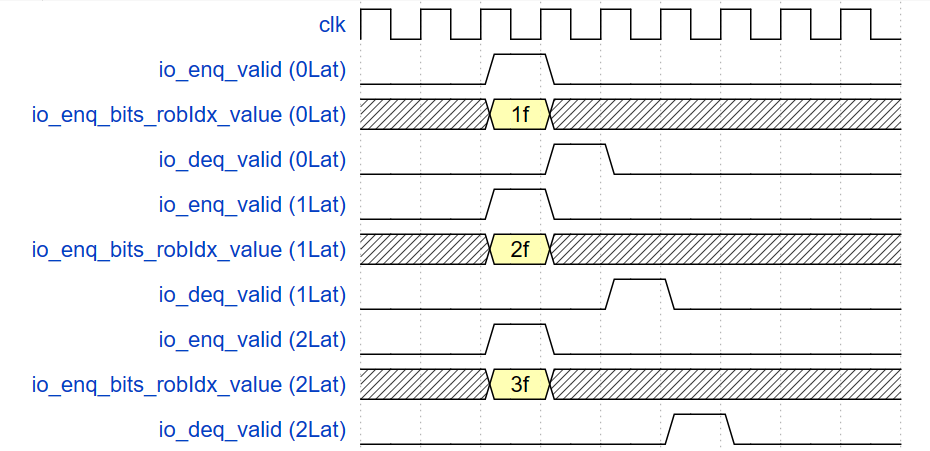
The issue queue is responsible for managing instructions, not only including the management of when instructions are issued but also informing other instructions when they can be issued, the latter of which is achieved through speculative wake-up. Generally, if an instruction's source operand depends on the write-back value of a previous instruction, the current instruction's source operand can only be marked as ready when the previous instruction writes back. To improve the performance of out-of-order instruction execution, if the previous instruction has a fixed execution latency, its write-back time can be determined when it is issued from the issue queue. Accordingly, the issue queue can generate a speculative wake-up signal at a certain time, as long as it is ensured that the speculatively woken instruction does not fetch its source operand earlier than the time the previous instruction obtains its result. This can accelerate out-of-order execution through forwarding or bypassing. In the issue queue, for non-memory IQ, the module responsible for generating speculative wake-up signals is the WakeupQueue. In the same cycle an instruction is selected for issue, it also enters the WakeupQueue, moving through different shift pipelines based on its execution latency—0 latency generates a speculative wake-up after one cycle, 2 latency after three cycles, and so on. This method enables the generation of speculative wake-up signals. For memory IQ, its wake-up signal is passed from the memory unit through the loadWakeUp interface unique to the memory IQ, delayed by one cycle, treated as the IQ's own wake-up signal, and then broadcast to other IQs through the same interface as the WakeupQueue.
Early detection of write-back conflicts
Write-back conflicts are divided into two parts. The first part involves the write-back conflict at the IQ exit itself. Each dequeue port of the issue queue corresponds to an EXU, and each EXU may contain a group of FUs with varying execution latencies. However, each EXU has only one write-back port (referring to the write-back port to the ROB, distinct from the register file write port, where one or more EXU write-back ports share a single register file write port). For example, a combination of ALU and Mul FUs can lead to write-back conflicts between 0-latency and 2-latency instructions. If a 0-latency instruction is issued two cycles after a 2-latency instruction, they will complete execution simultaneously, resulting in an FU write-back conflict. To prevent such scenarios, the issue queue internally instantiates the fuBusyTable module to detect FU conflicts. The fuBusyTable operates on a per-dequeue-port basis, recording each port's dequeued instructions and their respective feedback signals each cycle to update its records. Subsequent instruction selection and issuance also reference this module's records to avoid FU write-back conflicts. The second part involves register file write-back conflicts. Due to the limited number of register file write ports, multiple EXU write-back ports may share a single register file write port, leading to potential write port conflicts between issue queues. Similarly, the issue queue instantiates intWbBusyTable and vfWbBusyTable. Whenever an instruction is issued, the corresponding write logic is generated and sent to the external WbFuBusyTable module, where write ports with the same identifier are processed to obtain the final WbFuBusyTable. During instruction selection, the WbFuBusyTable is read from the external module based on the write port and fed into the IQ as a reference for selection.
Overall Block Diagram

Interface timing
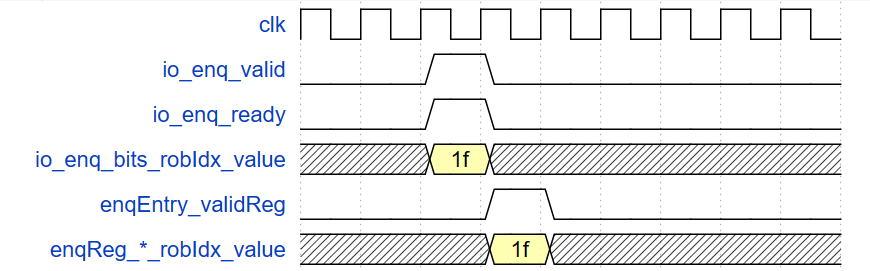
Secondary module WakeupQueue
A critical module controlling the issuance of speculative wake-up signals by each IQ, serving as the wake-up source for speculative wake-up and corresponding to each non-memory access IQ's dequeue port. The module internally consists of multiple pipelines, with the number of pipelines directly related to the Fu Latency of the corresponding dequeue port. The number of pipelines corresponds to the different Latencies of the Fu associated with the dequeue port.
Overall Block Diagram

Interface timing
Secondary module AgeDetector
This module is the age matrix module, maintaining the order of instruction age among entries in the issue queue. The entries in the issue queue can be categorized into at most three types, and for each type, their AgeDetector modules are independent. This module uses matrix registers to indicate the age relationships between entries, with the rows and columns of the matrix corresponding to the number of entries. Below is an example using a 6-entry SimpleEntry:

Overall Block Diagram
