Secondary Module: Repeater
The repeater consists of the following modules:
- PTWFilter itlbRepeater1
- PTWRepeaterNB itlbRepeater2
- PTWRepeaterNB itlbRepeater3
- PTWNewFilter dtlbRepeater
Design specifications
- Supports the transmission of PTW requests and responses between the L1 TLB and L2 TLB.
- Support filtering duplicate requests
- Supports TLB Hint Mechanism
Function
Transmits PTW requests from the L1 TLB to the L2 TLB.
There is a significant physical distance between the L1 TLB and L2 TLB, resulting in considerable wire delay. Therefore, repeater modules are inserted in between to add pipeline stages. Since both the ITLB and DTLB support multiple outstanding requests, the repeaters also function similarly to MSHRs, filtering duplicate requests. The filter can eliminate redundant requests, preventing duplicates in the L1 TLB. The number of entries in the filter partially determines the parallelism of the L2 TLB (see Section 5.1.1.2).
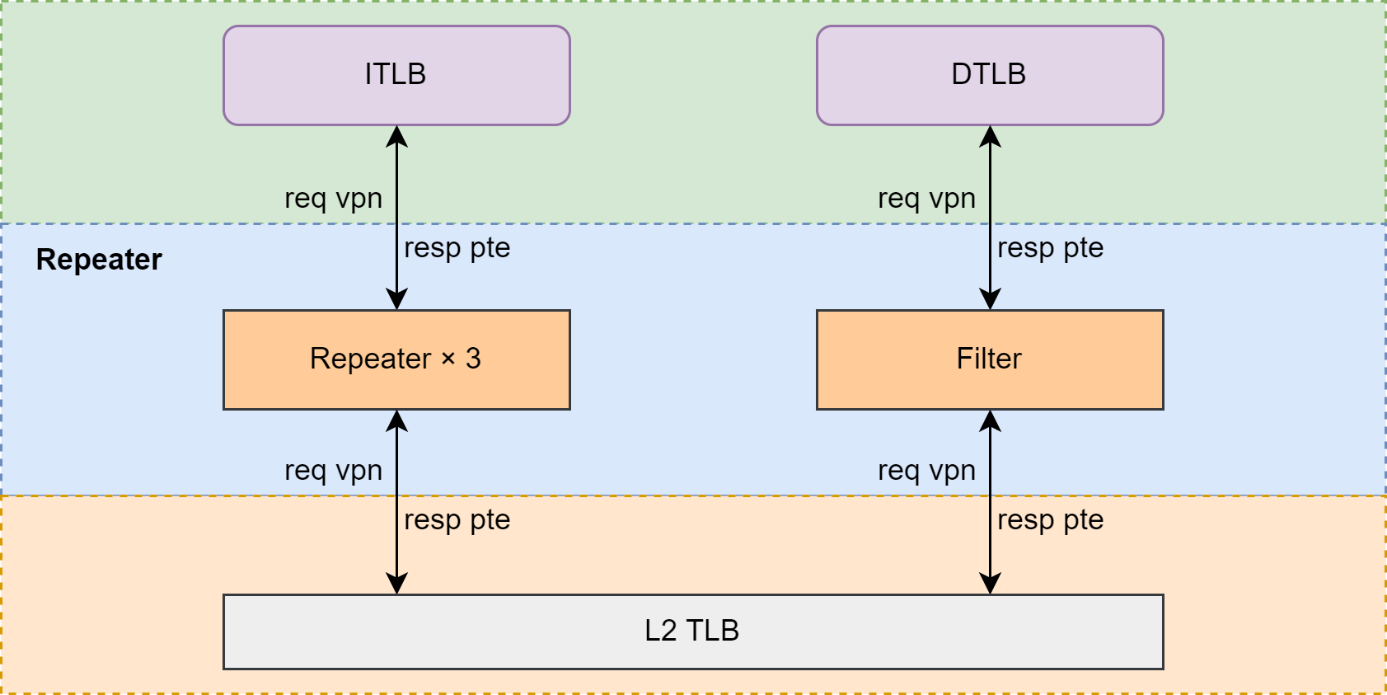
In the Kunminghu architecture, L2 TLB resides in the memblock module, but it is at a certain distance from both ITLB and DTLB. Xiangshan's MMU contains three itlbRepeaters and one dtlbRepeater, which act as buffers between L1 TLB and L2 TLB. The two levels of Repeaters interact via valid-ready signals. ITLB sends PTW requests and virtual page numbers to itlbRepeater1, which after arbitration forwards them to itlbRepeater2, then to itlbRepeater3, and through itlbRepeater3 delivers the PTW request to L2 TLB. L2 TLB takes the virtual page number corresponding to the PTW request, looks up the physical page number obtained from L2 TLB, the page table permission bits, page table level, whether an exception occurred, and other signals, and returns them to itlbRepeater3 and itlbRepeater2, eventually returning to ITLB via itlbRepeater1. The interaction between DTLB and dtlbRepeater is similar to that of ITLB. dtlbRepeater and itlbRepeater1 are Filter modules that can merge duplicate requests in L1 TLB. Since both ITLB and DTLB in the Kunminghu architecture are non-blocking accesses, these repeaters are also non-blocking Repeaters.
Filter duplicate requests
Both ITLB and DTLB include multiple channels, and duplicate requests may occur between different channels or within the same channel. If only a standard Arbiter is used, processing one request at a time, other requests accessing the L1 TLB would be resent, resulting in continued misses and being forwarded to the L2 TLB. This would reduce L2 TLB utilization and consume processor resources during resending. Therefore, the Filter module is employed. The Filter is essentially a multi-input, single-output queue that serves to filter duplicate requests.
Note that in the Kunminghu architecture, the DTLB repeater is composed of load entries, store entries, and prefetch entries. Requests from the load DTLB, store DTLB, and prefetch DTLB are directed to their respective entry types for processing. The three entry types use a round-robin arbiter to arbitrate and forward the results to the L2 TLB. Additionally, the ITLB repeater checks all incoming ITLB requests to filter duplicates, while the DTLB repeater checks for duplicates at the entry level—only ensuring no duplicates within the same DTLB (load, store, or prefetch). However, requests from different DTLBs (e.g., load and store) sent to the L2 TLB may still overlap.
Supports TLB Hint Mechanism
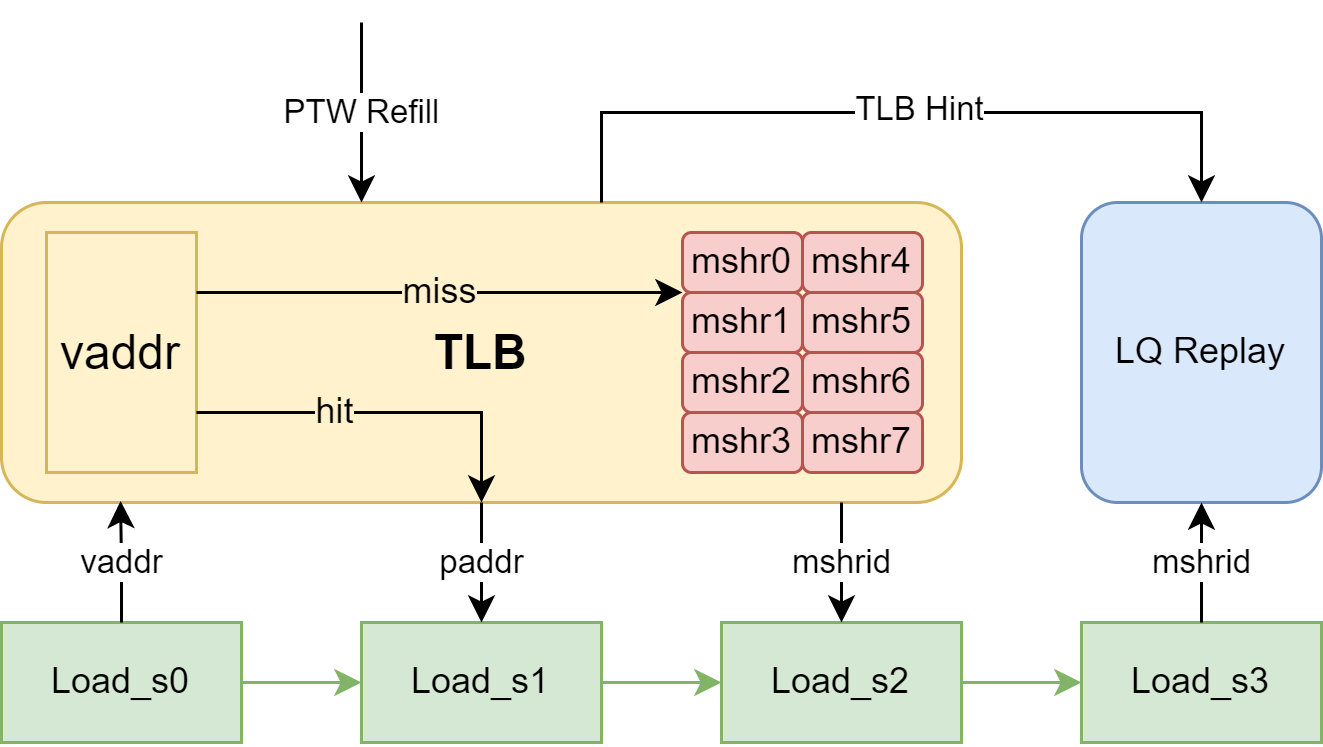
When the TLB hits, it does not affect the lifecycle of a load instruction (cycle 0: loadunit queries the TLB; cycle 1: TLB returns the result). On a TLB miss, the system continues querying the L2 TLB and the page tables in memory until a result is returned. However, from the perspective of the load instruction's lifecycle, the instruction enters the load replay queue to wait after a TLB miss. Only when the instruction is reissued by the load replay queue and the TLB query succeeds, obtaining the physical address, can subsequent operations proceed based on the physical address.
Thus, the timing of reissuing a load instruction is critical to reducing its execution time. If the load instruction is not reissued promptly, even shortening the TLB refill cycle will not improve overall memory access performance. Therefore, the Kunminghu architecture implements a TLB Hint mechanism to selectively wake up load instructions stalled due to TLB misses. Specifically, in the load_s0 stage, the vaddr is sent to the TLB. If a miss occurs, the miss information is returned in the load_s1 stage. Simultaneously, in the load_s1 stage, the TLB sends the miss information to the DTLB repeater for processing.
The DTLB repeater produces two possible outcomes: returning an MSHRid or a full signal. In the load entry of the DTLB repeater, new requests are first checked for duplication against existing entries. If a duplicate is found, the MSHRid of the existing entry is returned. If no duplicate exists, the repeater checks for available entries, returning an MSHRid if space is available or a full signal otherwise. If two load channels send requests to the DTLB repeater simultaneously with the same virtual address, the MSHRid from loadunit(0) takes precedence.
In the Kunminghu architecture, all instructions entering the load replay queue due to TLB misses can only wait to be woken up and resent. If a load instruction in the load replay queue never receives a wake-up signal, it may lead to a deadlock. To prevent deadlocks, when the DTLB sends a request to dtlbrepeater and dtlbrepeater has no available entries to receive it, a full signal must be returned, indicating that dtlbrepeater is full and cannot accept the PTW request corresponding to this load instruction. Consequently, the load replay queue will not receive a Hint signal, and it must ensure the instruction can be resent without causing a deadlock. Additionally, a full signal is returned to loadunit when a refilled entry has reached dtlb or dtlbrepeater but has not yet been written into the dtlb entry, indicating the need for resending.
During the load_s2 stage, dtlbrepeater returns mshrid information to loadunit, which is written into the load replay queue in the load_s3 stage. If the MSHRid is valid, the load replay queue must wait for the PTW refill information to match the MSHRid stored in dtlbrepeater. At this point, dtlbrepeater sends a wake-up (Hint) signal to the load replay queue, indicating that the MSHRid has been refilled and needs to be resent, allowing it to hit the dtlb. Moreover, when a PTW refill request corresponds to multiple MSHR entries (e.g., two VPNs within the same 2M space, with the PTW refill page table level being 2MB pages), dtlbrepeater sends a replay_all signal to the load replay queue, indicating that all load requests blocked due to dtlb misses must be resent. Since this scenario is rare, it is a convenient solution with almost no performance loss.
Overall Block Diagram
The overall block diagram of the repeater is described in 此图, featuring three ITLB repeaters and one DTLB repeater, which serve to pipeline stages between the L1 TLB and L2 TLB. The two levels of repeaters interact via valid-ready signals. The repeater accepts PTW requests from the ITLB and DTLB upstream, both of which support non-blocking access, so these repeaters are also non-blocking. Downstream, the repeater forwards PTW requests from the L1 TLB to the L2 TLB. The dtlbRepeater and itlbRepeater1 are filter modules that can merge duplicate requests from the L1 TLB.
Except for itlbRepeater1, the remaining two levels of itlbRepeater essentially serve only to add pipeline stages. The number of stages added depends on the physical distance. In the Kunminghu architecture of Xiangshan, the L2 TLB is located in the Memblock, which is physically distant from the Frontend module where the ITLB resides. Therefore, two levels of repeaters are added in the Frontend, and one level of Repeater is added in the Memblock. The DTLB is located in the Memblock, close to the L2 TLB, requiring only one level of Repeater to meet timing requirements.
Interface list
Refer to the interface list documentation.
Interface timing
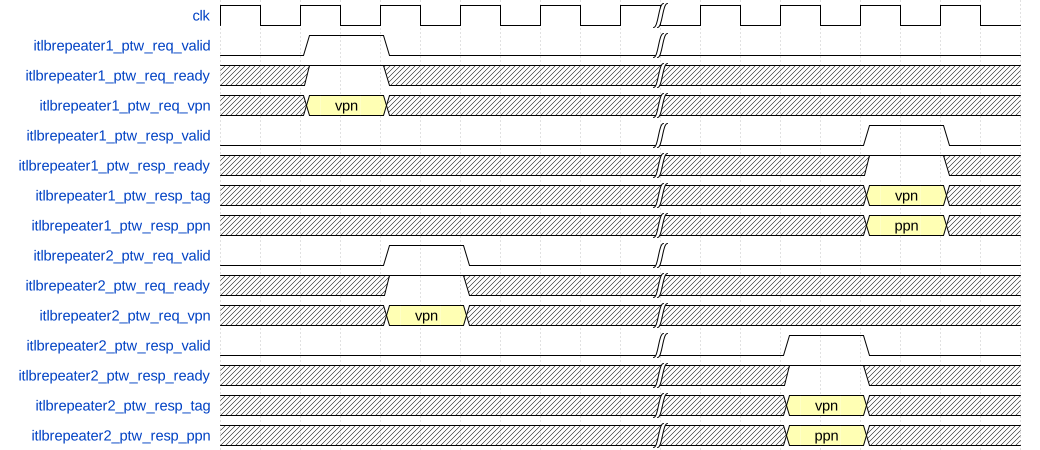
Timing interface between Repeater1 and L1 TLB
Refer to TLB and tlbRepeater timing interface.
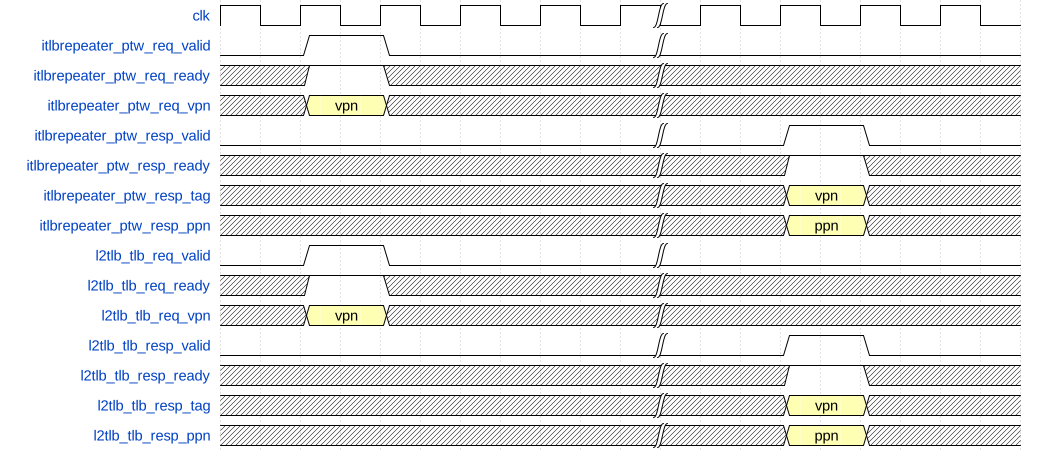
Timing interface between itlbRepeater3, dtlbRepeater1, and L2 TLB
The interface timing between itlbRepeater3, dtlbRepeater1, and the L2 TLB is shown in 此图. Handshaking is performed via valid-ready signals. The repeater forwards PTW requests and virtual addresses from the L1 TLB to the L2 TLB. The L2 TLB returns the physical address and corresponding page table to the repeater after completing the lookup.
Timing interface between multi-level itlbrepeaters
The timing interface between multi-level ITLB repeaters is shown in 此图. Handshaking between the two levels of repeaters is performed via valid-ready signals.