IssueQueueEntries
- Version: V2R2
- Status: OK
- Date: 2025/01/20
- commit:xxx
Glossary of Terms
| Abbreviation | Full name | Descrption |
|---|---|---|
| IQ | IssueQueue | Issue Queue |
Design specifications
- Supports three types of issue queue entries: EnqEntry, SimpleEntry, and ComplexEntry.
- Supports dual-port read/write.
- Supports writeback wakeup and speculative wakeup.
- Supports direct dequeue of EnqEntry.
- Supports instruction transfer between entries.
- Supports Wake-up, Cancellation, and Feedback
Function
Overall Functionality
Entries is the module within the issue queue that stores uops. It contains multiple entry modules, each capable of holding one uop. These entries are divided into two main categories: EnqEntry, which corresponds to the enqueue port of the issue queue, and OthersEntry, which are more numerous. \ \ Entries consolidates the issue and status information from all entries and passes it to the issue queue control logic. It also receives selection results from the control logic and outputs the complete information of the uop to be issued. \ \ Entries accepts wake-up signals from the IQ (either its own IQ or fast wake-ups from other IQs) and WriteBack (write-back wake-ups), cancellation signals from the datapath (e.g., og0Cancel, og1Cancel), and feedback signals post-issue, which are aggregated and forwarded to each entry. \ \ Entries also manages the transfer logic between entries. EnqEntry receives uops from the IQ input. If OthersEntry is ready, the uop is transferred to OthersEntry according to certain rules. EnqEntry supports transferring out the previous uop and enqueuing the next uop in the same cycle, enabling seamless transitions. \ \ In advanced issue queue configurations, OthersEntry is further divided into SimpleEntry and ComplexEntry. Entries also controls the transfer strategy from SimpleEntry to ComplexEntry.
Transfer Strategy
ComplexEntry is the final entry type and cannot be transferred. SimpleEntry can transfer to ComplexEntry, while EnqEntry can transfer to either ComplexEntry or SimpleEntry. Only entries that have not been issued can be transferred. If an issued entry fails, its issued flag is cleared, making it transferable again. If an issued entry succeeds, it becomes invalid and no longer needs transfer. EnqEntry-to-OthersEntry transfer logic: EnqEntry prioritizes transfer to ComplexEntry, then to SimpleEntry. Transfers are all-or-nothing—either fully to ComplexEntry, fully to SimpleEntry, or no transfer. EnqEntry transfers to ComplexEntry only if there are enough free ComplexEntries and all SimpleEntries are empty; otherwise, it transfers to SimpleEntry. SimpleEntry-to-ComplexEntry transfer logic: Each cycle, up to num_enq (equivalent to the number of EnqEntries) SimpleEntries can transfer to ComplexEntry, with one transfer per free ComplexEntry slot. SimpleEntry transfers take priority over EnqEntry. Transfer order for SimpleEntries is strictly age-based, with older entries prioritized, determined by querying the age matrix in IQ.

Issue and Dequeue
Entries collect the valid and canIssue signals from each entry and pass them to the IQ. The IQ returns the deqSelOH signal, which selects the entry positions to dequeue, and the deqReady signals indicating whether each exit can accept the dequeue (currently, deqReady is a constant high signal). When both are valid, the entry is considered dequeued, and the deqSel signal is sent to that entry. \ \ After receiving deqSel, the entry is not immediately cleared but is marked as issued, recording the issue port and the cycles elapsed since issue. It must then wait for the subsequent resp signal indicating successful issue before being cleared. \ \ Entries are responsible for aggregating all resp signals and forwarding the corresponding resp to the entry. For non-memory IQ entries, the resp signals are only og0resp and og1resp, selected based on the entry's dequeue port and the cycles elapsed since issue. The entry and robIdx must match the resp's robIdx for the resp to be forwarded. \ \ Memory IQs have more resp signals, varying by IQ type, and require comparing lqidx and sqidx to select the correct resp. \ \ During issue, the selected entry's uop information is also sent to the IQ. Due to timing constraints, deqSelOH is not used directly for selection. Instead, the IQ provides staged selection results, including enqEntryOldest, simpEntryOldest, and compEntryOldest. These signals are used to select the corresponding dequeued uops, which are then prioritized (comp > simp > enq) to determine the final dequeued uop.
Wakeup and Cancellation
Entries do not handle wakeup logic; they only pass wakeup and cancellation signals to all entries. Due to timing constraints, Entries also manage same-cycle cancellation logic. Cancellation sources have long latency, and if wakeup and cancellation were processed normally before IQ dequeues, timing would suffer. Thus, IQ dequeues based on same-cycle wakeup results, while Entries separately compute same-cycle cancellations before finally determining which uops to cancel among the dequeued candidates.
Overall Block Diagram

Interface timing
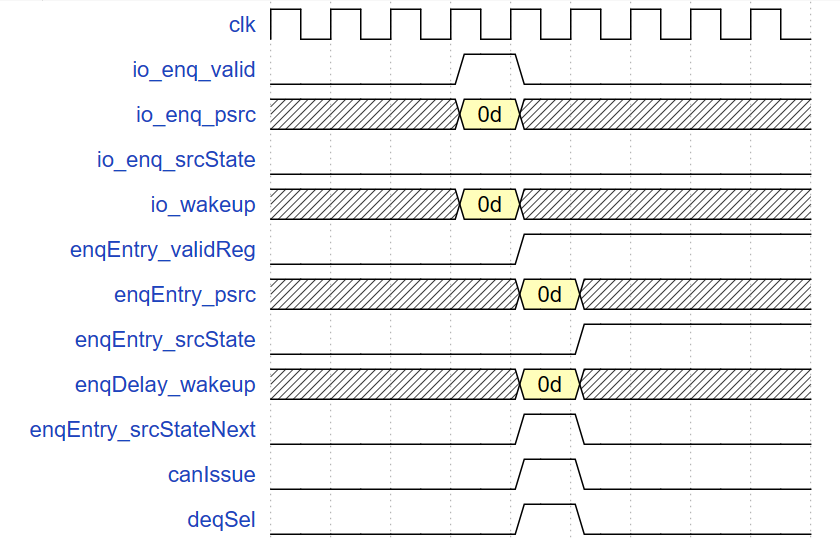
The io_* signal group is for IQ instruction enqueue, with a maximum of two instructions per cycle, accompanied by potential wakeup signals. Due to timing considerations, handling cases where enqueued instructions are simultaneously woken is addressed by delaying wakeup by one cycle (see enqDelay_wakeup in the diagram). To align timing, this portion of wakeup follows a bypass timing similar to speculative wakeup, affecting srcStateNext—thus impacting canIssueBypass—akin to ComplexEntry's same-cycle wakeup and issue.
Secondary Modules: EnqEntry & OthersEntry
Function
The functionalities of EnqEntry and OthersEntry are essentially the same. EnqEntry, being directly connected to the enqueue port, includes an additional layer of enqueue wake-up handling, while the rest of the features are identical. Hence, they are described together. The most critical functions of an Entry include: valid, canIssue, issued, and status. \ \ Valid indicates whether the entry is active. When a uop enters the entry, the uop information from the enqueue is written into the registers, and valid is set to active. The entry is cleared and valid is set to inactive under any of the following conditions: flush, tranSel being active, or issueResp indicating a successful issue. \ \ Issued records whether the uop has been issued. It is marked as issued when deqSel is active; it is marked as unissued if issueResp fails or if an operand is canceled and is no longer ready. \ \ When all source operands are ready and the state is unissued, canIssue is output as active. \ \ Status is a series of information describing the state of the source operands, including operand type (srcType), state (srcState), data sources (dataSources), load information for waking the operand (srcLoadDependency), EXU information for waking the operand (srcWakeUpL1ExuOH), and the post-wake-up cycle counter (srcTimer). \ \ wakeUpFromWB and wakeUpFromIQ transmit the pdest and register types (xp, fp, vp) to be woken. If the pdest number matches the register number of the entry's operand and the register types also match, the operand is woken and marked as ready. \ \ og0Cancel and og1Cancel transmit the EXU numbers to be canceled. For ogCancel, if the EXU to be canceled matches the EXU that woke the operand and the srcTimer corresponds to the issued pipeline delay, the operand is canceled. For ldCancel, if the load pipeline stage to be canceled matches srcLoadDependency, the operand is canceled. \ \ When wake-up and cancellation for the same operand arrive simultaneously, cancellation takes higher priority. \ \ The source operand status information output by the Entry comes in two forms: immediate and delayed, corresponding to fast and slow wake-ups. Immediate means the source operand status information is obtained from the registers and output immediately in the same cycle after the wake-up and cancellation updates. Delayed means the source operand status information is written back to the registers after wake-up and cancellation updates and is output from the registers in the next cycle. \ \ WB wake-ups are always slow, while IQ wake-ups can be configured as fast or slow. Entries configured for fast wake-ups are called ComplexEntry, while those configured for slow wake-ups are called SimpleEntry. EnqEntry could theoretically be configured, but in practice, it is always fast. \ \ The difference between EnqEntry and OthersEntry lies in the additional enqueue wake-up. Due to timing constraints, wake-up and cancellation during enqueue cannot be performed before writing to EnqEntry, so they are delayed to the beginning of the next cycle after writing to EnqEntry. First, the delayed wake-up and cancellation signals (enqDelay) are used to update the register-direct output state, followed by normal wake-up and cancellation. Note that enqueue wake-up only occurs in the first cycle after the uop enters EnqEntry; thereafter, the register-direct output state is used directly.
Summary: 1. An Entry is a structure within IssueQueue that stores critical uop information, analogous to RS. 2. The standard design specification for Kunming Lake's integer IssueQueue includes 24 Entry items. 3. Entries are logically categorized into three types: EnqEntry, SimpleEntry, and ComplexEntry. 4. 2 EnqEntries serve as enqueue ports. Each cycle, the two instructions entering the IQ can only be stored here. 5. 6 SimpleEntries + 16 ComplexEntries.
Overall Block Diagram


imm stores immediate values, while payload holds the original instruction information, which the entry does not process.

srcStatus indicates the status of each source operand for uops. issued marks the issue state of a uop, as issuance may succeed or fail. Only successful issuance can modify validReg, so issued is used to track whether the uop is mid-issuance.

The issueTimer and deqPortIdx exist to accommodate the entry transfer mechanism. After an instruction is issued, it passes through OG0 and OG1 stages. Only uops that successfully pass OG1 and enter the EXU are considered issued. If a failure occurs midway, the IQ must be notified to reissue. Without the transfer mechanism, uops can be located via entryIdx. With the transfer mechanism, a uop may move to another location immediately after being issued, making it difficult for OG0/1 resp signals to locate it. Hence, issueTimer and deqPortIdx signals are added. Once a uop is issued, issueTimer is modified and increments each cycle, while deqPortIdx records the dequeue port it was issued from. Based on the timing relationship shown in the diagram, OG0 and OG1 resp signals only need to recognize these two signal values within each Entry to locate the uop.

Wake-up --> Modify srcState srcWakeupL1ExuOH --> Mark speculative wake-up signals indicating which EXU they originated from.

Writeback wakeup is issued in the final cycle of uop execution; entries woken by writeback cannot be woken and issued in the same cycle.

dataSource is used for speculative wakeup scenarios. Writeback wakeup directly sets to reg. Speculative wakeup in the same cycle → forward. Each additional cycle of stay modifies it once, finally maintaining reg → forward → bypass → reg → reg.

srcLoadDependency 3-bit, used to record the Load dependency relationships of each uop. When ldCancel occurs, all uops on the wake-up chain are flushed.