Store address execution unit StoreUnit
Functional Description
The store instruction address pipeline is divided into five stages: S0/S1/S2/S3/S4, as shown in \ref{fig:LSU-StoreUnit-Pipeline}. It receives requests from the store address issue queue, processes them, and then responds to the backend and vector units. During processing, it provides feedback to the issue queue and StoreQueue, and finally performs writeback. If an exception occurs midway, the instruction is reissued from the issue queue.

Feature 1: The StoreUnit supports scalar store instructions.
-
stage 0:
-
Calculate VA address
-
Address misalignment check updates to uop.cf.exceptionVec(storeAddrMisaligned)
-
Issue a DTLB read request to the TLB
-
Update the instruction's mask information to s0_mask_out and send it to StoreQueue
-
Determine if it is a store instruction with a data width of 128 bits.
-
-
Stage 1:
-
Update DTLB query results to storeQueue
-
Send a store-load violation check request to the LoadQueue
-
If DTLB hits, send the store issue information to the backend
-
-
stage 2:
-
MMIO/PMP checks and updates the storeQueue
-
Update DTLB results to the backend via feedback_slow
-
-
stage 3
- To synchronize with RAW violation checks when sending to the backend, an additional cycle is required
-
stage 4
- Scalar store initiates Writeback and sends it to the backend via stout
Feature 3: StoreUnit supports vector Store instructions
The StoreUnit handles misaligned store instructions similarly to scalar operations, with the following specifics:
-
stage 0:
- Accept vsSplit execution request, which has higher priority than scalar requests and does not require virtual address calculation
-
Stage 1:
- Calculate vecVaddrOffset and vecTriggerMask
-
stage 2:
- No need to send a feedback_slow response to the backend
-
stage 4:
- Vector store initiates writeback and sends it to the backend via vecstout.
Feature 2: StoreUnit supports non-aligned Store instructions
The StoreUnit handles misaligned store instructions similarly to scalar operations, with the following specifics:
-
stage 0:
- Accepts requests from StoreMisalignBuffer with higher priority than vector and scalar requests, and does not require virtual address calculation
-
stage 2:
-
No need to send feedback response to the backend,
-
If the request is not from StoreMisalignBuffer and is a non-aligned request that does not cross a 16-byte boundary, it must be processed by StoreMisalignBuffer
-
Send an enqueue request to StoreMisalignBuffer via the io_misalign_buf interface
-
Does not enter stage 3
-
-
If the request is from StoreMisalignBuffer and does not cross a 16-byte boundary, a retry or writeback response must be sent to StoreMisalignBuffer
-
Send a response to StoreMisalignBuffer via the io_misalign_sout interface
-
If a TLB miss occurs, retry is required; otherwise, write back
-
Does not enter stage 3
-
-
\newpage
Overall Block Diagram

\newpage
Interface timing
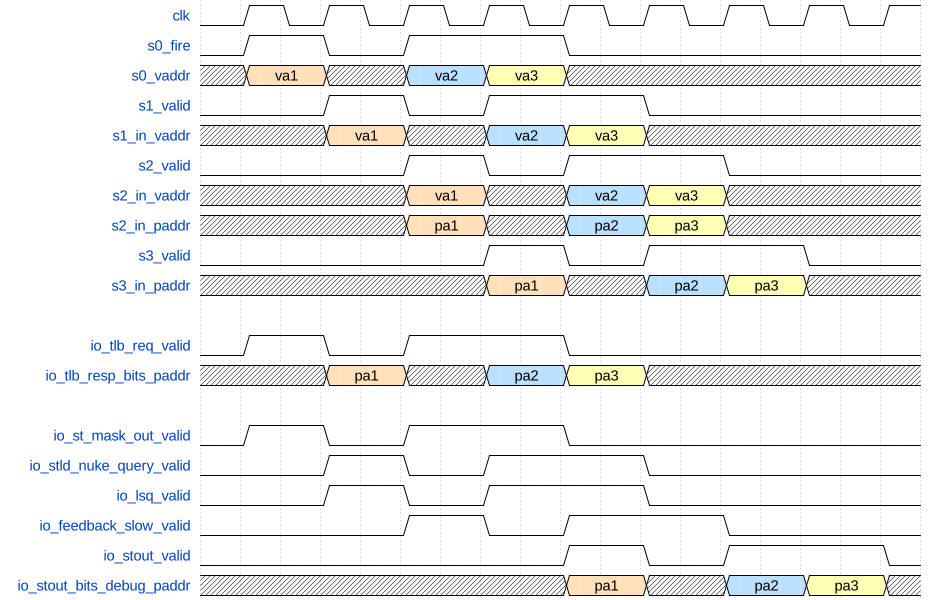
Interface timing example
As shown in Figure \ref{fig:LSU-StoreUnit-Timing}, after the store instruction enters the StoreUnit, it requests the TLB in stage 0 and obtains the paddr returned by the TLB in stage 1. In stage 0, the mask is written to the StoreQueue, and in stage 1, a request is sent to RAW, while other information of the store instruction is updated to the LoadStoreQueue via io_lsq. In stage 2, feedback-related information is obtained, and in stage 4, writeback is performed via stout.