Uncache Handling Unit Uncache
| Update time | Code Version | Updated by | Notes |
|---|---|---|---|
| 2025.02.26 | eca6983 | Maxpicca-Li | Initial version completed |
Functional Description
The Uncache serves as a bridge between the LSQ and the bus, primarily handling uncache access requests and responses to the bus. Currently, the Uncache does not support vector accesses, unaligned accesses, or atomic accesses.
The functional overview of Uncache is as follows:
- Receives uncache requests from LSQ, including uncache load requests from LoadQueueUncache and uncache store requests from StoreQueue.
- Selecting a pending uncache request to send to the bus and waiting for the bus response
- Return the processed uncache request to LSQ
- Forwarding the registered uncache store request data to the load being executed in LoadUnit
In the Uncache Buffer structure, there are currently 4 entries (configurable)
for Entries and States, along with a global state uState. Below are the
specific details for each entry.
The structure of an Uncache Entry is as follows:
cmd: Identifies whether the request is a load or store. In the current version, 0 indicates load and 1 indicates store.addr: Physical address of the request.vaddr: The virtual address of the request. Mainly used to determine virtual-physical address matches during forwarding.data: Stores the data to be written or the data to be read for load operations. Currently, only data accesses within 64 bits are supported.mask: The access mask for the request, with each byte represented by one bit to indicate whether data is present, totaling 8 bits.nc: Indicates whether the request is an NC (Non-Cacheable) access.atomic: Indicates whether the request is an atomic access.memBackTypeMM: Indicates whether the requested address is of PMA type main memory but PBMT type NC. Primarily used for L2 Cache NC-related logic.resp_nderr: The bus indicates whether the request can be processed as Uncache.
The State structure of the Uncache is as follows:
valid: Indicates whether the entry is valid.inflight: 1 indicates the request has been sent to the bus.waitSame: 1 indicates that there are other requests in the current buffer that overlap with the data block accessed by this request and have already been sent to the bus.waitReturn: 1 indicates the request has received a bus response and is waiting to write back to LSQ.
Uncache's uState, representing the various states of a request entry when
ignoring outstanding:
s_idleDefault states_inflight: Indicates that a request has been sent to the bus but no response has been received yet.s_wait_returnhas received a response but has not yet returned it to the LSQ
State transitions are as follows:

Feature 1: Enqueue Logic
(1) Each cycle processes at most one request from the LSQ, then checks if the request can enter the Buffer. If it can, it further checks whether to merge it with an existing entry or allocate a new one. The enqueue behavior for this request includes:
-
Allocate a new entry, mark it as valid
-
No entry with the same block address
-
Allocate a new entry, mark it as valid and waitSame
-
Entries with the same block address: Meet the primary merging condition but not the secondary merging condition.
-
Merge into existing entry
-
Entry with the same block address: Meets the primary merging condition and the secondary merging condition.
-
Reject
-
ubuffer full
- Entries with the same block address: Primary merging condition not met
Here, block address (blockAddr) refers to the starting address of every 8 bytes. The primary merging condition means both the incoming and existing entries are NC accesses, share identical attributes, the merged mask is contiguous and naturally aligned, and the entry has not initiated or completed a bus access in the current cycle. The secondary merging condition requires the existing entry to be valid, not yet sent for bus access, and not selected for bus access in the current cycle (since once a bus request is initiated or completed, it cannot be altered, necessitating a new entry allocation to wait for the existing request to complete before sending the new one).
Additionally, allocating a new entry will set all contents of the entry; merging into an existing entry will update mask, data, addr, etc. The addr update must ensure natural alignment.
Due to potential non-sequential bus access, especially during outstanding operations, multiple uncache access requests may be processed simultaneously on the bus. Thus, requests with the same address cannot coexist on the bus to ensure sequential access to the data block. Therefore, a new entry can only merge with an older one if it meets both primary and secondary merging conditions.
(2) In the next cycle, return the allocated Uncache Buffer entry ID. This ID is held by LoadQueueUncache or StoreQueue to map the uncache response. Since the Uncache Buffer supports merging, its returned response may correspond to multiple entries in LoadQueueUncache.
Feature 2: Dequeue Logic
From entries that have completed bus access in the current cycle (i.e., those
with valid and waitReturn set in the high bits of their state), select one
to return to LSQ and clear all state flags.
Feature 3: Bus interaction and outstanding logic
Bus interaction and outstanding logic are divided into two parts:
(1) Initiate request
Without outstanding, requests can only be sent to the bus when ustate is
s_idle. Select one request from the entries that is currently eligible for bus
transmission, i.e., only the valid status bit is set to 1, and send it to the
bus. With outstanding, requests can be selected and sent to the bus regardless
of ustate, where source indicates the request entry's ID.
When a request is sent to the bus, it is necessary to traverse the request
entries and set the waitSame flag for other entries with the same block
address.
(2) Upon receiving a response
When a bus response is received, the corresponding buffer entry is determined
based on the source bits, and the data is updated with the waitReturn flag
set.
Additionally, it is necessary to traverse the request entries and clear any
waitSame with the same block address.
Feature 4: Forwarding logic
Theoretically, the forwarding logic primarily targets NC accesses. When
outstanding is enabled, once an uncache NC store successfully writes from the
StoreQueue into the Uncache Buffer, the StoreQueue dequeues that entry and no
longer maintains it. Hence, the Uncache Buffer assumes responsibility for
forwarding the store data. Due to the merging logic in the Uncache Buffer's
enqueue process, the same address can appear in at most 2 entries
simultaneously. If there are 2 entries, one must be inflight and the other
waitSame. Because the StoreQueue dequeues in order, the former contains older
data while the latter has newer data.
In actual processing, when an uncache NC load initiates a forwarding request to
the Uncache Buffer, the Uncache compares the block addresses of existing
entries. A matching entry may be found, which could either be one already sent
to the bus or one yet to be sent. The former contains older data, while the
latter has newer data with higher priority. In the first cycle f0, virtual
block address matching is primarily performed to return forwardMaskFast within
the same cycle. In the second cycle f1, physical block address matching and
data merging are performed, and the result is returned.
Feature 5: Flush logic
Flushing refers to completing all bus accesses for entries in the Uncache Buffer
and returning them to the LSQ before accepting new entries. The Uncache Buffer
is flushed when a fence, atomic, or cmo operation occurs, or when a forwarding
request results in a virtual-physical address mismatch. At this time,
do_uarch_drain is set, and no new entries are accepted. Once all entries have
completed their tasks, do_uarch_drain is cleared, and the buffer resumes
normal operation to accept new entries.
Overall Block Diagram

Interface timing
LSQ Interface Timing Example
The figure below shows a detailed interface example with four uncache accesses.
Before the 5th cycle, m1, m2, and m3 are received sequentially, and idResp is
returned in the cycle following their request initiation. By the 6th cycle, the
Uncache is full, and m4 is stalled. By the 9+n cycle, all accesses for s1 are
completed and written back, freeing one entry. Thus, in the 10+n cycle,
io_lsq_req_ready is asserted, and m4 is accepted. Subsequent cycles gradually
write back other uncache access requests. 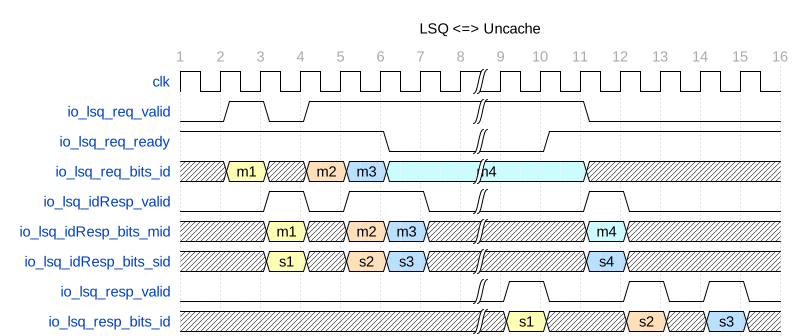
Bus interface timing example
(1) When there are no outstanding requests, only one uncache request can be
issued per segment (controlled by uState for outflow regulation). Another
uncache request can only be initiated after receiving a response on the d
channel. 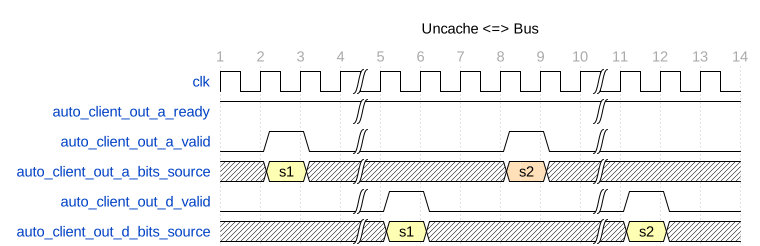
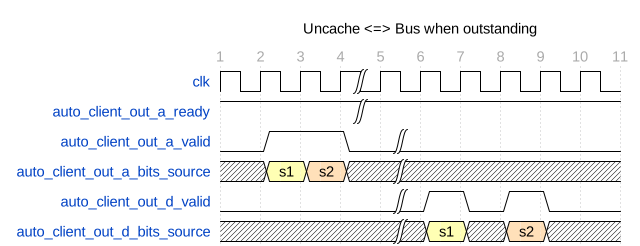
(2) When there are outstanding requests, multiple uncache accesses can be issued
per segment (controlled by auto_client_out_a_ready for outflow rate). As shown
in the figure below, two requests are issued consecutively in cycles 2 and 3,
and the access results are received in cycles 6+n and 8+n.