Level-3 Module: Page Cache
Page Cache refers to the following module: * PtwCache cache
Design specifications
- Supports separate caching of three-level page tables.
- Supports receiving PTW requests from L1 TLB
- Supports receiving PTW requests from the Miss Queue.
- Support returning hit results to the L1 TLB and sending PTW replies
- Supports returning miss results to L2 TLB and forwarding PTW requests
- Support for Page Cache refill
- Supports ECC verification
- Supports SFENCE flush
- Supports exception handling mechanism
- Support for TLB compression
- Supports classifying all levels of page tables into three types
- Supports accepting second-stage translation requests (HPTW requests)
- Supports HFENCE flush
Function
Separately cache the level-3 page tables
The Page Cache is an "enlarged" version of the L1 TLB and effectively serves as the L2 TLB. It separately caches three-level page tables, enabling single-cycle queries of three-level information (the H extension further divides each level into VS-stage page tables, G-stage page tables, and host page tables, which will be discussed in later chapters). The Page Cache determines hits based on the requested address, obtaining results closest to the leaf nodes. Since the memory access width is 512 bits (i.e., 8 page table entries), each Page Cache entry contains 8 page tables (1 virtual page number corresponding to 8 physical page numbers and 8 permission bits).
In the Page Cache, entries are cached according to the page table level, divided into five categories: l3, l2, l1, l0, and sp. The l3, l2, l1, and l0 entries store only valid page table entries, respectively storing Sv48 root page table (512GB), Sv39 root page table (1GB), intermediate page table (2MB), and leaf page table (4KB). l3 and l2 each contain 16 entries in a fully associative structure; l1 contains 8 entries in a 2-way set-associative structure; l0 contains 256 entries in a 4-way set-associative structure. sp is a 16-entry fully associative structure that stores large pages (leaf node page tables of 2MB, 1GB, 512GB) as well as invalid (V bit is 0 in the page table, or W bit is 1 and R bit is 0 in the page table, or the page table is misaligned) first-level and second-level page tables. When storing, l1, l2, and l3 entries do not need to store permission bits; l0 and sp entries need to store permission bits.
The configuration items of Page Cache are as shown in 此表.
| entry | item count | ** organizational structure ** | Implementation method | Replacement Algorithm | stored content |
|---|---|---|---|---|---|
| l0 | 256 (64 sets × 4 ways) | 4-way set-associative | SRAM | PLRU | 4KB page table, needs to store permission bits |
| l1 | 8 (4 sets × 2 ways) | 2-way set-associative | SRAM | PLRU | 2MB page table, does not need to store permission bits |
| l2 | 16 | Fully associative | Register heap | PLRU | 1GB page table, does not need to store permission bits |
| l3 | 16 | Fully associative | Register heap | PLRU | 512GB page table, does not need to store permission bits |
| sp | 16 | Fully associative | Register heap | PLRU | Large pages (leaf node page tables of 2MB, 1GB, 512GB) and invalid page table entries, need to store permission bits and level |
The information that a Page Cache entry needs to store includes: tag, asid, ppn, perm (optional), level (optional), prefetch. The H extension adds vmid and h (used to distinguish three types of page tables). Among them, the stored information for each entry is related to the address translation mode (Sv39 or Sv48), as follows: The l3 entry exists only in Sv48 mode, adopts a fully associative structure, the tag width is vpnnlen (9) + H extension bits (2) = 11 bits. The l2 entry adopts a fully associative structure; in Sv39 mode, the tag width is vpnnlen (9) + H extension bits (2) = 11 bits; in Sv48 mode, the tag width is 2 * vpnnlen (18) + H extension bits (2) = 20 bits. The l1 entry adopts a 2-way set-associative structure (4 sets × 2 ways); in Sv39 mode, the tag width is 2 * vpnnlen(18) - log2(4) - log2(8) + H extension bits (2) = 18 - 2 - 3 + 2 = 15 bits; in Sv48 mode, the tag width is 3 * vpnnlen(27) - log2(4) - log2(8) + H extension bits (2) = 27 - 2 - 3 + 2 = 24 bits. The l0 entry adopts a 4-way set-associative structure (64 sets × 4 ways); in Sv39 mode, the tag width is 3 * vpnnlen(27) - log2(64) - log2(8) + H extension bits (2) = 27 - 6 - 3 + 2 = 20 bits; in Sv48 mode, the tag width is 4 * vpnnlen(36) - log2(64) - log2(8) + H extension bits (2) = 36 - 6 - 3 + 2 = 29 bits. The sp entry adopts a fully associative structure; in Sv39 mode, the tag width is 3 * vpnnlen(27) + H extension bits (2) = 29 bits; in Sv48 mode, the tag width is 4 * vpnnlen(36) + H extension bits (2) = 38 bits. For l3 and sp entries, since they store leaf nodes, they need to store the perm entry, while l1 and l2 entries do not. The perm entry stores the D, A, G, U, X, W, R bits defined in the RISC-V manual, and does not need to store the V bit. For the sp entry, it needs to store the level, indicating the level of the page table (first or second). prefetch indicates that the page table entry was obtained by a prefetch request; vmid is only used in VS-stage page tables and G-stage page tables; asid is not used in G-stage page tables; h is a two-bit register that distinguishes these three types of page tables, with encoding consistent with s2xlate. The information that a Page Cache entry needs to store is shown in 此表, and the attribute bits of the page table are shown in 此表:
| entry | tag (Sv39 / Sv48) | asid | vmid | ppn | perm | level | prefetch | h |
|---|---|---|---|---|---|---|---|---|
| l0 | 20 bits / 29 bits | Yes | Yes | Yes | YES | NO | Yes | Yes |
| l1 | 15 bits / 24 bits | Yes | Yes | Yes | NO | NO | Yes | Yes |
| l2 | 11-bit / 20-bit | Yes | Yes | Yes | NO | NO | Yes | Yes |
| l3 | 0-bit / 11-bit | Yes | Yes | Yes | NO | NO | Yes | Yes |
| sp | 29-bit / 38-bit | Yes | Yes | Yes | Yes | Yes | Yes | Yes |
| ** bit ** | field | ** describing ** |
|---|---|---|
| 7 | D | Dirty, indicates that since the last time the D bit was cleared, the virtual page has been read. |
| 6 | A | Accessed, indicating that since the last A bit clear, this virtual page has been read, written, or fetched. |
| 5 | G | Indicates whether the page is a global mapping. When this bit is 1, it means the page is a global mapping, i.e., a mapping that exists in all address spaces. |
| 4 | U | Indicates whether the page can be accessed by User Mode. A value of 0 means it cannot be accessed by User Mode; a value of 1 means it can be accessed. |
| 3 | X | Indicates whether the page is executable; a value of 0 means not executable, and a value of 1 means the page is executable. |
| 2 | W | Indicates whether the page is writable; a value of 0 means not writable, and a value of 1 means the page is writable. |
| 1 | R | Indicates whether the page is readable; a value of 0 means not readable, and a value of 1 means the page is readable. |
| 0 | V | Indicates whether the page table entry is valid. If this bit is 0, the entry is invalid, and other bits of the entry can be freely used by software |
| h | ** describing ** |
|---|---|
| 00 | noS2xlate, host page table |
| 01 | onlyStage1, VS-stage page tables |
| 10 | onlyStage2, G-stage page table |
The manual permits updating the A/D bits via either software or hardware. Xiangshan opts for the software approach, where a page fault is triggered under the following two conditions, and the page table is updated by software.
- accessing a page where the A bit of its page table is 0
- Writing to a page where the D bit of its page table entry is 0.
Possible combinations and meanings of the X, W, and R bits in a page table entry are shown in 此表:
| X | W | R | ** describing ** |
|---|---|---|---|
| 0 | 0 | 0 | Indicates that the page table entry is not a leaf node and requires indexing the next-level page table through this entry. |
| 0 | 0 | 1 | Indicates the page is read-only |
| 0 | 1 | 0 | Reserved |
| 0 | 1 | 1 | Indicates that the page is readable and writable. |
| 1 | 0 | 0 | Indicates that the page is execute-only |
| 1 | 0 | 1 | Indicates that the page is readable and executable |
| 1 | 1 | 0 | Reserved |
| 1 | 1 | 1 | Indicates the page is readable, writable, and executable |
Receives PTW requests and returns results
The Page Cache receives PTW requests from the L2 TLB, which are arbitrated by an arbiter before being sent to the Page Cache. These PTW requests may originate from the Miss Queue, L1 TLB, hptw_req_arb, or Prefetcher. Since the Page Cache can only process one request per query, for allStage requests, it first queries the first stage. For allStage requests, when querying each h, only the onlyStage1 page tables are queried. The second-stage translation is handled by PTW or LLPTW after the request is forwarded to them. The Page Cache query process is as follows:
- Cycle 0: Issue read requests for five entries l0, l1, l2, l3, sp simultaneously
- Cycle 1: Obtain results read from the register stack (l2, l3, sp entries) and SRAM (for l0, l1 entries), but not directly used in the current cycle due to timing reasons; wait for the next cycle for subsequent operations.
- Cycle 2: Compare the tag stored in each entry of the Page Cache with the tag of the incoming request; compare the h register of each entry with the incoming s2xlate (allStage converted to query onlyStage1); simultaneously check if there is a match among the l0, l1, l2, l3, sp entries; additionally, an ECC check is required.
- Cycle 3: Summarize the results obtained from matching the five entries l0, l1, l2, l3, sp, as well as the results of the ECC check.
After the aforementioned Page Cache lookup process, if a leaf node is found in the Page Cache, it is returned to the L1 TLB (for allStage requests, if the first stage hits, it is sent to PTW for processing); otherwise, the request is forwarded to LLPTW, PTW, HPTW, or the Miss Queue based on different scenarios.
Send a PTW request to the L2 TLB
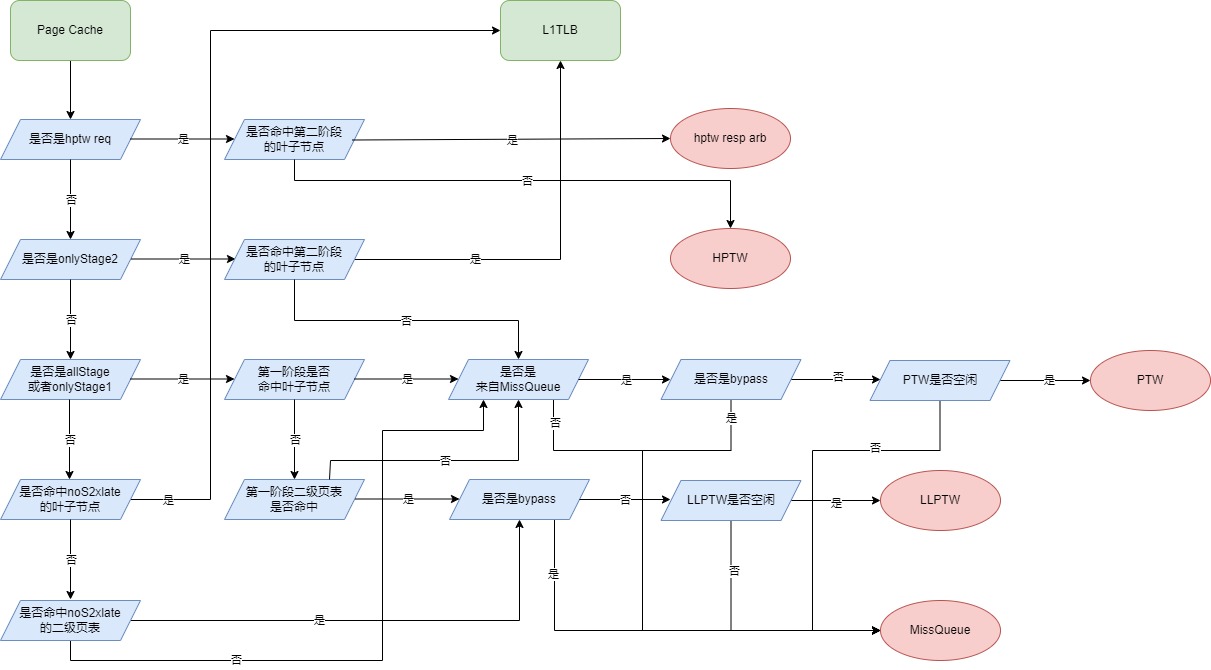
The Page Cache forwards requests to LLPTW, PTW, HPTW, or the Miss Queue depending on the situation.
- For noS2xlate, onlyStage1, and allStage, if the Page Cache misses the leaf node but hits the second-level page table (for onlyStage1 and allStage, it's a first-stage second-level page table hit), and this PTW request is not a bypass request, the Page Cache forwards the request to llptw.
- For noS2xlate, onlyStage1, and allStage, if the Page Cache misses the leaf node and the second-level page table also misses (for onlyStage1 and allStage, this refers to the first-stage second-level page table miss), the request must be forwarded to the Miss Queue or PTW. If the request is not a bypass request, originates directly from the Miss Queue, and the PTW is idle, the PTW request is forwarded to the PTW. For allStage requests, if the first-stage translation hits a leaf node, it is also sent to the PTW for the final second-stage translation. For onlyStage2 requests, missing the second-stage leaf node also triggers sending to the PTW for further translation.
- If the request is a second-stage translation request (hptwReq) from PTW or LLPTW, a hit will send it to hptw_resp_arb, while a miss will forward it to HPTW for processing. If HPTW is busy at this time, the Page Cache will be blocked.
- If the Page Cache misses the leaf node and the request is neither from a
prefetch request nor an hptwReq request, it must meet one of the following
three conditions to enter the miss queue.
- This request is a bypass request
- This request misses in the L2 page table or hits in the first-stage translation, and the request originates from the L1 TLB or PTW cannot accept Page Cache requests.
- The request hits the second-level page table, but the LLPTW cannot accept the request
It is important to note that points 1, 2, 3, and 4 are parallel processes. For every request forwarded by the Page Cache, it will always satisfy exactly one of the conditions in 1, 2, 3, or 4. However, these four conditions are evaluated independently, with no sequential relationship between them. To clarify the request forwarding scenario, a serialized flowchart is provided for illustration, but in reality, the hardware description is inherently parallel, with no sequential dependencies. The serialized flowchart is shown in 此图.
Refill Cache
When a PTW request sent by PTW or LLPTW to mem receives a reply, a refill request is simultaneously sent to the Page Cache. The information passed to the Page Cache includes: the page table entry, the level of the page table, the virtual page number, the page table type, etc. After this information is passed into the Cache, it will be filled into the l0, l1, l2, l3, or sp entry according to the level of the refilled page table and the attribute bits of the page table. If the page table is valid, it is filled into the five entries l0, l1, l2, l3, sp according to the different levels of the page table; if the page table is invalid and the page table is not a leaf node page table, it is filled into the sp entry. For the replaced Page Cache entry, the replacement policy can be selected via the ReplacementPolicy. Currently, XiangShan's Page Cache uses the PLRU replacement policy.
Supports bypass access
When a Page Cache request misses, but data for the requested address is simultaneously being written into the Cache, the Page Cache request will be bypassed. If this situation occurs, the data being written into the Cache will not be directly handed over to the request accessing the Page Cache. The Page Cache will send a miss signal to the L2 TLB, and simultaneously send a bypass signal to the L2 TLB, indicating that this request is a bypass request and needs to access the Page Cache again to obtain the result. The bypassed PTW request will not enter the PTW but will directly enter the MissQueue, waiting for the next access to the Page Cache to get the result. However, it should be noted that for the second-stage translation request of hptw req (from PTW and LLPTW), a bypass may also occur, but the hptw req does not enter the miss queue. Therefore, to avoid duplicate fills into the Page Cache, the signal sent by the Page Cache to the HPTW includes a bypassed signal. When this signal is valid, the results of the memory access performed by this request after entering the HPTW will not be refilled into the Page Cache.
Supports ECC verification
Page Cache supports ECC verification. When accessing L0 or L1 entries, an ECC check is performed simultaneously. If the ECC check reports an error, it does not raise an exception but instead sends a miss signal for that request to the L2 TLB. At the same time, the Page Cache flushes the entry with the ECC error and re-sends a PTW request. The remaining behavior is the same as when a Page Cache miss occurs. The ECC check uses the SECDED strategy.
Supports SFENCE flush
When the sfence signal is valid, the Page Cache flushes cache entries based on the rs1 and rs2 signals of sfence and the current virtualization mode. The flushing of the Page Cache is performed by setting the v bit of the corresponding cache line to 0. Since L0 and L1 entries are stored in SRAM, ASID comparison cannot be performed in the current cycle. Therefore, for flushing L0 and L1, the ASID is ignored (the handling of VMID and ASID is the same), and instead, a partial match is performed using the hash value; L2, L3, and SP entries are stored in register files, allowing complete ASID/VMID comparison. For information related to the sfence signal, refer to the RISC-V manual. Under virtualization, sfence flushes the page tables of the VS stage (first-stage translation, where VMID needs to be considered); under non-virtualization, sfence flushes the page tables of the G stage (second-stage translation, where VMID is not considered).
Support for exception handling
ECC verification errors may occur in the Page Cache, in which case the Page Cache invalidates the current entry, returns a miss result, and reinitiates the Page Walk. Refer to Section 6 of this document: Exception Handling Mechanism.
Support for TLB compression
To support TLB compression, when the Page Cache hits a 4KB page, it must return 8 consecutive page table entries. In fact, due to the 512-bit memory access width, each Page Cache entry inherently contains 8 page tables, which can be directly returned. Unlike the L1TLB, the L2TLB still uses TLB compression under the H extension.
Supports classifying all levels of page tables into three types
In the H extension, there are three types of page tables, managed by vsatp, hgatp, and satp, respectively. The Page Cache adds an h register to distinguish these page tables: onlyStage1 represents those related to vsatp, onlyStage2 represents those related to hgatp (where asid is invalid), and noS2xlate represents those related to satp (where vmid is invalid).
Supports accepting second-stage translation requests (HPTW requests)
In L2TLB, PTW and LLPTW send second-stage translation requests (indicated by the isHptwReq signal). These requests first query the Page Cache, following the same process as onlyStage2 requests—only querying page tables of the onlyStage2 type. However, depending on whether they hit, these requests are forwarded to either hptw_resp_arb or HPTW. The hptwReq return signal from the Page Cache includes an id signal to determine whether the response should go to PTW or LLPTW. The return signal also contains a bypassed signal, indicating that the request was bypassed. If such a request proceeds to HPTW for translation, none of the page tables obtained by HPTW's memory accesses will be refilled into the Page Cache. HptwReq requests also support l1Hit and l2Hit functionality.
Supports HFENCE flush
The hfence instruction can only be executed in non-virtualization mode. There are two instructions of this type, responsible for flushing the VS stage page tables (first-stage translation, the h field is onlyStage1) and the G stage page tables (second-stage translation, the h field is onlyStage2), respectively. The content to be flushed is determined based on rs1 and rs2 of hfence, as well as the added VMID and h fields. Similarly, because ASID and VMID are stored in SRAM for L0 and L1, flushing L0 and L1 does not consider VMID and ASID. Furthermore, for the implementation of flushing L0 and L1, a simple approach is adopted: directly flush the VS or G stage page tables (in the future, if necessary, the flushing can be further refined to the set where the addr resides).
Overall Block Diagram
The essence of the Page Cache is a cache. The internal implementation of the Page Cache has been detailed above, and the internal block diagram of the Page Cache is of limited reference value. For the connection relationships between the Page Cache and other modules in the L2 TLB, see Section 5.3.3.
Interface list
The signal list of Page Cache can be mainly categorized into the following 3 types:
- req: arb2 sends PTW requests to the Page Cache.
- resp: The response from Page Cache to L2 TLB's PTW, where Page Cache may send requests to PTW, LLPTW, Miss Queue, and HPTW; and send responses to mergeArb and hptw_resp_arb.
- refill: The Page Cache receives refill data returned from memory.
Please refer to the interface list documentation for details.
Interface timing
The Page Cache interacts with other modules in the L2 TLB using a valid-ready handshake mechanism. The signals involved are relatively trivial, and there are no particularly noteworthy timing relationships, so they will not be elaborated further.