WayLookup Submodule Documentation
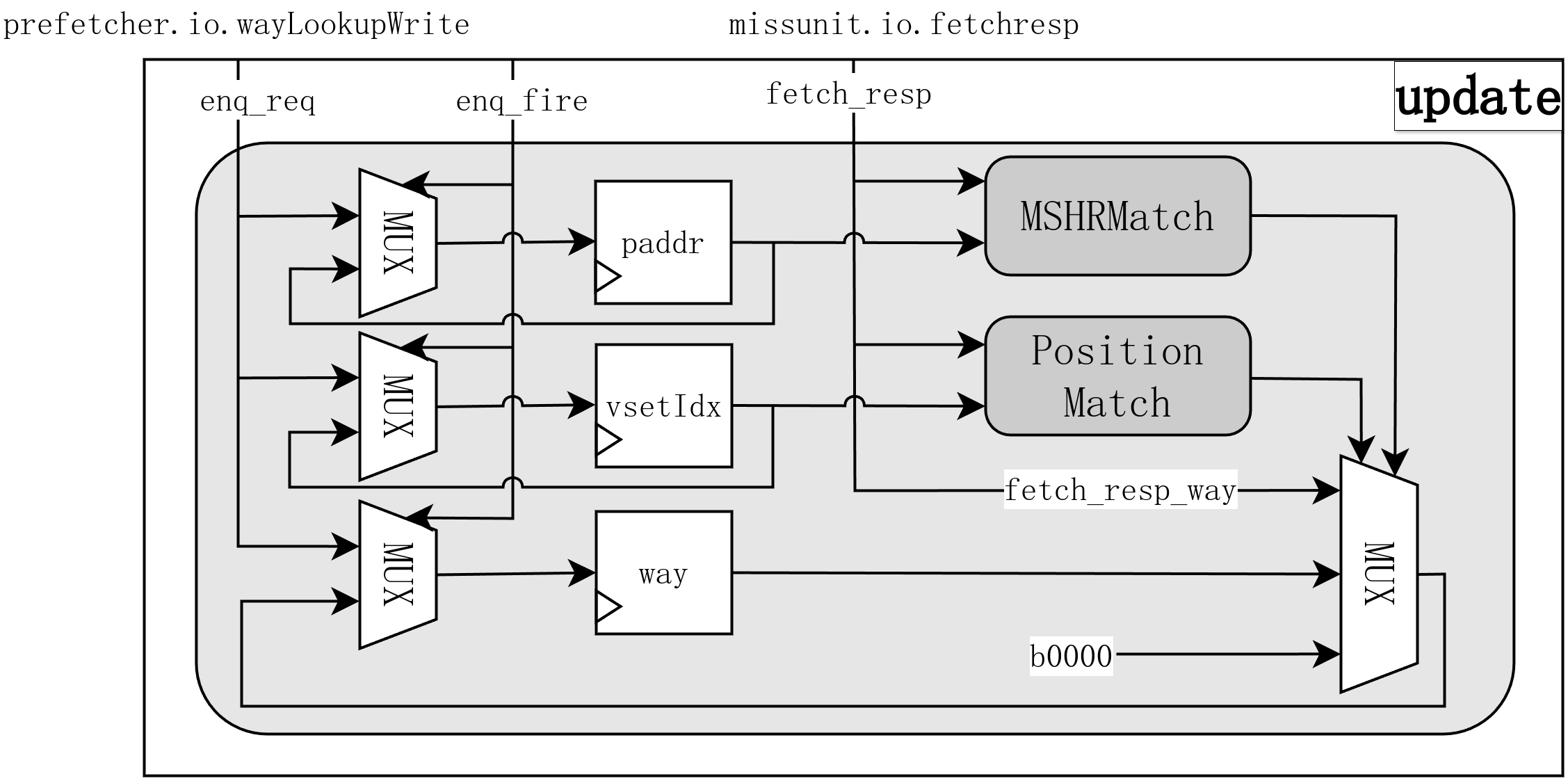
WayLookup is a FIFO structure that temporarily stores metadata obtained by IPrefetchPipe from querying MetaArray and ITLB for MainPipe's use. It also monitors MSHR writes to the SRAM cacheline and updates hit information. The update logic is the same as in IPrefetchPipe—see the section "Hit Information Updates" in the IPrefetchPipe Submodule Documentation.
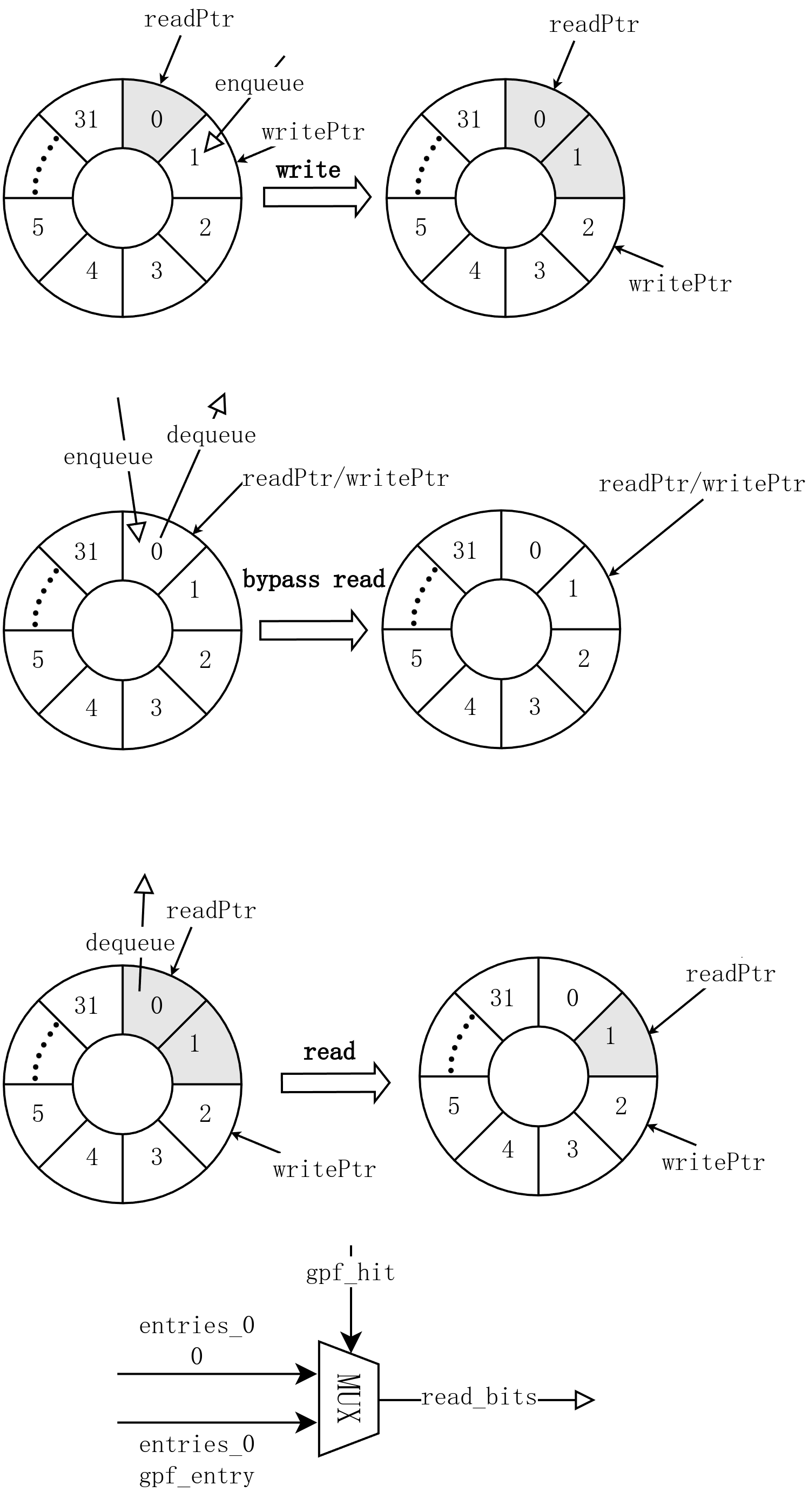
Bypass is allowed (i.e., when WayLookup is empty, directly dequeue the enqueue request). To avoid introducing update logic latency into the DataArray access path, dequeuing is blocked when MSHR has new writes. MainPipe's S0 stage also accesses DataArray, so if MSHR has new writes, it cannot proceed further, meaning this measure has no additional impact.
GPaddr Area-Saving Mechanism
Since gpaddr is only relevant when a guest page fault occurs, and after each
gpf, the frontend operates on the wrong path (with the backend guaranteeing a
redirect (WayLookup flush) to the frontend—whether due to
misprediction/exceptions before the gpf or the gpf itself), WayLookup only needs
to store the gpaddr of the first valid gpf after reset/flush. For dual-line
requests, only the gpaddr of the first line with a gpf needs to be stored.
In implementation, the gpf-related signals (currently only gpaddr) are
separated from other signals (paddr, etc.) into two bundles. Other signals are
instantiated nWayLookupSize times, while gpf-related signals are instantiated as
a single register. A gpfPtr pointer is also used. This saves a total of
\((\text{nWayLookupSize}*2-1)* \text{GPAddrBits} -
\log_2{(\text{nWayLookupSize})} - 1\) bits in registers. When prefetch writes to
WayLookup, if a gpf occurs and no existing gpf is present in WayLookup, the
gpf/gpaddr is written to the gpf_entry register, and gpfPtr is set to the
current writePtr. When MainPipe reads from WayLookup, if bypassing, it
directly dequeues the prefetch-enqueued data; otherwise, if readPtr ===
gpfPtr, it reads gpf_entry; otherwise, it reads all zeros. Note:
- For dual-line requests, only one
gpaddrneeds to be stored (if the first line triggers a gpf, the second line is already on the wrong path and need not be stored). However, the gpf signal itself must still be stored twice, as the IFU needs to determine whether it is a cross-line exception. - The condition
readPtr===gpfPtrmay causereadPtrto loop around and matchgpfPtragain if the flush is slow, erroneously re-reading the gpf. However, as mentioned earlier, this occurs on the wrong path, so re-reading the gpf is inconsequential. - A special case to note: For a fetch block spanning two pages, where the first
32B lies on the previous page without exceptions and the last 2B on the next
page triggers a gpf, if the first 32B happens to be 16 RVC compressed
instructions, the IFU will discard the last 2B and its corresponding
exception information. This may cause the
gpaddrof the next fetch block to be lost. When WayLookup already has an unclaimed gpf and related information, it must block enqueuing (i.e., the IPrefetchPipe s1 stage). See PR#3719.