Main Pipeline MainPipe
Functional Description
Pipeline control manages Store, Probe, Refill, and atomic operations (i.e., all instructions requiring contention for WritebackQueue to initiate requests/writeback data to the lower-level cache).
Feature 1: Functions Completed by Each Stage of the MainPipe Pipeline:
- Stage 0: Arbitrate incoming MainPipe requests, selecting the one with the highest priority; determine whether the resources required by the request are ready based on the request information; issue tag and meta read requests.
- Stage 1: Obtain tag and meta read request results; perform tag matching check to determine hit status; if replacement is needed, obtain PLRU-provided replacement selection; perform permission checks based on read meta; pre-determine if MissQueue access is required.
- Stage 2: Obtain the read data result and combine it with the data to be written; if a miss occurs, attempt to write this request's information into MissQueue; check tag_error and l2_error.
- Stage 3: Update meta, data, and tag based on the operation's results; return a store response to lsu if there's a hit; if the instruction requires accessing/writing back data to the lower-level cache, generate a WritebackQueue access request in this stage and attempt to write to WritebackQueue; check data_error; special support for atomic instructions: AMO instructions stay in this stage for two cycles, first completing the AMO instruction's operation, then writing the result back to dcache and returning a response; LR/SC instructions set/check their reservation set here.
Feature 2: MainPipe Contention and Blocking
MainPipeline contention follows this priority: probe_req > refill_req > store_req > atomic_req. A request is only accepted if all requested resources are ready, there is no set conflict, and no higher-priority request exists. Write requests from the committed store buffer have separate check logic due to timing reasons.
Feature 3: Set Blocking Logic
Ensuring parallel instructions do not simultaneously access different rows in the same set maintains data consistency and correctness, preventing scenarios where s3 (or s1, s2) processes data not yet written while s0 reads incorrect data. Under valid conditions, MainPipe set conflicts compare s0 and s1, s0 and s1, and s0 and s2 address indices. If they match, a set conflict is triggered, blocking s0.
Feature 4: Meta Update
Meta updates occur in s3. Among the four different types of requests in Main Pipe, all require updating the corresponding cacheline's meta data in MainPipe. These requests update via the meta_write port, but their specific behaviors differ.
In stage s3, the Probe request generates the required meta_coh to be written based on the probe_param parameter carried in the request, corresponding to the permission modification intended by this Probe request.
For hit Store and AMO requests, the coh of the corresponding data block is obtained in s1, and the new_coh after this access is generated in s2. In s3, the two are compared to determine whether a meta write is needed. If a write is required, it is updated to the new_coh generated in s2.
For requests that miss on the first attempt and subsequently re-enter MainPipe via MissQueue backfill, in s3, the miss_new_coh required for updating during this backfill access is generated based on the Acquire-related parameters carried in the MissQueue backfill request, followed by meta writing.
Feature 5: AMO Instruction Handling
After contending for priority, AMO requests enter MainPipe. In the first two pipeline stages, their execution flow is largely consistent with other types of instructions. In s1, they obtain tag and meta read request results, perform tag matching checks and meta permission checks to determine whether amo_hit occurs, deciding if the AMO request needs to enter MissQueue. If the current AMO request misses the cache, its request information is written into MissQueue in s2; if it hits, the read data result is obtained in s2, and the request proceeds to s3. Upon entering s3, the AMO instruction stays in this stage for two cycles: the first cycle performs the AMO instruction's operation, and the second cycle writes the result modification back to dcache and returns a response to the atomic instruction processing unit.
For LR/SC instructions, the reservation set is set/checked in the s3 stage, the lrsc_count is updated to maintain execution correctness, preventing interruptions or deadlocks during execution.
Feature 6: MainPipe Writeback
MainPipe's writeback requests are initiated in s3. For instructions requiring access/writeback to the lower-level L2 Cache, writeback requests are sent to the WritebackQueue, which subsequently processes them to complete the actual write to L2 Cache. There are three types of writeback requests in MainPipe.
For refill requests sent back by MissQueue, if the backfilled data requires replacing a data block that is currently valid in dcache (not Nothing), this data block needs to be released to L2 Cache. In s3, an attempt is made to write it into wbq.
For Probe requests, a ProbeAck must be returned to the lower-level cache, requiring a write request to wbq. If the probed data block contains dirty data, it must be written back to the lower-level L2 Cache, replying with ProbeAckData, which also requires sending a writeback request to wbq.
For miss AMO requests requiring writeback, the process is similar to the refill flow. Miss AMO requests re-enter the MainPipe pipeline after refill. If the refilled data block needs to replace a valid one, the latter must be released to the lower-level cache, generating a writeback request to wbq in s3.
Feature 7: MainPipe Backfill Data Exception Handling
Currently, all refill requests are initiated in advance by the MissQueue upon receiving a hint signal to MainPipe. The refill data block is obtained via refill_info forwarding when the request is processed to s2 in MainPipe. This may lead to abnormal intervals between l2_hint and refill data, causing the request to enter s2 without the corresponding MSHR forwarding valid refill data. For such abnormal cases, the following two measures are taken.
To ensure the efficiency of backfilling and reduce the number of replays, the s2 stage allows an additional cycle of tolerance for delayed data arrival. When a backfill request enters the s2 stage, if refill_info is found to be invalid (s2_req_miss_without_data), it can be blocked for an additional cycle to wait for the backfill data to arrive in the next cycle for subsequent processing.
If valid refill data is still not received after blocking for one cycle, s2_replay_to_mq notifies the corresponding MSHR to resend the refill_req. The current request exits MainPipe without further data operations.
In cases of cache aliasing and other special scenarios, a refill request may need to replace a Cacheline that is currently in a valid MSHR, awaiting a response to an L2 Acquire request. To ensure correctness and compliance with the manual, this replacement operation cannot proceed. The refill request is also notified via s2_replay_to_mq to resend the refill_req, and the current request exits MainPipe without further data operations.
Overall Block Diagram
The overall architecture of MainPipe is shown in 此图.

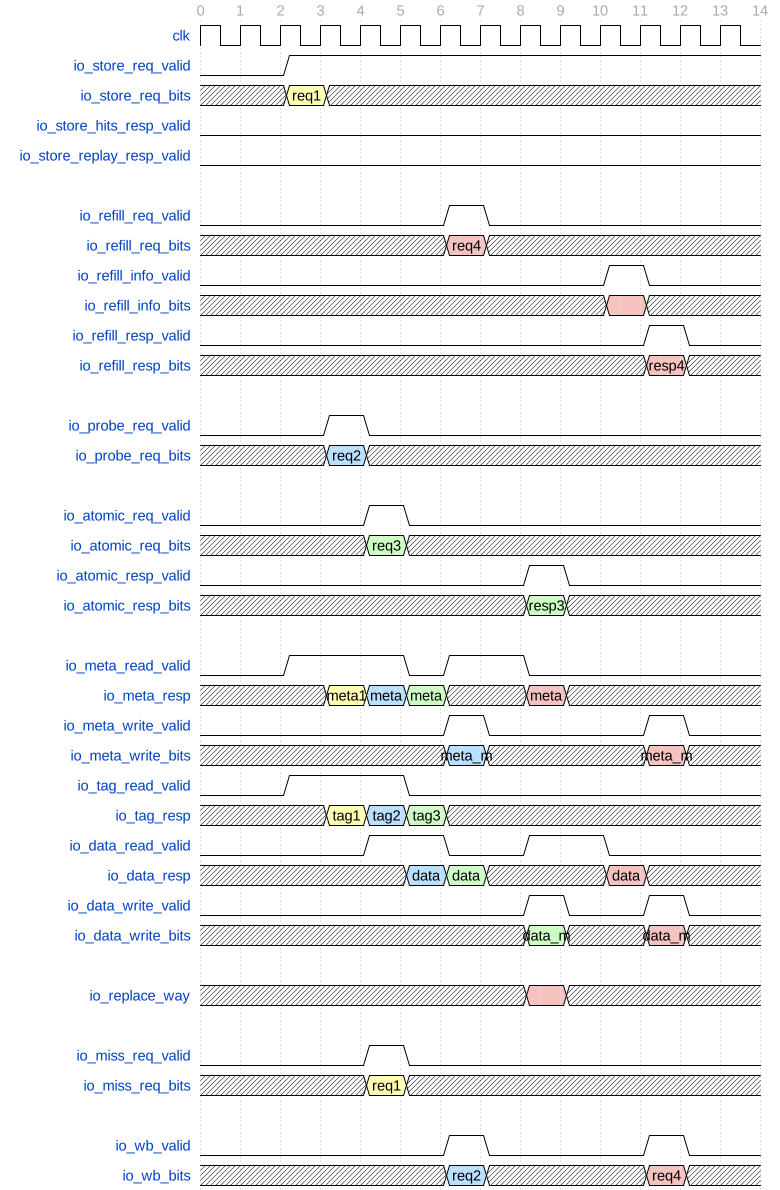
Interface timing
Request Interface Timing Example
Interface timing is shown in 此图. req1 is a store request: cycle 1 reads meta and tag, cycle 2 performs tag comparison and detects a miss, cycle 3 sends the miss request to MissQueue, and cycle 4 does not return a response to StoreBuffer due to the miss. req2 is a probe request: cycle 1 reads meta and tag, cycle 2 reads data, cycle 3 obtains probe data block results, cycle 4 updates meta based on probe command, initiates a wb request to WritebackQueue, and returns a probeAck response. req3 is an AMO instruction: cycle 1 reads meta and tag, cycle 2 performs tag comparison and hits, issues a data read request, cycle 3 obtains data results, cycles 4 and 5 are in stage_3, with cycle 4 executing the instruction operation and cycle 5 issuing a data write to update the original data block content and returning a response to AtomicsUnit. req4 is the refill request for req1: cycle 1 reads meta, but req2 is writing meta (metaArray write takes priority over read), so req4 stalls in stage_0 for one cycle; cycle 3 (stage_1) reads data and obtains PLRU replacement selection, but req3 is writing data, so it stalls again in stage_1; cycle 5 (stage_2) obtains the data block to be replaced and refill data forwarded from MissQueue; cycle 6 (stage_3) initiates a wb request to WritebackQueue to queue the replacement block, writes the refill data to storage, and returns a refill completion response to MissQueue.