Third-level module: Last Level Page Table Walker
The Last Level Page Table Walker refers to the following module:
- LLPTW llptw
Design specifications
- Supports accessing the last-level page table.
- Supports parallel processing of multiple requests.
- Support sending PTW requests to memory
- Supports sending refill signals to the Page Cache.
- Supports exception handling mechanism
- Support second stage translation
Function
Access the last-level page table
The Last Level Page Table Walker is responsible for accessing the last-level page table while enhancing the parallelism of Page Table Walker accesses. The Page Table Walker can only handle one request at a time, whereas LLPTW can process multiple requests concurrently. If duplicate requests exist, LLPTW does not merge them but records these requests to share memory access results, avoiding redundant memory accesses.
The LLPTW may receive requests from either the Page Cache or the Page Table Walker. For requests from the Page Cache, they must meet the conditions of hitting the second-level page table, missing the third-level page table, and not being a bypass request. For requests from the Page Table Walker, since they already satisfy the condition of only missing the last-level page table, the LLPTW can access memory directly. Requests from the Page Cache and Page Table Walker are arbitrated and then forwarded to the LLPTW.
The Page Table Walker and LLPTW work together to complete the entire Page Table Walk process. To improve memory access parallelism, the LLPTW assigns different IDs to requests, allowing multiple inflight requests to coexist. Since the first two levels of page tables may be the same across different requests, and considering that the miss probability for the first two levels is lower than for the last level, there is no need to enhance parallelism for the first two levels. Instead, the Page Table Walker handles single requests to reduce design complexity.
Parallel processing of multiple requests
The LLPTW can handle multiple requests simultaneously, with the number of parallel processes equal to the number of entries in the LLPTW. If there are duplicate requests among them, the LLPTW does not merge them but records these requests and shares the memory access results to avoid redundant memory accesses. Each entry in the LLPTW maintains the state of memory access through a state machine. When the LLPTW receives a new request, it compares the address of the new request with those of existing requests. If the addresses match, the state of the existing request is copied to the new request. Thus, requests with the same address can share memory access results, avoiding redundant access requests.
Send PTW requests to memory
Similar to the behavior of the Page Table Walker, the LLPTW can also send PTW requests to memory. The LLPTW merges duplicate requests and shares memory access results to avoid redundant memory accesses. Since the data returned by memory is relatively large (512 bits), the returned results are not stored in the LLPTW. If a PTW request is sent to the LLPTW while it is awaiting a memory response for a previously sent PTW request, and the physical address of the new request matches the physical address returned by memory, the new request is forwarded to the Miss queue to await the next access to the Page Cache.
Send a refill signal to the Page Cache
The logic for the Last Level Page Table Walker to send a refill signal to the Page Cache is similar to that of the Page Table Walker and will not be elaborated here.
Exception Handling Mechanism
An access fault exception may occur in the Last Level Page Table Walker and will be delivered to the L1 TLB. The L1 TLB handles it based on the request source. Refer to Section 6 of this document: Exception Handling Mechanism.
Support second stage translation
Four new states have been added: state_hptw_req, state_hptw_resp, state_last_hptw_req, and state_last_hptw_resp. When a two-stage translation request enters the LLPTW, it first performs a second-stage translation to obtain the actual physical address of the third-level page table. After address checking and memory access, once the third-level page table is obtained, another second-stage translation is required before returning to obtain the final physical address.
Each entry has been augmented with an hptw resp structure to store the results of each second-stage translation. Upon the first second-stage translation, when hptw returns, all entries are checked. If a memory access request for the same cacheline has already been issued, it directly enters the mem waiting phase.
The LLPTW introduces additional arbiters for the second-stage translation. hyper_arb1 is used for the first second-stage address translation, corresponding to the hptw req state; hyper_arb2 is used for the second second-stage address translation, corresponding to the last hptw req state. The input of hptw_req_arb consists of hyper_arb1 and hyper_arb2, and the output is the hptw request signal from the LLPTW.
Overall Block Diagram
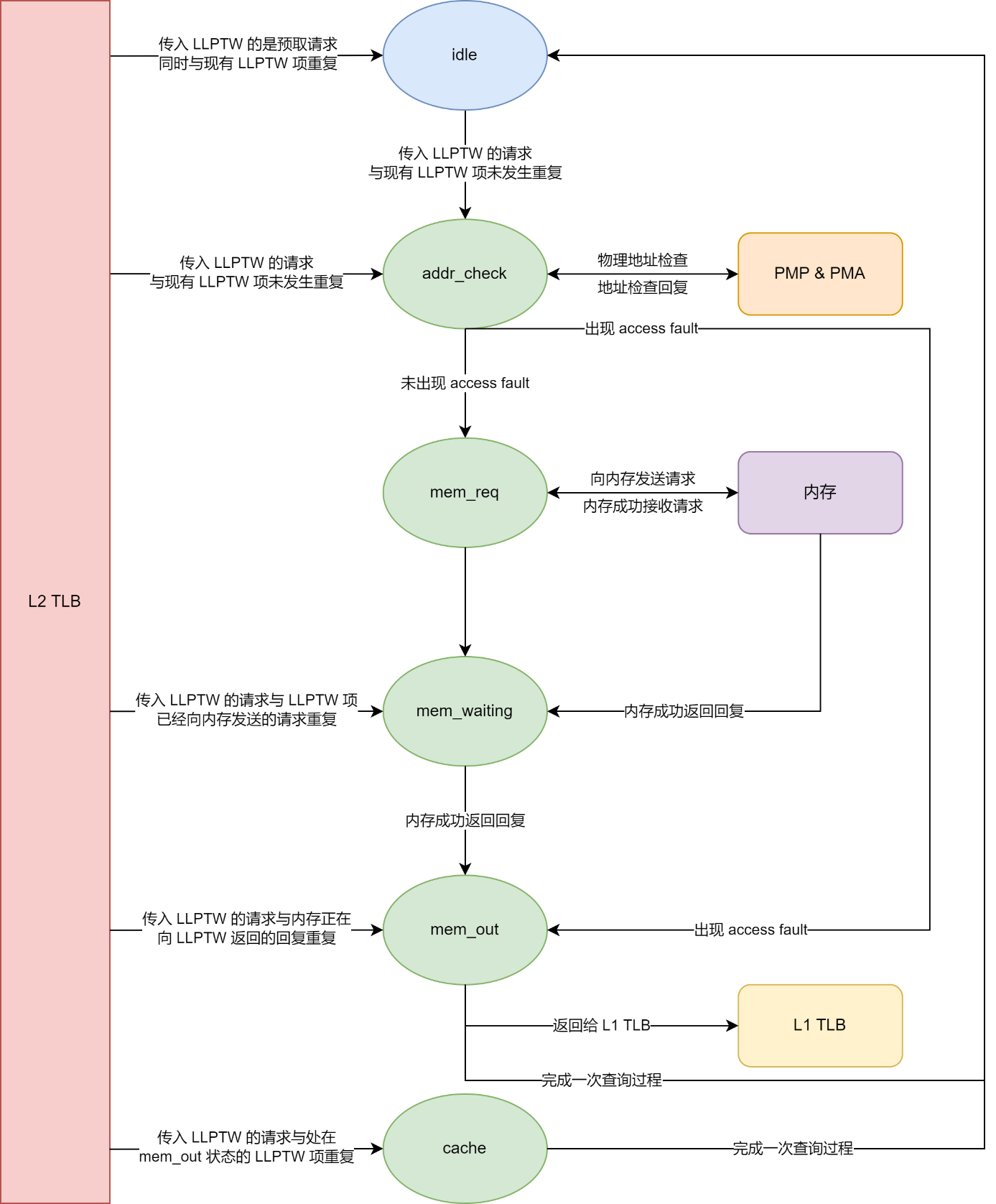
Although the Last Level Page Table Walker can process multiple accesses to the last-level page table in parallel, its internal logic, like the Page Table Walker, is implemented via a state machine. This section describes the state transition diagram and transition relationships of the state machine. For the connection relationships between the Last Level Page Table Walker and other modules in the L2 TLB, refer to Section 5.3.3.
The state transition diagram of the state machine is shown in 此图, which illustrates the state transitions for requests involving non-two-stage address translation.
After adding the virtualization extension, the state machine of the LLPTW when receiving a two-stage address translation request is as shown in 此图.
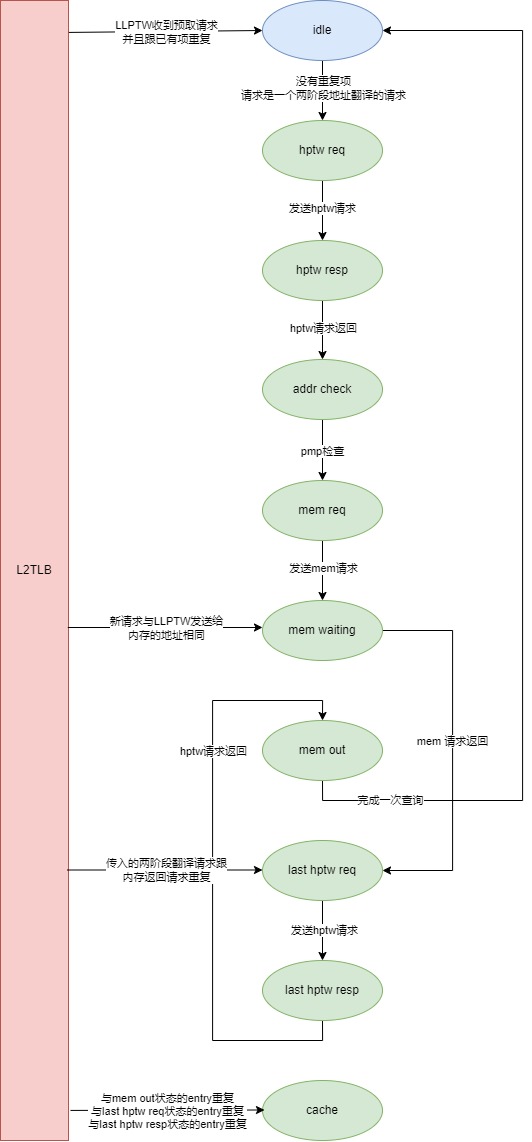
Requests entering the LLPTW do not all start from the idle state. Depending on the existing entries in the LLPTW, they may enter idle, addr_check, mem_waiting, mem_out, or cache states. For two-stage address translation requests, they may enter hptw_req, cache, mem_waiting, or last_hptw_req states.
- idle: Initial state. After completing an LLPTW request, it returns to the idle
state, indicating that the entry in LLPTW is empty. When a prefetch request
enters LLPTW and duplicates an existing request in LLPTW, the prefetch request
is not accepted, keeping the LLPTW entry idle. Possible transitions back to
idle occur under three scenarios:
- Currently in the mem_out state, a PMP&PMA check results in an access fault, which is returned to the L1 TLB, transitioning the state to idle.
- Currently in the mem_out state, the last-level page table is queried and returned to the L1 TLB, transitioning the state to idle.
- Currently in the cache state, the queried page table has been written into the Page Cache and needs to be returned to the Page Cache for further querying, transitioning the state to idle.
- hptw_req: This state is entered when the incoming request is for two-stage address translation. In this state, an hptw request is sent to the L2TLB.
- hptw_resp: After issuing an hptw request, it enters this state to await the hptw response. Upon receiving the response, if it duplicates an existing LLPTW entry in mem_waiting, it transitions to mem_waiting; otherwise, it proceeds to addr_check.
- addr_check: This state is entered when the incoming request to the LLPTW does not duplicate any existing requests and is not a two-stage translation request. Additionally, for two-stage address translation requests, this state is entered after the hptw request returns, and the physical address must be sent to the PMP module for PMP&PMA checks. The PMP module must return the check result in the same cycle. If no access fault occurs, the state transitions to mem_req; otherwise, it transitions to mem_out.
- mem_req: This state has completed PMP&PMA checks and can issue requests to memory (mem_arb). For each LLPTW entry, when the memory access request sent by mem_arb matches the virtual page number in the LLPTW entry, it transitions to the mem_waiting state to await memory's response.
- mem_waiting: When the incoming request to the LLPTW matches the virtual page number of a PTW request already sent to memory by the LLPTW, the state of the new LLPTW entry is set to mem_waiting. This state waits for a response from memory. When the memory returns a page table entry corresponding to this LLPTW entry, for non-two-stage address translation LLPTW entries, the state transitions to mem_out, while for two-stage address translation LLPTW entries, the state transitions to last_hptw_req.
- last_hptw_req: When the incoming LLPTW request matches the virtual page number of the request being responded to by memory for LLPTW and the request involves two-stage translation, upon obtaining the final page table from memory, it enters this state to perform the last second-stage address translation and issue an hptw request.
- last_hptw_resp: Waits for the hptw request to return. After the hptw request returns, it transitions to the mem_out state.
- mem_out: When the incoming request to the LLPTW matches the virtual page number of a request being responded to by memory and the request is not a two-stage translation request, the state of the new LLPTW entry is set to mem_out. Since the three-level page table lookup is already completed, the virtual address and page table entry are returned to the L1 TLB. Additionally, for cases where an access fault occurs in the addr_check state, it must also be reported to the L1 TLB. After successfully returning the information to the L1 TLB, the state transitions to idle.
- cache: When an incoming LLPTW request matches the virtual page number of an LLPTW entry currently in mem_out/last_hptw_req/last_hptw_resp, the page table entry obtained from memory has been written back to Cache. Thus, a query request is sent to Cache, and the new request's LLPTW entry state is set to cache. Once Cache (specifically mq_arb) accepts the request, the state transitions to idle.
Interface timing
The Last Level Page Table Walker interacts with other modules in the L2 TLB using a valid-ready protocol. The signals involved are relatively trivial, and there are no particularly noteworthy timing relationships, so they will not be elaborated further.