BPU Submodule: Composer
Functional Overview
Composer is a module designed to combine multiple predictors. In Nanhu, it integrates five predictors—uFTB, FTB, TAGE-SC, ITTAGE, and RAS—and abstracts them into a three-stage pipelined coverage predictor. Each predictor within Composer can be enabled or disabled by writing to the custom register sbpctl, allowing for on-demand usage. Upon detecting an external redirect, Composer forwards the redirect request to each predictor to recover speculatively updated elements. After all instructions in the prediction block are committed, the predictors within Composer undergo training. Finally, Composer outputs the three-stage prediction results to the Predictor.
During internal redirects in the three-stage BPU pipeline, only speculatively updated states—such as branch history and RAS—are restored in case of prediction errors. Other predictor updates are performed post-commit.
If the predictor is not flushed and only the pipeline is refreshed, wouldn't the same location predict incorrectly again? Refreshing the pipeline starts prediction from the corrected path. If the subsequent path revisits the same location, it might predict the same result again. However, due to differing branch histories, the predictors like TAGE could index different entries.
If a target address error is detected during execution, no redirect is initiated immediately. Instead, the redirect is uniformly deferred until instruction commit. One reason for this design is that misprediction redirects occur on incorrect paths, where execution results may also be erroneous. Training under such conditions could potentially corrupt the predictors.
Configuration of the starting PC
Composer's IO interface io_reset_vector enables configuration of the starting PC. The desired starting PC only needs to be passed to this IO.
Connection with Predictors
Composer connects the five predictors—uFTB, FTB, TAGE-SC, ITTAGE, and RAS. Since there are three branch predictor pipeline stages, and each predictor has a fixed latency (completing prediction by its designated stage), Composer simply outputs the corresponding predictor's result at the appropriate pipeline stage.
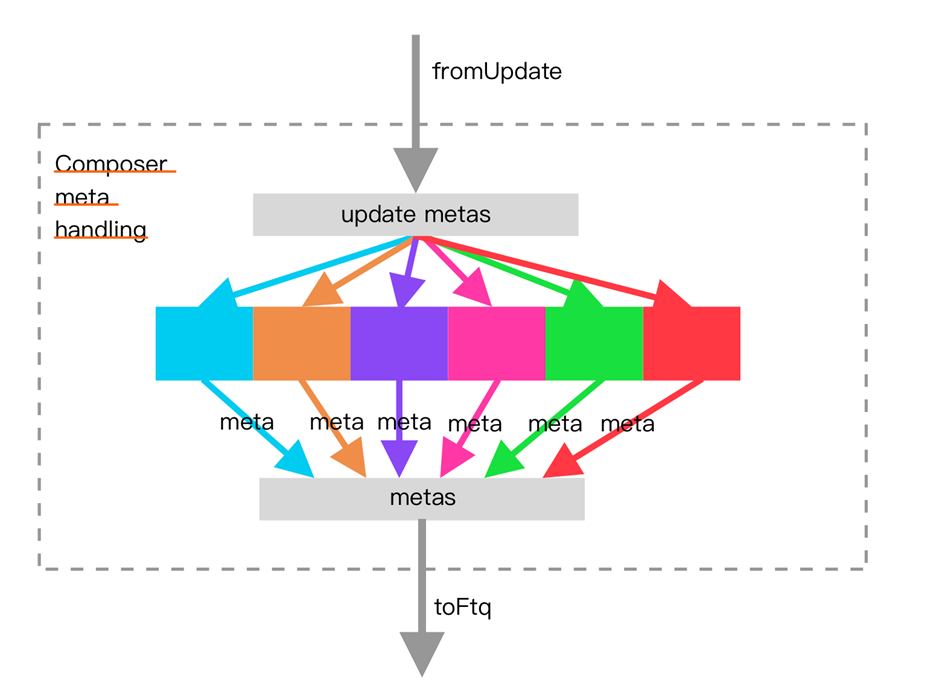
Meta refers to the data used by predictors during prediction, which is retrieved during updates for training. They are all called meta because the Composer integrates all predictors and interacts with the outside world through a common meta interface.
Predictor enable/disable
Through Zicsr instructions, we can read and write the custom CSR sbpctl to control the enablement of various predictors in the Composer. sbpctl[6:0] represents the enablement of seven predictors: {LOOP, RAS, SC, TAGE, BIM, BTB, uFTB}. A high level indicates enablement, while a low level indicates disablement. Specifically, the value of the spbctl CSR is passed to each predictor through the Composer's IO interface io_ctrl_*, with each predictor responsible for implementing the enablement.
Redirection recovery
The Composer receives redirection requests through IO ports such as io_s2_redirect, io_s3_redirect, and io_redirect_*. These requests are sent to its predictors to recover speculatively updated elements, such as the top item of the RAS stack.
Predictor training
The Composer sends training signals to its predictors through the IO port io_update_*. In general, to prevent contamination of predictor contents by incorrect execution paths, each predictor is trained after all instructions in the prediction block are committed. Their training content comes from their own prediction information and the decoding and execution results of instructions in the prediction block, which are read from the FTQ and sent back to the BPU. The prediction information is packed and stored in the FTQ after prediction; the decoding results of instructions come from the IFU's pre-decoding module and are written back to the FTQ after fetching the instructions; and the execution results come from various execution units.
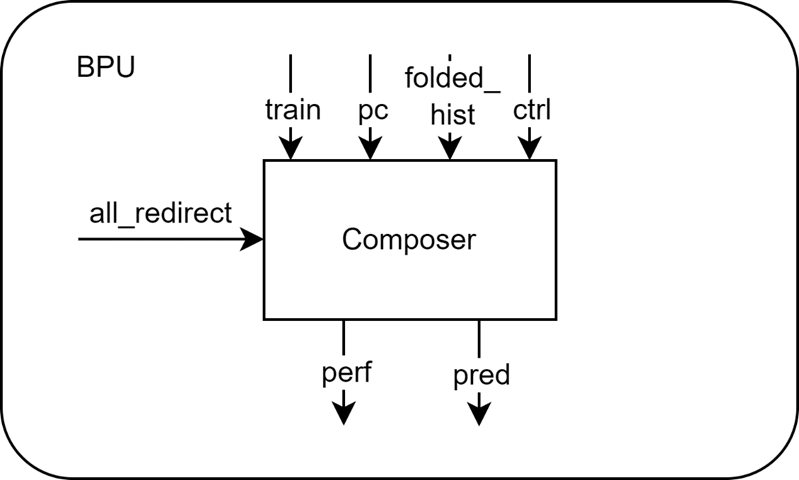
Overall Block Diagram
Interface timing
Control signal Ctrl interface timing

The above diagram illustrates a timing example of the Composer module's control signal Ctrl interface. The io_ctrl signal is delayed by one cycle after entering the Composer module before being passed to the internal components submodule.
Redirection interface timing

The above diagram shows the redirection request interface of the Composer module. After the BPU receives a redirection request from the backend, it is delayed by one cycle before being sent to the Composer, so the predictors inside the Composer receive the corresponding request one cycle later.
Branch prediction block training interface timing

Similar to redirection, to optimize timing, the update interface for branch prediction block training is also delayed by one cycle within the BPU before being sent to the Composer and its internal predictors.
Key circuits
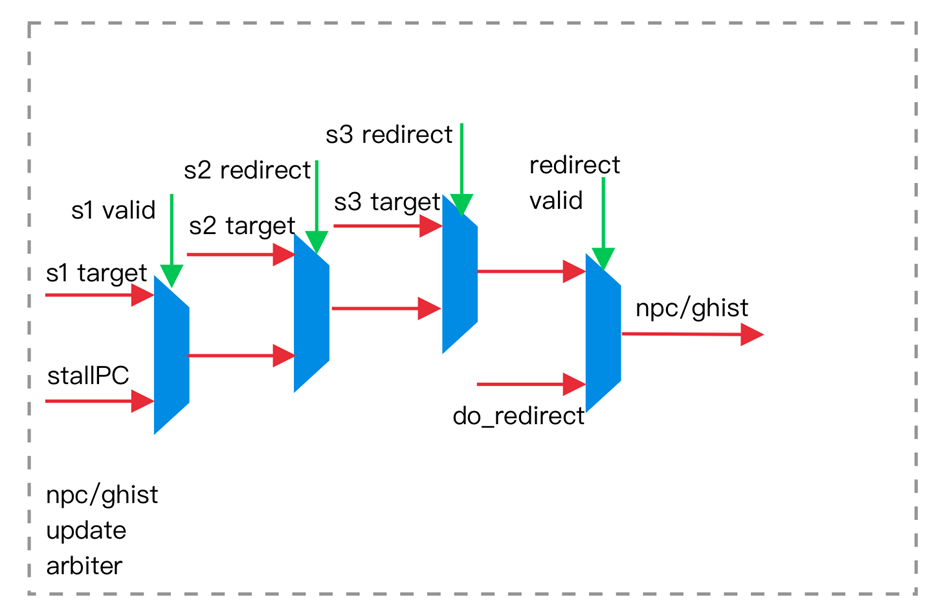
The following diagrams illustrate the Composer meta concatenation and the arbitration logic for redirection/branch history update sources.