Uncache Load Handling Unit LoadQueueUncache
| Update time | Code Version | Updated by | Notes |
|---|---|---|---|
| 2025.02.26 | eca6983 | Maxpicca-Li | Initial version completed |
Functional Description
For uncache load access requests, LoadQueueUncache and the Uncache module serve as an intermediate station between the LoadUnit pipeline and bus access. The Uncache module, being closer to the bus side, functions as described in Uncache. LoadQueueUncache, as the pipeline-side component, is responsible for the following tasks:
- Receives uncache load requests passed from the LoadUnit pipeline.
- Select a ready uncache load request and send it to the Uncache Buffer.
- Receives processed uncache load requests from the Uncache Buffer.
- Returns the processed uncache load requests to the LoadUnit.
Structurally, the LoadQueueUncache currently has 4 entries (configurable in number) of UncacheEntry, each independently responsible for a request and utilizing a set of status registers to control its specific processing flow; there is a FreeList managing the allocation and recycling of each entry. The LoadQueueUncache primarily coordinates the overarching logic for new entry allocation, request selection, response dispatch, dequeueing, etc., among the 4 entries.
Feature 1: Enqueue Logic
LoadQueueUncache is responsible for receiving requests from LoadUnit 0, 1, and 2. These requests can be MMIO requests or NC requests. First, the system sorts the requests by their robIdx in chronological order (oldest to newest) to ensure the earliest requests are prioritized for allocation to free entries, avoiding deadlocks caused by rollbacks of older entries under special circumstances. The conditions for processing are: the request is not resent, has no exceptions, and the system allocates entries sequentially from the FreeList's available free entries to the requests.
When the LoadQueueUncache reaches its capacity limit and there are still requests that have not been allocated entries, the system selects the earliest unallocated request for rollback.
Feature 2: Dequeue Logic
When an entry completes the Uncache access operation and is returned to the LoadUnit, or is flushed due to a redirect, the entry is dequeued and the flag for that entry in the FreeList is released. Multiple entries may be dequeued in the same cycle. Requests returned to the LoadUnit are selected in the first cycle and returned in the second cycle.
Among them, the LoadUnit ports available for handling uncache return requests are pre-configured. Currently, MMIO only returns to LoadUnit 2; NC can return to LoadUnit 1\2. In cases where multiple ports are available for returns, the remainder of the uncache entry id divided by the number of ports is used to specify which LoadUnit port each entry can return to, and an entry is selected from the candidate entries of that port for return.
Feature 3: Uncache interaction logic
(1) Send req
In the first cycle, select one from the currently ready uncache accesses, and in
the second cycle, send it to the Uncache Buffer. The sent request will mark the
selected entry's id, referred to as mid. Whether it is successfully received
can be determined by req.ready.
(2) Receives idResp
If the sent request is accepted by the Uncache Buffer, the Uncache's idResp
will be received in the next cycle after acceptance. This response includes
mid and the entry id (referred to as sid) allocated by the Uncache Buffer
for the request. The LoadQueueUncache uses mid to locate the corresponding
internal entry and stores sid in that entry.
(3) Receives resp
After the Uncache Buffer completes the bus access for the request, it returns
the access result to LoadQueueUncache. The response includes sid. Due to the
merging feature of the Uncache Buffer (detailed merging logic can be found in
Uncache), one sid may correspond to multiple entries in
LoadQueueUncache. LoadQueueUncache uses sid to locate all relevant internal
entries and passes the access result to them.
Overall Block Diagram

Interface timing
Enqueue interface timing example
As shown in the diagram below, assume five consecutive NC requests enter through
LoadUnit 0\1\2 in sequence, and the current LoadQueueUncache has only four
entries. Therefore, the first four requests are normally allocated to the
available entries. The r5 appearing in the third cycle cannot be allocated an
entry due to the buffer being full, resulting in a rollback in the fifth cycle.
Note that the diagram assumes each NC request enters in order per cycle, i.e.,
r1 < r2 < r3 and r4 < r5. If sorting is required, replace io_req
with the sorted results in sequence, while the rest of the logic remains the
same.

Example of dequeue interface timing
The figure below illustrates scenarios with mmioOut, one ncOut per cycle,
and two ncOut per cycle. Using the first example for detailed explanation: in
cycle 2, the writeback entry is selected, and the freeList is updated. After
being held for one cycle, it is written back to the LoadUnit in cycle 3. The
subsequent examples follow the same logic.

Uncache interface timing example
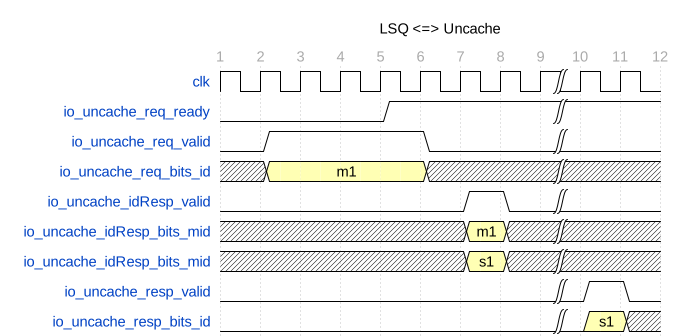
(1) When there are no outstanding requests, only one uncache access can be
issued per segment (controlled by io_uncache_req_ready) until the uncache
response is received. As shown in the figure, in cycle 5, io_uncache_req_ready
goes high, and the uncache request is issued. In cycle 6, the Uncache receives
the request and returns idResp in cycle 7. After some access time, the Uncache
access result is received in cycle 10+n.
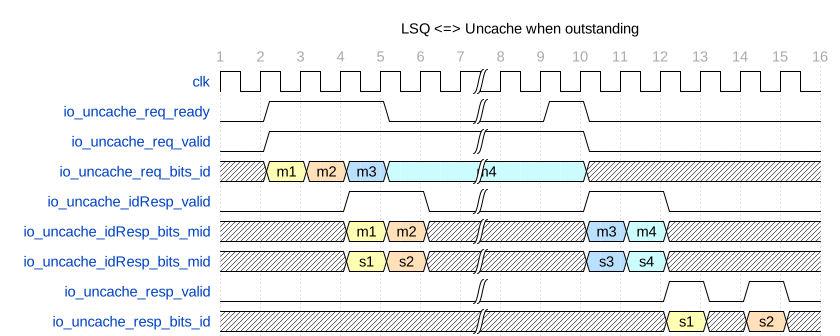
(1) When there are outstanding requests, multiple uncache accesses can be issued
per segment (controlled by io_uncache_req_ready). As shown in the figure,
requests m1, m2, m3, and m4 are issued consecutively. In cycles 4 and 5, the
Uncache dispatch results for the first two requests are received. At this point,
the Uncache is full, m3 is held by the intermediate register, and m4 waits for
io_uncache_req_ready to go high. In cycle 9+n, io_uncache_req_ready goes
high, and m4 is also issued. The Uncache dispatch results for m3 and m4 are
received in cycles 10+n and 11+n, respectively. Subsequent cycles will receive
the Uncache access responses.
UncacheEntry Module
UncacheEntry is responsible for independently managing the lifecycle of a request and uses a set of state registers to control its specific processing flow. Key structures are as follows:
req_valid: Indicates whether the entry is valid.req: Stores all relevant content of the received request.uncacheState: Records the current lifecycle stage of this entry.slaveAccept,slaveId: Records whether the entry is allocated to the Uncache Buffer and the assigned Uncache Buffer ID.needFlushReg: Indicates whether the item needs delayed flushing.
Feature 1: Lifecycle and State Machine
The lifecycle of each UncacheEntry can be fully described by uncacheState,
which includes the following states:
s_idle: Default state, indicating no request or a request exists but is not yet ready to be sent to the Uncache Buffer.s_req: Indicates the request is now ready to be sent to the Uncache Buffer, awaiting selection by LoadQueueUncache and reception by its intermediate register (theoretically, it should be received by the Uncache Buffer, but after selection by LoadQueueUncache, the request is stored for one cycle before being sent to the Uncache Buffer; if not received by the Uncache Buffer, it remains in the intermediate register). For UncacheEntry, it is unaware of the intermediate register's existence—it only knows the request has been sent and successfully received.s_resp: Indicates that the request has been received by the intermediate register and is awaiting the access result from the Uncache Buffer.s_wait: Indicates the Uncache Buffer's access result has been received, awaiting selection by LoadQueueUncache and reception by LoadUnit.
The state transition diagram is as follows, where black indicates the normal lifecycle of the item, and red indicates an abnormal termination of the item's lifecycle due to a redirect requiring the item to be flushed.

For the normal lifecycle, the triggering events are detailed as follows:
canSendReq: For MMIO requests, when the corresponding instruction reaches the head of the ROB, the Uncache access can be sent. For NC requests, whenreq_validis valid, the Uncache access can be sent.uncacheReq.fire: The entry is received by the LoadQueueUncache intermediate register. In the next cycle, it receives theidRespfrom the Uncache Buffer and updatesslaveAcceptandslaveId.uncacheResq.fire: The access result returned by the Uncache Buffer for this entry.writeback: When in thes_waitstate, the writeback request can be sent. Note that the writeback signals for MMIO requests and NC requests differ and need to be distinguished.
Feature 2: Redirect Flush Logic
For cases with abnormal lifecycles, they are typically triggered by pipeline redirects.
Upon receiving a pipeline redirect signal, it checks whether the current entry
is newer than the redirected entry. If the current entry is newer, it needs to
flush the entry and generate the needFlush signal. Normally, the entry's
contents are flushed immediately, and the entry is reclaimed by the FreeList.
However, Uncache requests and responses must fully correspond to the same
uncache load request. Therefore, if the entry has already issued an uncache
request, its lifecycle can only be terminated upon receiving the Uncache
response, resulting in a "delayed flush" scenario. Hence, when the needFlush
signal is generated, if the entry cannot be flushed immediately, the signal must
be stored in the needFlushReg register. The flush operation is executed only
upon receiving the Uncache response, and the needFlushReg is cleared.
Feature 3: Exception Cases
Exception cases in LoadQueueUncache include:
- When the request is sent to the bus, the bus returns corrupt or denied. This exception needs to be flagged during UncacheEntry writeback and handled by the LoadUnit.