Probe Queue: ProbeQueue
Functional Description
Responsible for receiving and processing coherence requests from L2, comprising 8 ProbeEntries, each handling one Probe request. It converts Probe requests into internal signals and sends them to the MainPipe, which modifies the permissions of the probed block. The ProbeEntry is released once the MainPipe returns a response.
The ProbeQueue only interacts with L2 through Channel B and connects with the MainPipe. Internally, it consists of 8 ProbeEntry items, each controlled by a set of status registers for receiving, converting, and sending request signals.
Feature 1: Aliasing Issue
The Kunminghu architecture employs a 64KB VIPT cache, introducing cache aliasing issues. To address aliasing, the L2 Cache directory maintains alias bits for each physical block stored in the DCache. When the DCache attempts to access a block with a different alias bit at a physical address, the L2 Cache initiates a Probe request to evict the original aliased block from the DCache, recording its alias bit in the TileLink B channel. Upon receiving the request, the ProbeQueue concatenates the alias bit with the page offset, converts it into an internal signal, and sends it to the MainPipe, which then accesses the DCache storage module to read the data.
Feature 2: Blocking Caused by Atomic Instructions
Since atomic operations (including lr-sc) are completed in the DCache, when executing an LR instruction, it ensures the target address is already in the DCache. To simplify the design, the LR instruction registers a reservation set in the MainPipe, recording the LR address and blocking Probes to that address. To avoid deadlocks, the MainPipe will stop blocking Probes after waiting for the SC instruction for a certain period (determined by parameters LRSCCycles and LRSCBackOff). At this point, any received SC instruction is considered an SC fail. Therefore, during the time between registering the reservation set by LR and waiting for the matching SC, Probe requests must be blocked from operating on the DCache.
Overall Block Diagram
The overall architecture of the ProbeQueue is shown in 此图.

Interface timing
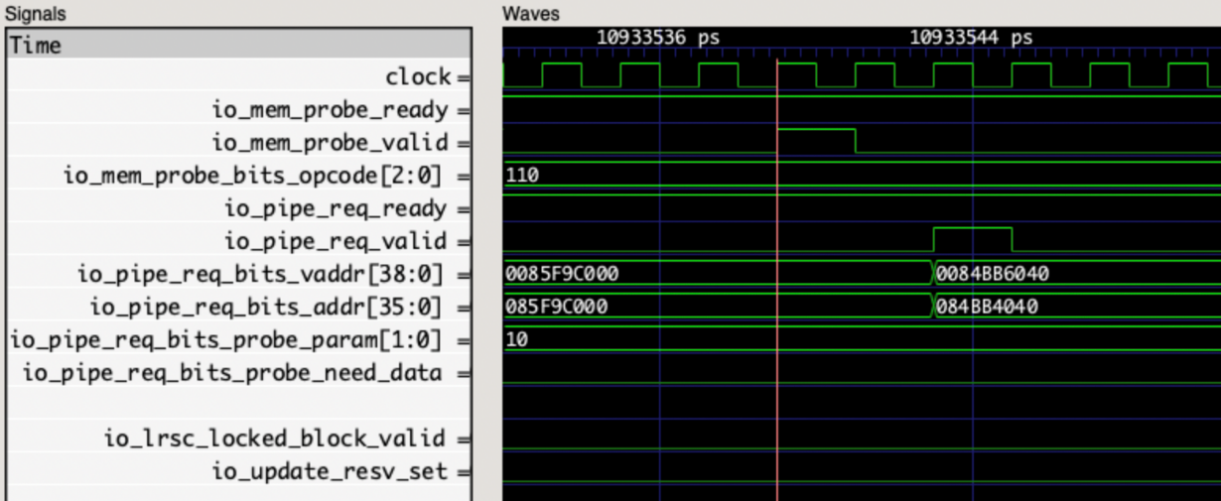
Request Interface Timing Example
此图 illustrates the interface timing for the Probe Queue processing a probe request. The Probe Queue first receives the probe request from L2, converts it into an internal request, and allocates an empty ProbeEntry. After a one-cycle state transition, it can send the probe request to the MainPipe. However, due to timing considerations, this request is delayed by another cycle (as selecting an entry in the ProbeQueue involves an arbiter, and the MainPipe entry also has an arbiter to choose requests from various sources—completing both arbitrations in one cycle is challenging, hence the additional cycle of latching). Thus, pipe_req_valid is asserted two cycles later. Subsequently, upon receiving the MainPipe's response, the ProbeEntry is released.
ProbeEntry module
The Probe Entry is controlled by a series of status registers, with a state machine executing Probe transactions. 此表 illustrates the meaning of the three status registers contained in each Entry, and the state machine design is shown in 此图.
| Status | Descrption |
|---|---|
| s_invalid | Reset state: This Probe Entry is empty. |
| s_pipe_req | Probe request allocated, sending Main Pipe request |
| s_wait_resp | Main Pipe request transmission completed, awaiting Main Pipe response. |
